
ELEMIS Wrote Lender Transfer Mechanics Into Its Articles Before PAI Can Close
ELEMIS’s pre-close articles add secured-institution transfer rules while Reinold Geiger remains the registered controller ahead of PAI’s 2027 acquisition.
On this page
Conduct your own private market research
Add dossaro to Claude or ChatGPT and run source-backed register research from your own workspace.
 Add to Claude
 Add to ChatGPT
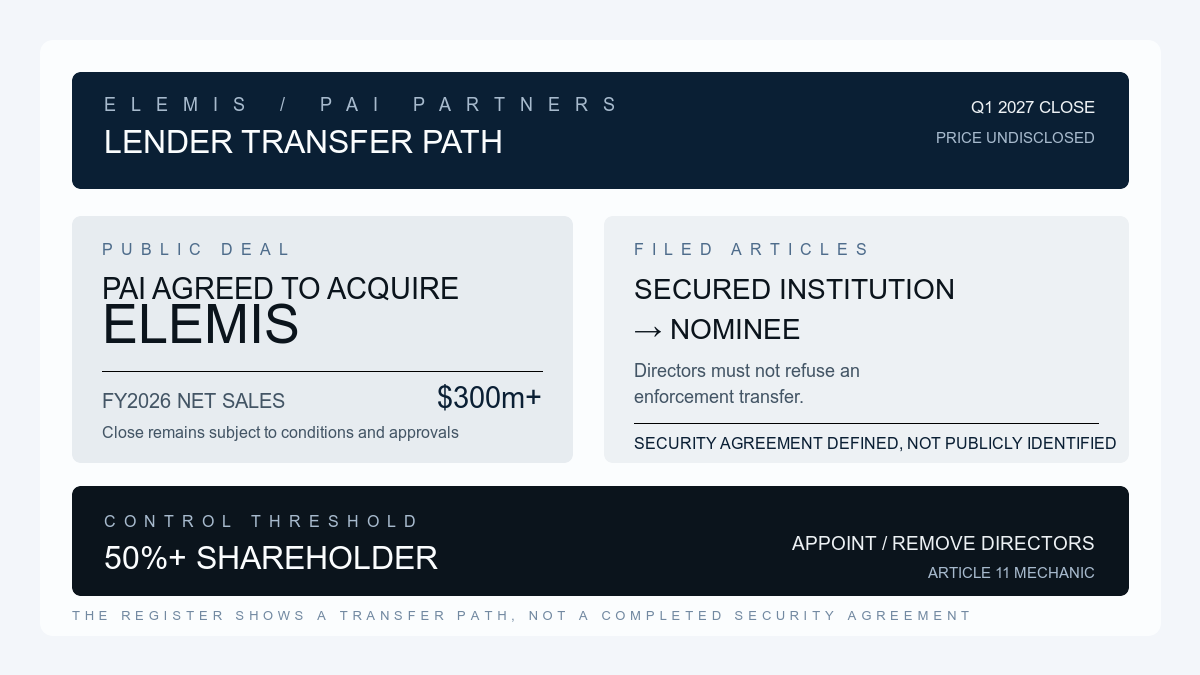
ELEMIS has already rewritten its UK company articles for a lender-backed change of ownership, even though PAI Partners cannot become the brand’s owner until its acquisition from L’OCCITANE Group closes. A sole-shareholder resolution passed on 15 October 2026 and filed at Companies House on 23 October adopted new articles that define a security agreement over shares and a “Secured Institution” that can receive shares on a transfer or enforcement.
The filing does not prove that a lender already holds security, identify the lender or disclose the acquisition price. It does show that ELEMIS has removed a set of transfer frictions before PAI’s announced Q1 2027 closing window. The articles say the company’s lien does not apply where a share is subject to a security agreement, and that directors must not refuse a transfer to or by a secured institution or nominee, or a transfer made on enforcement. The same articles give shareholders holding at least 50% of the issued share capital a direct route to appoint or remove directors.
That is the important distinction in this transaction. The public story is a pending luxury-beauty sale. The filed story is a company whose governance and share-transfer rules are already prepared for financing-backed control to move, while Reinold Geiger remains the registered person with significant control.
The filing predates PAI’s announcement
The exact company is ELEMIS LIMITED, company number 02279688. Its filing history shows a 23 October memorandum-and-articles filing, a one-page written resolution and a two-page objects filing. The sole-shareholder resolution says the new articles were passed on 15 October and adopted in complete substitution for the existing articles.
The new articles define a “Security Agreement” as an agreement with a bank or financial institution under which a security interest has been granted over shares in ELEMIS. A “Secured Institution” is a bank or financial institution that is party to that agreement. These are not generic references to a future sale. They are operative definitions inside the company’s transfer and lien rules.
The sequence matters because PAI announced its agreement to acquire ELEMIS from L’OCCITANE Group on 4 November, almost three weeks after the articles were filed. PAI said ELEMIS generated more than $300 million of net sales in FY2026, with about half of sales in the United States and nearly half online. It expects the transaction to close in the first quarter of 2027, subject to conditions and approvals, and said it becomes the owner only at closing.
What the new articles change
The key provisions turn a potential lender remedy into a registration path that the company’s directors cannot simply block.
| Filed mechanism | What the articles say | Commercial reading |
|---|---|---|
| Security Agreement | A bank or financial institution can hold security over ELEMIS shares | The document is drafted for share-backed financing, but no agreement is identified publicly |
| Lien disapplication | The company lien in article 14 does not apply to a share subject to a Security Agreement | A company claim over shares should not compete with the defined security route |
| Enforcement transfer | Directors must not decline or suspend registration of a transfer to or by a Secured Institution or nominee, or a transfer made on enforcement | A lender or nominee has a pre-written route into the register if enforcement occurs |
| Director threshold | Shareholders holding 50% or more may appoint or remove directors by signed memorandum | A holder at that threshold can change the board without waiting for an ordinary meeting resolution |
The rules also exclude statutory pre-emption rights. That can make an issue or transfer easier to execute, but it does not reveal who will receive shares, how much they will pay or which investor protections exist. The CC04 filing separately records the removal of the company’s old objects. That is a housekeeping change alongside the new articles, not evidence of a completed acquisition.
The article 15 wording is the strongest evidence in the package. It does not say that ELEMIS has granted security. It says what the company will do if a security agreement exists. The distinction prevents the filing from being read as proof that PAI or a lender already owns, controls or has pledged the shares.
Financing is confirmed, but the collateral is not
PAI’s announcement keeps the price undisclosed. A 5 November Linklaters note says the firm advised various lenders supporting PAI’s bid in a complex private-credit acquisition financing. That independently confirms a lender group around the bid. It does not name the borrower, state the facility size or say that ELEMIS shares are the collateral.
That gap is where the new articles become commercially useful. The public sources establish a pending acquisition and a financing process. The register establishes a transfer framework that can accommodate a secured institution or nominee. Taken together, the evidence supports a narrow conclusion: the UK company was prepared for financing-backed share movement before the buyer could close. It does not support the stronger conclusion that enforcement is expected or that PAI’s lender already has a perfected security interest.
The difference is material in a private-company sale. A buyer can acquire a business through a normal share transfer, while a lender can still require a documented route for taking or selling those shares if a financing default occurs. By removing a company lien obstacle and directing the board not to refuse the defined transfers, ELEMIS’s articles separate the sale mechanics from the downside mechanics of the financing. That is a risk-allocation decision, not a public announcement of distress.
Registered control has not moved yet
The Companies House PSC page currently records Reinold Geiger in the 50% to 75% band. The filing chronology also shows L’OCCITANE International SA ceasing to be a PSC on 1 March 2019 and Geiger entering the current band on that date. Earlier archived records show Nemo (UK) Holdco Ltd in the 75% or more band between 2016 and 2019.
Those records describe registered control at the company today. They do not jump forward to the announced deal. PAI said it will become owner when the transaction closes, not when the articles were adopted. Until a transfer, allotment or control filing changes the register, Geiger remains the named PSC and the new 50% board threshold remains a rule in the articles rather than a reported post-close ownership outcome.
The threshold nevertheless matters. If a buyer or its nominee ultimately holds at least half of the issued shares, the articles provide a direct appointment and removal mechanism for directors. That is different from saying PAI has that stake now. It is a pre-written control path that would make the governance transition legible when the next filings arrive.
Why the control path matters for the deal
ELEMIS is not a shell with no operating story. PAI and L’OCCITANE describe a global beauty brand that has nearly doubled net sales under L’OCCITANE ownership, with a large US and online footprint. The commercial value sits in the brand, distribution and repeat consumer demand. The share-transfer provisions therefore matter because they describe how financing claims can sit around that operating asset while a new sponsor takes over.
The sequence is a useful contrast with Autoneum’s Trèves share rollover, where the public transaction narrative and the filed ownership mechanics could be compared after the event. ELEMIS is earlier in the timeline. Nexgen’s loan-control reset shows why lender rights can matter even when a company presents the financing as growth capital, while Dorma-Glas’s prepared successor transfer illustrates how transfer wording can expose transaction preparation before a sale is fully visible.
The commercial consequence is not that ELEMIS is in trouble. It is that a financing-backed acquisition has two control clocks. The first is PAI’s expected Q1 2027 closing. The second is the lender’s ability, if the documents permit and a default occurs, to move shares through a nominee or enforcement transfer without a new fight over the company lien. The filed articles make the second clock explicit while leaving the facility terms private.
The next filings should settle the boundary
Three future records would change the analysis. A charge or other financing filing could identify the borrower and the assets securing the facility. A share transfer or confirmation statement could show when PAI or a nominee enters the register. A PSC update could reveal whether the post-close control band sits with PAI, a fund vehicle or another holding company.
Until then, the strongest source-backed reading is precise. ELEMIS adopted new articles on 15 October and filed them on 23 October, before PAI publicly announced its agreement on 4 November. Those articles define a lender and nominee transfer route, disapply the company lien for secured shares and give a 50% shareholder a director appointment and removal path. PAI’s financing is real, but its lender, price, security package and post-close cap table remain undisclosed.
Sources
- PAI Partners announcement, 4 November 2026.
- Linklaters lender-financing note, 5 November 2026.
- ELEMIS Limited profile and filing history.
- ELEMIS new articles, sole-shareholder resolution, and CC04 objects filing.
- ELEMIS PSC record.
Continue reading
Related Research
Autoneum's Trèves Deal Is a Share Rollover and Debt Refinance, Not a €64m Cash Exit
Autoneum's Trèves acquisition puts about 80% of the €40m upfront into new shares, refinances debt with a CHF200m loan and leaves earn-out risk open.
NexGen Cloud's $106m GPU Loan Followed a Founder-Control Reset
NexGen Cloud's $106m GPU loan followed a founder-linked control reset, a new charge over Finnish capacity and a filed €121m promissory-note schedule.
DORMA-Glas's Asset Deal Was Prepared Before The Rescue Headline
DG Glas's €25,000 successor vehicle and shareholder filings predated DORMA-Glas's rescue announcement, separating operating continuity from creditor recovery.
Roadsurfer's Kennedy Lewis Majority Follows a Nearly €500m Fleet-Debt Build-Out
Roadsurfer's Kennedy Lewis majority follows nearly €500m of fleet debt, founder rollover and a 2027 profitability target, public sources report.