
Autoneum's Trèves Deal Is a Share Rollover and Debt Refinance, Not a €64m Cash Exit
Autoneum's Trèves acquisition puts about 80% of the €40m upfront into new shares, refinances debt with a CHF200m loan and leaves earn-out risk open.
On this page
Conduct your own private market research
Add dossaro to Claude or ChatGPT and run source-backed register research from your own workspace.
 Add to Claude
 Add to ChatGPT
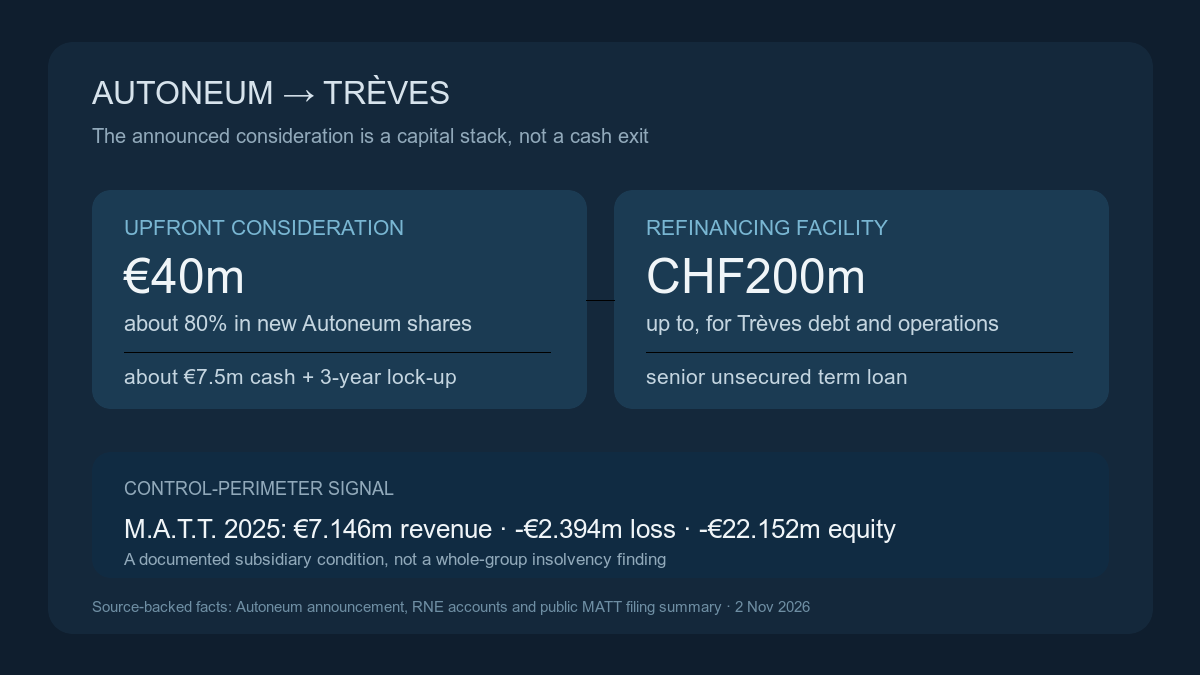
Autoneum's announced acquisition of Trèves Group is not a €64 million cash exit for the sellers. The 2 November agreement puts about 80% of the €40 million upfront consideration into newly issued Autoneum shares, adds an earn-out of up to €24 million and refinances Trèves' existing debt with an underwritten senior unsecured term loan of up to CHF 200 million. The sellers therefore keep exposure to Autoneum's share price and the combined company's execution, while Autoneum takes on the refinancing and integration burden.
That structure matters more than the maximum headline. Autoneum's investor materials describe a combined business with more than CHF 2.9 billion of pro forma 2026 revenue, more than CHF 50 million of annual synergies and earnings-per-share accretion from 2028. Those are the buyer's forward case, not cash already received by Trèves' owners. The register record adds a second, narrower signal: a Trèves-controlled French subsidiary reported a €2.394 million loss and negative equity of €22.152 million for 2025. That filing does not show that the whole group is distressed, but it does show why the financing and integration terms deserve scrutiny.
The headline price hides the payment mix
Autoneum's 2 November webcast sets the initial purchase price at €40 million and the potential earn-out at up to €24 million. The earn-out can be zero, €12 million or €24 million, depending on defined financial KPIs and the delivery of synergies. Closing is targeted for early 2027, subject to employee consultation and regulatory approvals.
| Transaction element | Published term | Economic reading |
|---|---|---|
| Upfront consideration | About €40m | The amount due at transfer, before any earn-out |
| New Autoneum shares | About 80% of upfront | Sellers receive listed equity and a three-year lock-up, rather than only cash |
| Cash portion | About €7.5m | The buyer funds this portion from existing funds |
| Earn-out | Up to €24m | Additional value depends on financial performance and synergies |
| Trèves debt refinancing | Up to CHF 200m term loan | Autoneum funds the target's existing debt and operating needs |
The webcast says the new shares will be handed to the Trèves family and Fonds Avenir Automobile, represented by Bpifrance, and that those shareholders have agreed to a three-year lock-up. That is a rollover mechanism, not proof that every seller made the same decision or that any individual seller received a particular amount. The final value of the share component can change with Autoneum's share price at the transfer date. The transaction therefore converts part of the seller's exit value into public-market exposure.
Acquisitions News independently describes the same payment mix as about €7.5 million in cash, with the rest in newly issued shares, plus the earn-out. Its summary also notes that the earn-out is linked to EBITDA improvement and synergies by 2029. The public record does not publish a final number of shares, a valuation for the private group or a cash proceeds figure for any named person.
Refinancing is part of the acquisition, not a footnote
Autoneum says Trèves' existing debt will be refinanced and that it has secured an underwritten senior unsecured term loan of up to CHF 200 million. The company's presentation says the cash portion of the purchase price is financed from existing funds, while the Trèves financing is covered by the new term loan. Net debt to EBITDA is expected to rise to about 2.0 times at closing before returning below 1.5 times in the medium term.
This allocation separates the sources of risk. Trèves creditors are not simply paid out by a cash buyer. Their claims are being refinanced inside the enlarged Autoneum balance sheet. Autoneum shareholders absorb the leverage step-up and the risk that the new debt, the €60 million of estimated restructuring costs and the integration plan produce the promised return. Trèves sellers, meanwhile, receive a large listed-equity component and an earn-out tied to a business they will no longer operate directly.
The contrast is useful when reading other control and financing stories. In Roadsurfer's Kennedy Lewis transaction, a majority-control change also made the financing package part of the ownership story. Here, the unusual feature is that the purchase consideration, the refinancing and the seller's continuing exposure are bound together in one listed-buyer transaction.
A weak subsidiary changes the question, not the conclusion
The public acquisition material describes Trèves Group as a private, family-owned automotive supplier with about €720 million of 2025 revenue, roughly 4,600 employees and 26 production sites in 15 countries. Those are group-level operating figures. They should not be mixed with the standalone accounts of Trèves SAS, the French holding company registered under SIREN 562011452.
Trèves SAS's 2024 president decision records €13.049 million of standalone revenue, €1.679 million of net profit and post-result equity of €81.923 million. The auditor's report separately identifies €155.6 million of net participation investments. Those numbers describe a holding-company balance sheet with investments in subsidiaries, not the revenue of the operating group presented in Autoneum's announcement.
The latest public record for Manufacture de l'Aisne de Transformation Textile, or M.A.T.T., SIREN 312450497, is more fragile. The 2025 accounts show revenue of €7.146 million, a €2.394 million loss and negative equity of €22.152 million. The 2024 accounts showed €6.919 million of revenue and a €2.423 million loss. The filing chain identifies Trèves SAS as the sole shareholder, so the subsidiary is a documented part of the control perimeter behind the deal.
That is a meaningful diligence signal, but it is not a group insolvency finding. A small subsidiary can carry historic losses, intra-group balances or accounting effects that do not describe the parent or the consolidated group. Autoneum's own CFO said the standalone Trèves business had positive EBITDA, while declining to disclose the detailed standalone figures. The stronger public conclusion is narrower: Autoneum is buying a broad industrial platform and refinancing its debt while at least one controlled unit has negative equity and continuing losses.
The buyer's synergy case carries the upside risk
Autoneum's rationale is explicit. It expects more than CHF 50 million of annual run-rate synergies, fully effective from 2029, from purchasing, insourcing, overhead consolidation and footprint optimisation. The company estimates CHF 60 million of costs to achieve those synergies and expects earnings-per-share accretion from 2028.
The arithmetic explains why the buyer can accept a share-heavy upfront. The maximum €64 million consideration is small relative to Trèves' reported revenue, but the acquisition is not priced as a simple revenue multiple. Autoneum is underwriting a turnaround and integration case in which the value comes from loading its own plants, reducing overlapping overhead and refinancing the target's debt. The 3.1 times post-synergy EV/EBITDA multiple quoted by Autoneum is therefore a result of the plan working, not a neutral measure of the target's current earnings.
The risk is asymmetric across stakeholders. Autoneum shareholders bear dilution from the new shares issued to the sellers and the temporary leverage increase. Trèves sellers retain upside if the enlarged company delivers its synergies and the earn-out is paid, but they also retain public-equity downside during the lock-up. Employees and suppliers face the operational consequences of footprint consolidation. Creditors receive a refinancing proposal whose quality depends on the combined company's cash flow after integration costs.
What the next documents should settle
The first decision-changing document is the closing announcement and the final share-transfer calculation. It should show how many Autoneum shares were issued, the transfer-date price used, and whether the earn-out framework changed. A post-close shareholder disclosure would also show whether the Trèves family and Fonds Avenir Automobile remain material holders of Autoneum.
The second watchpoint is the debt package. The term-loan documentation, if disclosed, would clarify maturity, covenants, ranking and the portion used to refinance existing Trèves debt versus working capital. The public announcement gives the facility ceiling, not the drawn amount or lender economics.
The third is the operating perimeter. M.A.T.T.'s next accounts and any restructuring or intra-group financing documents will show whether the negative-equity position is being repaired, sold, merged or simply carried inside the enlarged group. Until then, the subsidiary is evidence of a weak point, not a proxy for the full Trèves balance sheet.
The strongest source-backed reading is therefore precise: Autoneum is buying Trèves through a share-heavy upfront payment, a contingent earn-out and a separate debt-refinancing facility. The deal gives sellers a continuing stake in the public buyer while shifting integration and refinancing risk to Autoneum. The register adds a documented weak subsidiary, but the economics of the transaction still turn on whether the promised synergies arrive.
Sources
- Autoneum's M&A announcement and analyst transcript, 2 November 2026.
- Autoneum's conference-call presentation, 2 November 2026.
- Octagon Professionals' independent deal record, 2 November 2026.
- Acquisitions News' transaction report, 2 November 2026.
- Trèves SAS 2024 RNE annual accounts artifact, published 14 August 2025.
- MATT public company and 2025 account summary, last 2025 balance-sheet figures.
- Trèves Group, company context.
Continue reading
Related Research
Roadsurfer's Kennedy Lewis Majority Follows a Nearly €500m Fleet-Debt Build-Out
Roadsurfer's Kennedy Lewis majority follows nearly €500m of fleet debt, founder rollover and a 2027 profitability target, public sources report.
VÆRIDION's €30m Series A2 Expanded Capital as Grant and Commitments Shared Industrialisation Risk
VÆRIDION's €30m Series A2 expanded registered capital 44.6%, while a €94.5m EU grant and €730m aircraft commitments share industrialisation risk.
NexGen Cloud's $106m GPU Loan Followed a Founder-Control Reset
NexGen Cloud's $106m GPU loan followed a founder-linked control reset, a new charge over Finnish capacity and a filed €121m promissory-note schedule.
Verdane Says It Will Top Enginsight's 22.08% Public Stake
Verdane says it will become Enginsight's largest shareholder, while the last register still showed a 22.08% public-fund block before the deal.