
VÆRIDION's €30m Series A2 Expanded Capital as Grant and Commitments Shared Industrialisation Risk
VÆRIDION's €30m Series A2 expanded registered capital 44.6%, while a €94.5m EU grant and €730m aircraft commitments share industrialisation risk.
On this page
Conduct your own private market research
Add dossaro to Claude or ChatGPT and run source-backed register research from your own workspace.
 Add to Claude
 Add to ChatGPT
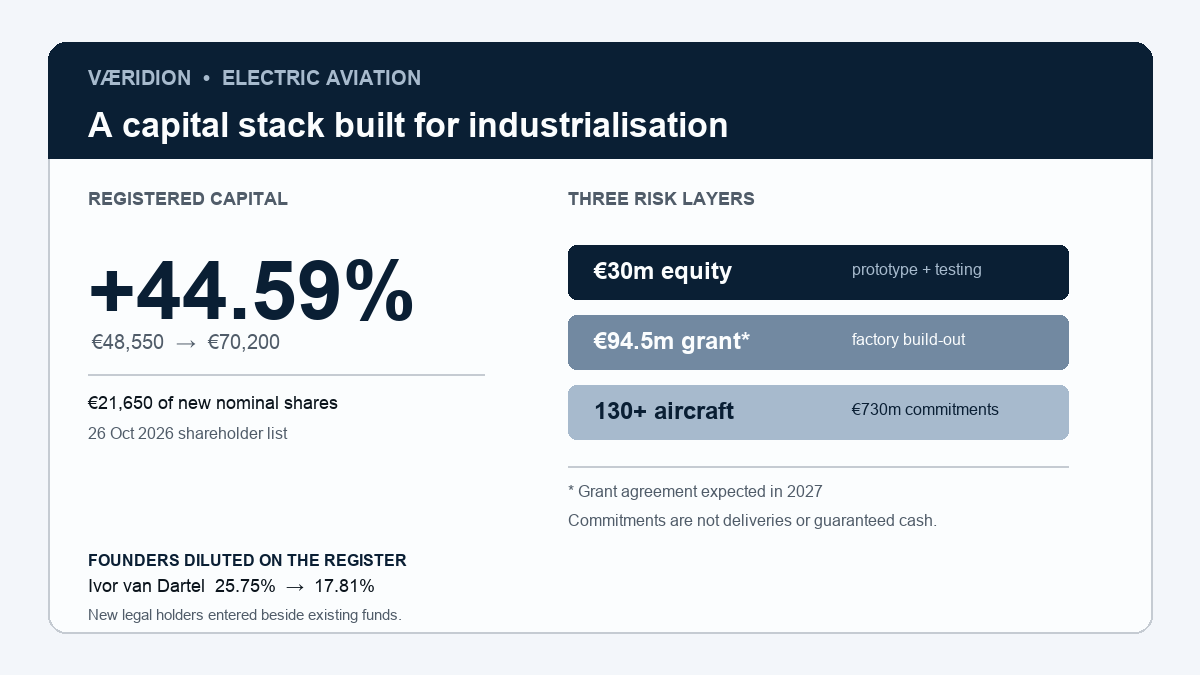
VÆRIDION's €30 million Series A2 did more than finance another aircraft prototype. The latest German shareholder list records a 44.6% increase in registered capital, from €48,550 to €70,200, while adding a new group of holders and reducing the founder and treasury blocks. At the same time, the company announced a separate €94.5 million European Innovation Fund grant selection and commercial commitments for more than 130 aircraft valued at over €730 million.
That is a three-layer risk-sharing structure. Equity pays for the first conforming Microliner and integrated battery and propulsion testing. The grant is intended to support an industrial facility, but remains subject to a grant agreement expected in 2027. Customer commitments create a demand signal, but they are not the same as delivered aircraft or guaranteed cash recovery. The register shows how the equity layer changed before those industrial milestones arrive.
The registered capital moved before the headline round
World Fund's announcement dated 5 November says VÆRIDION closed the €30 million Series A2 led by SHIFT Invest and Invest-NL, with World Fund, Project A and Vsquared Ventures among the returning investors. Invest-NL's own account says it invested €5 million and describes the same round. Aviation Week's independent report confirms the prototype use, the grant selection and the aircraft-commitment figures.
The German shareholder lists add a dated legal-capital view that the financing announcements do not provide:
| Register measure | 22 June 2026 list | 26 October 2026 list | Change |
|---|---|---|---|
| Registered capital | €48,550 | €70,200 | +€21,650, or +44.59% |
| Ivor van Dartel | 25.75% | 17.81% | -7.94 percentage points |
| Markus Kochs-Kämper | 8.00% | 5.53% | -2.47 percentage points |
| Vaeridion GmbH treasury holding | 10.77% | 7.45% | -3.32 percentage points |
| World Fund I | 14.06% | 16.04% | +1.98 percentage points |
| SIV I Coöperatief U.A. | Not listed | 9.73% | New listed block |
The calculation is based on €21,650 of additional one-euro shares divided by the €48,550 starting capital. It is a registered-capital change, not a reconstruction of the €30 million cash price, the company's valuation or the economic value of each class. The list records 70,200 shares at the later date and marks the new blocks created through capital increases.
Dilution was uneven, not a clean founder reset
Ivor van Dartel's registered percentage fell from 25.75% to 17.81%. Markus Kochs-Kämper moved from 8.00% to 5.53%, and Sebastian Seemann from 6.97% to 4.82%. The company's own treasury holding also fell from 10.77% to 7.45%. Those changes show existing holders absorbing the denominator effect of new shares, but they do not prove that any founder sold shares or lost voting control.
The investor changes were more mixed. World Fund I rose from 14.06% to 16.04%, and Project A rose slightly from 14.14% to 14.34%. Vsquared Ventures moved from 11.89% to 9.52%, while InnovationQuarter increased from 2.63% to 3.67%. The different directions are consistent with a financing in which some existing investors subscribed and others were diluted. They are not enough to infer who led, who sold or how governance rights were allocated.
The list also names several blocks that were not present in the June state, including SIV I Coöperatief U.A. at 9.73%, RInvest GmbH at 3.35%, Vaeridion Roundtable Co-Invest I SCSp at 1.25%, Sprites SA at 0.97% and Operator Circle GmbH at 0.44%. The register does not identify SIV I Coöperatief as SHIFT Invest or Invest-NL. The public announcement names those organisations as round leaders, but the legal holder mapping remains a separate question.
This distinction matters because a new legal block is not automatically a new controlling block. The shareholder list shows percentages and the marked capital-increase entries. It does not disclose the full articles, voting agreements, liquidation preferences, board rights or any side letters that could change the practical decision-making balance.
Equity, grant and customer commitments solve different problems
VÆRIDION says the equity round will build the first conforming nine-passenger Microliner and support integrated propulsion and battery testing. The company targets 400 kilometres with nine passengers under instrument flight rules, while its release also describes a four-passenger visual-flight-rules range of up to 550 kilometres. Those are development targets, not certified operating results.
The €94.5 million CAROLUS grant selection addresses a different risk. World Fund says it would support establishing and ramping a final-assembly facility at Oberpfaffenhofen Airport, and that the grant agreement is expected to be signed in 2027. The selection is therefore meaningful public support, but it is not the same as €94.5 million of unrestricted cash already available to the company.
The more than 130 aircraft commitments, valued at over €730 million, address demand risk. Aviation Week reports that the commitments span regional airlines, charter operators and lessors, with ASL Group as launch customer. The sources do not say how many commitments are firm orders, when deliveries are scheduled or how deposits and cancellation rights work. A commitment value cannot be treated as booked revenue, collateral or a guaranteed recovery for shareholders or lenders.
Together, these layers reduce different parts of the industrialisation problem before certification and production are complete. The equity investors fund technical proof and prototype work. The proposed grant can support manufacturing capacity if the agreement is completed. The customer commitments indicate potential market pull. None of those layers eliminates certification, manufacturing, customer-performance or execution risk.
The financing changes the commercial question
VÆRIDION's public headline is often compressed into “more than €124 million raised.” That shorthand combines the €30 million equity round with the €94.5 million grant selection. It should not be read as a €124.5 million equity valuation, a single cash subscription or a completed grant drawdown.
The register gives the headline a more useful commercial interpretation. Existing founder and treasury blocks became smaller on a simple registered-percentage basis, while the company added a broader set of investment vehicles before its first conforming aircraft and industrial facility are complete. That is a risk-sharing capital stack, not a clean proof that the founders have surrendered control or that the new investors have received a particular return profile.
The pattern is comparable to other recent capital-stack stories. Hypersonica's Series B shows a German defence company where new shares moved founder vehicles below a simple majority while the rights behind the percentages remained unresolved. Bioweg's financing shows why grant support and equity should be described as separate layers rather than one headline amount. VÆRIDION adds a third layer: reported aircraft commitments that have commercial value but are not yet deliveries.
What the public record still cannot answer
The two shareholder lists do not disclose the subscription price or premium for the new shares. They cannot show whether the €30 million was paid in one closing, whether all new holders subscribed directly, or whether a legal holder represents an underlying fund or co-investor group. They also do not establish a post-round voting majority.
The next decision-changing documents are the 29 September 2026 resolutions and amended articles behind the capital increase, followed by a later shareholder list if more authorised capital is issued. Those documents should clarify class rights, the role of the authorised capital and any governance protections. On the commercial side, the next watchpoint is the signed CAROLUS grant agreement and the first post-round evidence of prototype, certification and customer-delivery milestones.
For now, the strongest source-backed conclusion is narrower: VÆRIDION expanded registered capital by 44.59%, diluted several earlier blocks and added new legal holders while pairing the equity with a proposed €94.5 million industrialisation grant and reported commitments for more than 130 aircraft. The company has diversified who shares the risk of building an electric regional aircraft, but the documents do not yet show who controls the resulting upside.
Sources
- World Fund's Series A2 and CAROLUS announcement, 5 November 2026.
- Invest-NL's investment announcement, 5 November 2026.
- Aviation Week's independent report, 5 November 2026.
- German Handelsregister portal, VÆRIDION GmbH, Munich HRB 267524, shareholder lists dated 22 June and 26 October 2026.
Continue reading
Related Research
Hypersonica's €100m Series B Diluted Founders as New Investor Layer Entered
Hypersonica's €100m Series B lifted German registered capital 24.39%, diluted founder vehicles below 42%, and kept SPRIND visible on the cap table.
BIOWEG's €30m Series A Mixes Rabo Equity With a €10.3m Grant
BIOWEG’s €30m Series A combines Rabo equity with €10.3m of NRW-linked grant funding, while its register shows Rabo Ventures B.V. at 5.16% in new shares.
Roadsurfer's Kennedy Lewis Majority Follows a Nearly €500m Fleet-Debt Build-Out
Roadsurfer's Kennedy Lewis majority follows nearly €500m of fleet debt, founder rollover and a 2027 profitability target, public sources report.
Impress’s €40m EIB Loan Adds a New Layer to Existing Venture Debt
Impress’s €40m EIB loan sits beside outstanding Trinity charges, while older lender security was satisfied in January, making the debt stack visible.