
Verdane Says It Will Top Enginsight's 22.08% Public Stake
Verdane says it will become Enginsight's largest shareholder, while the last register still showed a 22.08% public-fund block before the deal.
On this page
Conduct your own private market research
Add dossaro to Claude or ChatGPT and run source-backed register research from your own workspace.
 Add to Claude
 Add to ChatGPT
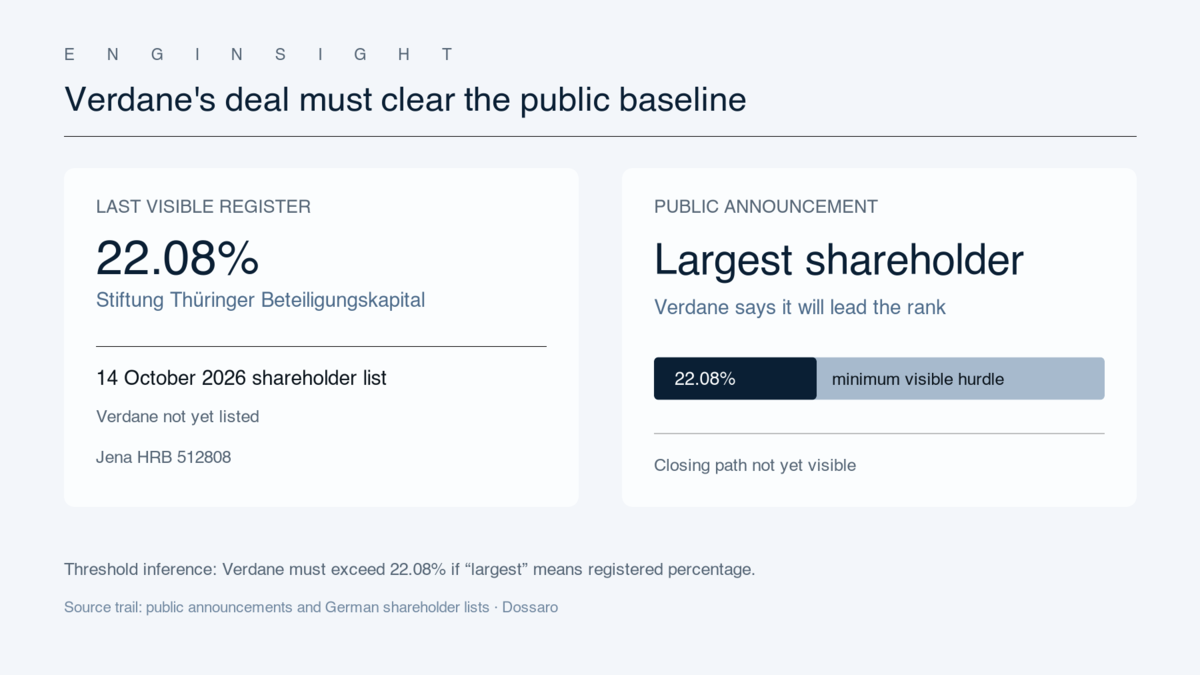
Verdane says it will become Enginsight's largest shareholder after leading a growth-financing round in the German cybersecurity company. The last dated shareholder list before that announcement still placed Stiftung Thüringer Beteiligungskapital first at 22.08%, with Verdane absent. That makes 22.08% the measurable threshold the closing must clear, while the legal route to the new position remains undisclosed.
The financing was announced by Verdane on 2 November and by Enginsight on 3 November. Both releases say existing investors UVC, HDI and SIV are participating alongside Verdane. An independent Buyout Desk deal record repeats the largest-shareholder language and identifies the round as a double-digit-million financing, but no source publishes Verdane's percentage or the consideration paid for any transferred shares.
The last visible list still had a public-fund lead
Enginsight GmbH is registered in Jena under HRB 512808. Its 14 October 2026 shareholder list is the latest primary ownership state available before the financing announcement. It shows the Thüringen public-investment foundation at 22.08%, followed by the two founders at 16.88% each and Unternehmertum VC Fonds III at 15.14%.
| Holder or measure | 9 September 2022 | 14 October 2024 | 14 October 2026 | What the sequence shows |
|---|---|---|---|---|
| Stiftung Thüringer Beteiligungskapital | ~28.51% | 22.30% | 22.08% | Public-fund exposure remained the largest visible block before the announcement |
| Mario Jandeck | 24.32% | 17.05% | 16.88% | Founder exposure fell as the capital base expanded |
| Eric Range | 24.32% | 17.05% | 16.88% | Founder exposure followed the same dilution pattern |
| Unternehmertum VC Fonds III | Not listed at this position | 15.29% | 15.14% | UVC remained a major institutional holder |
| Smart Infrastructure Ventures | 7.08% | 10.27% | 10.17% | Existing strategic capital stayed visible |
| Total registered capital | €51,404 | €73,330 | €74,053 | The largest reset occurred before the Verdane announcement |
The list also records Hannover Digital Investments at 6.83%, seed & speed at 4.91%, Max Tarantik at 2.48% and Paysmark at 2.01%, alongside smaller holders. Verdane does not appear. The list is therefore a pre-deal baseline, not evidence that the announced financing failed to close.
Verdane's claim creates a threshold, not a complete cap table
“Largest shareholder” is an affirmative public claim, but it does not disclose the percentage, the seller or the instrument. If the phrase refers to registered percentage ownership after closing, Verdane's position must be larger than the foundation's 22.08% baseline. That is a useful threshold for the next shareholder list, not a substitute for one.
Three legal paths remain open. Verdane could receive newly issued shares, buy an existing block, or combine a primary investment with a transfer. Each path distributes the economic effect differently. New issuance would expand the denominator and dilute holders that do not participate. A transfer would move a block from a seller to Verdane without changing registered capital. A combined close could do both, while agreements not printed in a shareholder list could still alter voting or consent rights.
The public releases narrow the co-investor picture but not the allocation. UVC, HDI and SIV are said to participate again, so some existing holders may defend or expand their exposure. The foundation and the founders are the visible pre-deal blocks whose rank may change. The available evidence does not identify a seller, say whether the foundation sold anything, or quantify founder dilution after closing.
That distinction separates a threshold inference from a control claim. A 22.08% stake is the largest simple percentage in the last list, but it is not proof of voting control. The list does not show reserved matters, voting agreements, liquidation preferences or other rights that could make a smaller registered position economically or strategically important.
The earlier reset explains why timing matters
The 2022 and 2024 lists show that Enginsight had already experienced a meaningful capital and ownership reset before Verdane arrived. Registered capital rose from €51,404 in September 2022 to €73,330 in October 2024, an increase of €21,926, or about 42.7%. Over the same period, the two founders moved from 24.32% each to 17.05% each. Paysmark fell from approximately 29.02% to about 2.03%, while UVC, SIV and HDI became the visible institutional core.
The 2026 list shows only a smaller move from the 2024 state: capital reached €74,053, the founders stood at 16.88% each, the foundation at 22.08%, UVC at 15.14%, SIV at 10.17% and HDI at 6.83%. That makes the Verdane announcement a new ownership event layered onto a cap table that was already reshaped by prior issuance and transfers. It is not safe to read the public release as if Enginsight were moving from an untouched founder-only structure into institutional ownership for the first time.
The commercial consequence is straightforward. Verdane is backing an expansion strategy built around more managed-service-provider partners, international markets and a European buy-and-build plan. If the round closes with Verdane above 22.08%, the investor will hold the largest visible registered block in a company whose prior growth already changed the balance between founders, a public fund and several venture vehicles. The next financing or acquisition will be negotiated against that new ranking, even if the current public materials leave the exact rights and price unstated.
For Enginsight, the ranking also matters operationally. The company says it serves more than 750 customers through more than 250 active partners and wants to build a broader European platform. That strategy can require follow-on capital, acquisitions and decisions about where intellectual property and sales teams sit. A new largest shareholder may bring distribution and acquisition capacity, but the register alone cannot tell readers whether Verdane has a board appointment, veto rights or only the economics of its stake. Those are separate questions that the closing documents must answer before the public ownership headline can be translated into governance.
This is the same separation between a financing headline and its legal perimeter seen in Hypersonica's Series B, where new shares and a new investor layer were visible only after the German list was updated. VÆRIDION's capital expansion shows the other side of the problem: a public grant and customer commitments can alter downside without appearing as equity at all. Enginsight's open question is narrower but just as material: which part of Verdane's announced partnership is new capital, and which part is a change in who ranks first on the register?
The next filing should decide who moved
The decision-changing document is the first shareholder list or capital filing after the financing closes. It should show whether Verdane crossed the 22.08% threshold through new shares, a transfer or both. It may also show whether the foundation, founders or earlier investors sold, and whether the co-investors received new positions. The associated deed or amended articles would be needed to assess preferences, voting arrangements and consent rights.
Until that filing appears, the strongest defensible reading is precise. Verdane publicly says it will become Enginsight's largest shareholder. The last visible list before the announcement still shows a Thüringen public foundation at 22.08% and no Verdane. The public event therefore establishes an incoming ownership shift, while the closing documents must establish the percentage, seller, dilution and rights. The unresolved mechanics are not a footnote. They determine who absorbed the change and what “largest” means in economic terms.
Sources
- Verdane financing announcement, 2 November 2026.
- Enginsight announcement, 3 November 2026.
- Buyout Desk independent deal record, 4 November 2026.
- German Handelsregister portal, Enginsight GmbH, Jena HRB 512808, shareholder lists dated 9 September 2022, 14 October 2024 and 14 October 2026.
Continue reading
Related Research
Hypersonica's €100m Series B Diluted Founders as New Investor Layer Entered
Hypersonica's €100m Series B lifted German registered capital 24.39%, diluted founder vehicles below 42%, and kept SPRIND visible on the cap table.
VÆRIDION's €30m Series A2 Expanded Capital as Grant and Commitments Shared Industrialisation Risk
VÆRIDION's €30m Series A2 expanded registered capital 44.6%, while a €94.5m EU grant and €730m aircraft commitments share industrialisation risk.
AP Ventures’ $300m Fund III Leaves Manager-Level Control Concentrated on Andrew Hinkly
AP Ventures’ $300m Fund III has backed 13 companies, while Companies House records 75%+ manager voting and surplus rights with Andrew Hinkly.
StrollMe’s €22m Raise Finances a Fleet, Not Just a Valuation
StrollMe raised €22m in equity and debt. Its filings and customer terms put the key question on fleet, receivables and risk allocation, not valuation.