
AP Ventures’ $300m Fund III Leaves Manager-Level Control Concentrated on Andrew Hinkly
AP Ventures’ $300m Fund III has backed 13 companies, while Companies House records 75%+ manager voting and surplus rights with Andrew Hinkly.
On this page
Conduct your own private market research
Add dossaro to Claude or ChatGPT and run source-backed register research from your own workspace.
 Add to Claude
 Add to ChatGPT
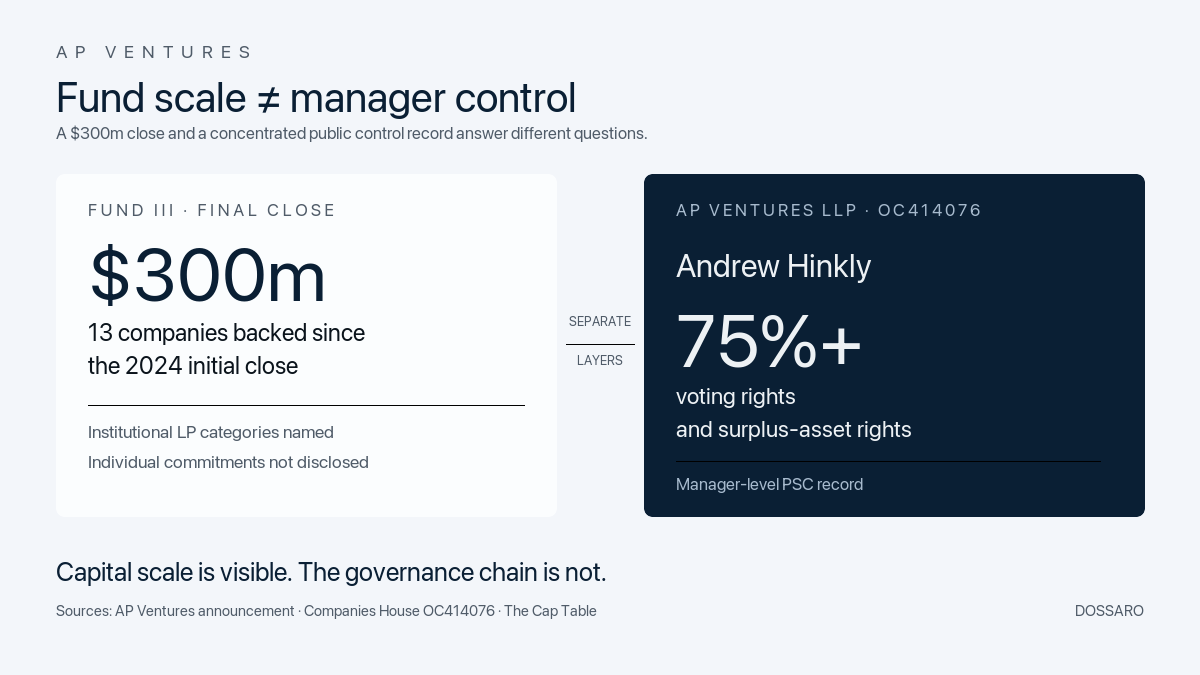
AP Ventures has closed its third fund at $300m, but the public record answers the fund-size question more clearly than it answers who controls the manager deploying that capital. The firm’s 28 October 2026 announcement says Fund III has backed 13 companies since its initial close in 2024 and is supported by a broad base of sovereign wealth funds, corporates, pension funds and family offices. It does not identify individual Fund III commitments or explain the manager’s governance terms.
Companies House supplies a different kind of visibility. AP VENTURES LLP, company number OC414076, has one active person with significant control: Andrew Robert Hinkly. The register records him with 75% or more of the LLP’s voting rights and 75% or more of the right to surplus assets. That is a manager-level control record, not evidence that Hinkly owns 75% of Fund III, its portfolio companies or its limited-partner economics.
The distinction matters commercially. A large pool of institutional capital can coexist with a concentrated public control record at the management entity. For founders, LPs and industrial partners, the open questions are then about succession, key-person protections and who can change the manager, rather than about whether AP Ventures has raised enough to execute its strategy.
Fund III is large, active and still opaque at the LP level
AP Ventures’ official close announcement says the final close brought in $300m of commitments from existing and new institutional investors. It describes Fund III as an early-stage vehicle for low-carbon molecules, carbon capture and utilisation, circularity and advanced recycling, with applications in chemicals, steel, aviation and heavy mobility.
The firm says the fund has already backed 13 portfolio companies since its 2024 initial close. The release names examples including Teragen Energy, Aether Fuels, CREW Carbon, Rosy Soil, Reclinker, Lydian Labs and Rubi Laboratories. That portfolio count means the close is not only a fundraising milestone. It is also a pool already moving through the long interval between a seed cheque, industrial deployment and follow-on capital.
The independent Cap Table report corroborates the $300m close and the 13-company portfolio. It also reports that Anglo American Platinum and South Africa’s Public Investment Corporation each committed $100m as cornerstone backers of the firm’s earlier platform. The report does not identify the individual investors in Fund III, and neither source publishes a target size, fee schedule, carried-interest allocation or LP-by-LP commitment table.
That is a normal limit of a private fund announcement, but it sets the evidence boundary. The public record establishes the pool’s size, strategy and early deployment. It does not establish who holds what proportion of the fund, which LPs have governance rights, or whether any investor can replace the manager.
The manager record is concentrated in one active PSC
The Companies House overview identifies AP VENTURES LLP as an active English limited liability partnership incorporated on 6 October 2016, with its registered office at 45 Gresham Street in London. Its last accounts were made up to 31 March 2025, and its latest confirmation statement was made on 5 October 2026.
The PSC record lists Andrew Robert Hinkly as the only active person with significant control. It records two forms of control:
| Manager-level record | What Companies House says | What it does not say |
|---|---|---|
| Andrew Robert Hinkly | 75% or more of voting rights and 75% or more of the right to surplus assets | It does not allocate Fund III LP interests, carry, portfolio-company shares or fund voting rights |
| Anglo Platinum Marketing Limited | Corporate PSC ceased 13 April 2018 | It does not prove that Anglo’s economic or contractual relationship ended on that date |
| Anglo Platinum Ventures Holdings Limited | Corporate PSC ceased 13 April 2018 | It does not establish who replaced the corporate control rights |
The manager’s officer record shows Hinkly and Kevin Eggers as active designated members. The filing history records a 1 July 2026 change-of-details filing for Hinkly and an 8 October 2026 member-details filing for Eggers. Those entries show the manager’s current public administrative state, but they do not convert LLP control rights into an LP cap table.
The timeline is important. Anglo Platinum Marketing Limited and Anglo Platinum Ventures Holdings Limited were appointed as designated members at incorporation and both ceased as PSCs on 13 April 2018. Kevin Eggers’ historical PSC statement is shown as ceased on 31 July 2019, while he remains an active designated member. The visible control record therefore moved away from the two Anglo corporate entities before Fund III reached its final close.
Capital-provider diversity is not manager-control diversity
AP Ventures calls Fund III’s backing a diverse institutional base. That description can be true while the manager has a concentrated control surface. LPs supply capital under fund documents; the management entity directs the investment process, signs contracts and may hold the rights that determine succession or replacement. Those are related layers, but they are not interchangeable.
For founders, the distinction affects who can make a follow-on decision when a portfolio company reaches an industrial deployment milestone. For LPs, it affects how key-person, removal and no-fault divorce provisions operate in practice. For corporate partners, it affects which manager-level counterparties can approve a commercial arrangement or change the investment mandate. None of those outcomes can be inferred from the $300m headline alone.
This is the same analytical separation visible in Fractile’s Series C, where a large preferred-share issuance could be measured precisely while the replacement control position remained undisclosed. It also echoes Sprints Fund V, where the fund label and the manager’s balance-sheet evidence answered different questions. In AP Ventures’ case, the public event is a fund close and the less visible evidence sits at the manager level.
There is a benign reading. A single active PSC may reflect LLP filings that do not capture every contractual right, side letter or fund-level governance arrangement. Anglo’s former PSC status may have ended while commercial or economic ties continued through other vehicles. Hinkly’s 75% or more manager rights may also be paired with internal agreements that distribute practical decision-making more widely than the public register suggests.
Those possibilities are why this article does not call the structure a governance failure or identify a hidden owner. The supportable finding is narrower: the public manager record is concentrated in Hinkly, while the public fund announcement leaves the LP roster and fund governance terms undisclosed.
The next document should connect the layers
Fund III’s next meaningful evidence will not be another repetition of the $300m headline. It will be a document that connects manager control to fund governance. A new confirmation statement, LLP agreement filing, fund vehicle record or published investor disclosure could show whether any other person or entity has reportable rights, whether Anglo remains economically present through another vehicle, or how succession and removal provisions are allocated.
The same watchpoint applies to portfolio companies. AP Ventures says it invests at seed and Series A and supports commercialisation, industrial deployment and scale-up. Follow-on announcements may show whether the 13 companies receive capital from the same vehicle, a co-investment structure or a later fund, but they will not by themselves answer who controls the manager.
AP Ventures’ Fund III is therefore best read as two linked but separate facts. The first is a $300m institutional pool that had already backed 13 industrial-technology companies by its final close. The second is a manager whose current public PSC record gives Andrew Hinkly 75% or more of voting rights and surplus-asset rights. The capital scale is visible. The full governance chain is not.
Sources
Continue reading
Related Research
Fractile’s £577m Series C Arrived After Its Oxford-Linked PSC Ceased
Fractile’s £577m Series C created 19.2% of its shares after Oxford Science Enterprises left the PSC record, leaving the new control position undisclosed.
Sprints’ €725m Fund V Sits Above a £654,887 Manager Balance Sheet
Sprints says Fund V closed at a €725m hard cap, while UK filings show £2.07m cash, £654,887 net assets and two new HSBC security filings remain outstanding.
XRlabs Added Seed-2 Preference Rights While Its Founder Kept Statutory Control
XRlabs raised an $8.4m Playground-led seed while filings show 621,130 Seed-2 shares and a founder still above 50% with majority board rights.
Epoch's $4.25m Seed Came With 670,087 Preferred Shares
Epoch's $4.25m seed sits beside 670,087 preferred shares, $6.26m of filed paid-in amounts, a Burnt Island board appointment and a June issue window.