
ECIIF's €10m Guarantee Covers Loans, Not Its Equity Risk
ECIIF II closed €21.45m toward an €80m target, but its €10m InvestEU guarantee protects qualifying loans, not the fund's equity investments.
On this page
Conduct your own private market research
Add dossaro to Claude or ChatGPT and run source-backed register research from your own workspace.
 Add to Claude
 Add to ChatGPT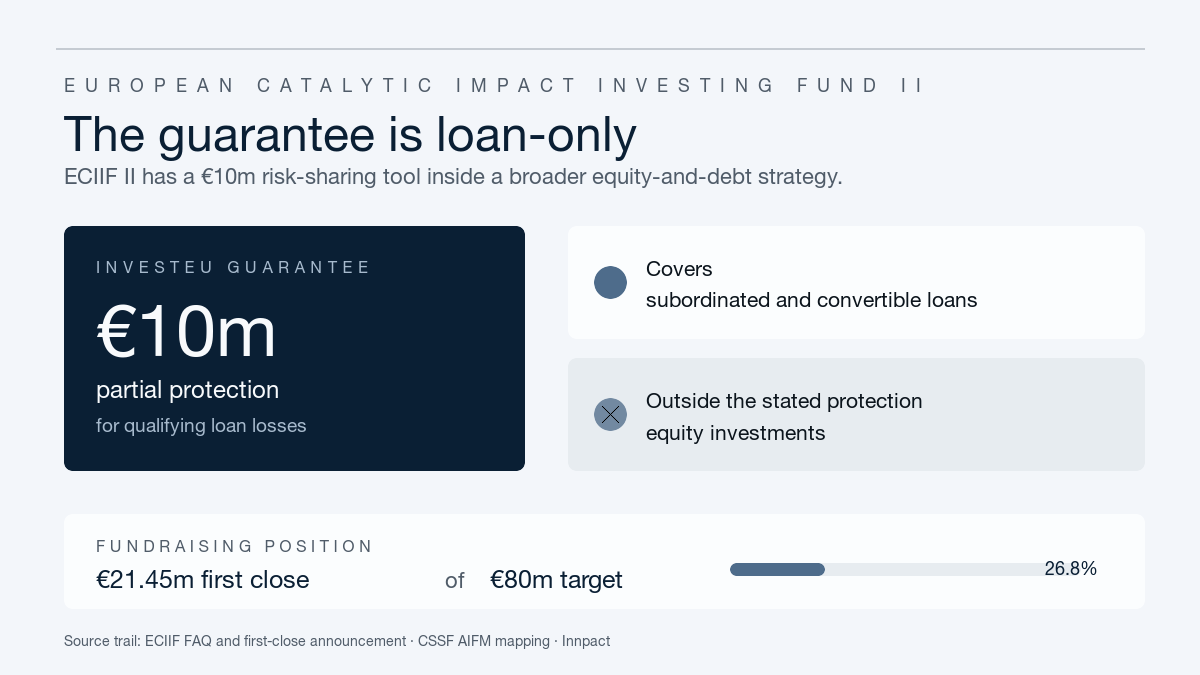
ECIIF II has closed €21.45 million toward an €80 million target, but the fund's headline €10 million InvestEU guarantee is narrower than the launch language suggests. The fund's own FAQ says the protection can recover net losses on subordinated and convertible loans, while equity investments receive no equivalent guarantee coverage.
That distinction is the economic story. ECIIF II is designed to finance European impact ventures that do not fit a conventional venture-capital exit model. Its risk-sharing tool is real, but it applies to only part of the instrument mix. Investors are not looking at a €10 million blanket shield around a €21.45 million portfolio. They are looking at a Luxembourg alternative investment fund whose downside protection depends on what it lends, what it converts and what it owns outright.
The first close is a milestone, not a blanket loss backstop
ECIIF II's 15 September announcement says the fund reached a first close above €21 million with backing from European impact investors and a catalytic guarantee from the European Investment Fund. Its FAQ specifies the close at €21.45 million against an €80 million target. The same materials say the fund expects to build a portfolio of up to 40 ventures across education and employment, health and care, food and agriculture, and circular economy and climate action.
The core numbers describe different things:
| Capital fact | What it establishes | What it does not establish |
|---|---|---|
| €21.45m first close | Capital committed at the September 2026 milestone, according to ECIIF's FAQ | That the full €80m target has been raised or called |
| €80m target | The fund's planned total size | A guaranteed deployment amount or investor commitment schedule |
| €10m InvestEU guarantee | A stated maximum of partial protection for qualifying loan losses | A guarantee covering every fund asset or every investor loss |
| Up to 40 ventures | The intended portfolio breadth | The number of investments already made |
The first close is 26.8% of the target. That is meaningful launch capital, but it leaves most of the fundraising and deployment programme ahead. The announcement also names SFPIM Relaunch, a subsidiary of Belgium's Federal Holding and Investment Company, among the investors, alongside foundations, family offices, an impact fund and other private wealth owners. It does not publish a commitment table or identify the amount supplied by each backer.
The fund's public proposition is therefore a capacity statement, not a completed portfolio. That matters because the guarantee is described alongside the strategy as if it were a single risk-reduction feature. The FAQ gives a more precise boundary.
The guarantee's scope is the real structure
The FAQ says the catalytic InvestEU guarantee provides partial protection against portfolio defaults and that net losses on loans can be recovered up to €10 million. It then adds the limiting sentence: the protection applies only to subordinated loans and convertible loans, not to equity investments.
That creates a two-track risk model:
| Fund instrument | Publicly stated guarantee treatment | Business consequence |
|---|---|---|
| Subordinated loans | Eligible for partial protection against net losses, up to the stated €10m ceiling | The guarantee can absorb part of the downside in a qualifying loan book, subject to the agreement's conditions |
| Convertible loans | Eligible for the same stated category of protection | The risk profile can change if a loan converts, because the investment may move from a protected debt claim into equity |
| Equity investments | Explicitly outside the guarantee | Investors retain the equity downside without the FAQ describing an equivalent public backstop |
The conversion point is particularly important for an impact fund that says it invests in both debt and equity. A convertible loan may begin in the protected category and later become shares. The public materials do not explain whether protection is assessed at origination, at default, at conversion or under another contractual test. That is not a claim that the guarantee disappears on conversion. It is the business question created by the stated scope.
The same FAQ says ECIIF uses self-liquidating instruments such as debt with an equity kicker or redeemable equity to give investors a planned exit without selling a portfolio company. The language fits the fund's non-exit thesis, but it also shows why instrument classification matters. A venture can remain independent while the fund still needs a repayment, redemption or conversion path. The guarantee can support some of those paths, but the public record does not say how the protection interacts with the fund's exit design.
A real Luxembourg fund sits behind the announcement
The fund is more than a strategy page. Production Dossaro's Luxembourg fund-register search identifies EUROPEAN CATALYTIC IMPACT INVESTING FUND II SCA SICAV-RAIF under CSSF registration lu:cssf:00013541. The record classifies it as an active alternative investment fund mapping and gives an authorisation date of 8 July 2026. A source-backed CSSF relationship links the fund to INNPACT FUND MANAGEMENT S.A. as its alternative investment fund manager.
The CSSF supervised-entities register is the relevant public regulatory surface. Innpact's project page independently describes ECIIF II as a Luxembourg SCA, RAIF with a July 2026 inception, a €21.45 million first close, an €80 million target and Innpact Fund Management as the alternative investment fund manager. Innpact says its role includes risk management, compliance, portfolio management, reporting and marketing support.
That structure establishes a regulated operating layer around the fund's public strategy. It does not disclose limited partners, depositary arrangements, fee sharing, beneficial ownership or the terms under which the guarantee is passed through to investors. An alternative investment fund manager relationship is a regulatory service-provider fact, not proof that Innpact owns the fund or supplies its capital.
The separation is familiar in European private markets. Headline's EU VIII records also distinguish a Luxembourg fund from the entities mapped to its management layer, while Titanbay's ELTIF platform shows how a distribution product can sit on a separately formed regulated vehicle.
The distinction matters for a fund whose public pitch rests on catalytic design. The strategy may be founded by FASE and Chi Impact Capital, managed through a newly formed platform and regulated through Innpact, while the guarantee is an EIF risk-sharing contract. Those are separate layers. Combining them into one “backstop” would overstate what the public record says.
Patient capital is being built around an instrument choice
ECIIF says it targets ventures that have revenues above €500, expect to reach break-even within one to two years and need more patient capital than a typical seed or Series A investor provides. The fund's FAQ contrasts that model with traditional venture capital, which often requires a small number of investments to produce very large returns.
The commercial logic is clear enough to test. A cooperative, steward-owned business or other non-exit venture can receive a loan or convertible instrument without promising an imminent sale. The fund can pursue repayment or redemption, while the InvestEU guarantee reduces some of the downside associated with qualifying loans. Equity investments remain part of the strategy, but the FAQ places them outside the stated protection.
For founders, that can widen the set of financing structures available before a conventional equity round. For investors, it makes the portfolio mix more important than the €10 million figure alone. A fund with more equity exposure will have a different risk profile from a fund that deploys most of its capital through qualifying loans, even if both sit under the same guarantee headline.
The public materials do not say how the first-close capital will be split between debt, convertibles and equity. Nor do they publish the share of the portfolio expected to be covered by the guarantee. The gap is not a footnote. It determines how much of the €21.45 million is exposed to the protected loan channel and how much remains ordinary equity risk.
The €80m target is still a deployment question
The fund's public ambition is large relative to its current close. Reaching €80 million would give ECIIF room for up to 40 initial or follow-on positions, but the target is not a commitment schedule. The first close can fund early investments while the managers continue to raise capital, and the guarantee may be sized to a subset of loans rather than to the entire target.
That sequencing is commercially relevant. A fund manager can announce a broad investment universe, close a first tranche, and use the guarantee to make certain loans investable before the full target is reached. The first companies to receive capital may therefore be selected not only for impact and growth, but also for their fit with the guarantee's eligible instrument categories. The public sources do not identify those companies or claim that such a selection has occurred.
ECIIF's announcement says investment will soon begin across four verticals. It does not say which investments have been signed, which are conditional, or whether the guarantee agreement has been drawn. The next meaningful disclosure would be a portfolio announcement or offering document that connects the guarantee to actual instruments and losses.
What the public record still leaves open
The affirmative finding is narrow but useful: ECIIF II is an active Luxembourg alternative investment fund, its AIFM relationship is source-backed, and the fund's €10 million InvestEU protection is limited to net losses on subordinated and convertible loans. Equity investments sit outside that stated protection.
The unresolved business question is how the protection will work in the fund's actual portfolio. A guarantee agreement, prospectus or investor report could show the covered-loss calculation, the order of claims, the treatment of a converted loan and who receives any recovery. It could also reveal how the €21.45 million first close is divided across loans and equity.
Until that document appears, the right reading is not that ECIIF has a €10 million shield. It is that ECIIF has a €10 million loan-focused risk-sharing tool inside a broader impact strategy whose equity exposure, fundraising path and investor economics remain open.
Continue reading
Related Research
Headline's $400m Fund Is Real. Its Manager Map Is Not Yet Singular
Headline's $400m EU VIII is an active Luxembourg AIF, but CSSF and CNMV records map it to two AIFM relationships while LP economics remain undisclosed.
Titanbay's Luxembourg platform predates LFDE's €1,000 ELTIF launch
Titanbay's Luxembourg SICAV was formed months before LFDE's €1,000 ELTIF launch, putting a legal platform behind the public private-markets partnership.
Project Ventures’ £5m Fund Splits General-Partner Vote From Carry
Project Ventures’ £5m fund gives Infra One 75%+ voting rights in the general partner while Project Ventures Consulting holds 75%+ of surplus assets.
Mustard Seed's €150m First Close Is Already a Deployment Vehicle
Mustard Seed + Partners says nearly €150m is closed and €55m is deployed, but public records still leave LP commitments and fund control unallocated.