
Cloover's $100m Facility Tests Whether Financing Capacity Can Become a Virtual Power Plant
Cloover says a $100m facility lifts financing capacity above $1.3bn as it scales a virtual power plant, but the debt is not a new equity round.
On this page
Conduct your own private market research
Add dossaro to Claude or ChatGPT and run source-backed register research from your own workspace.
 Add to Claude
 Add to ChatGPT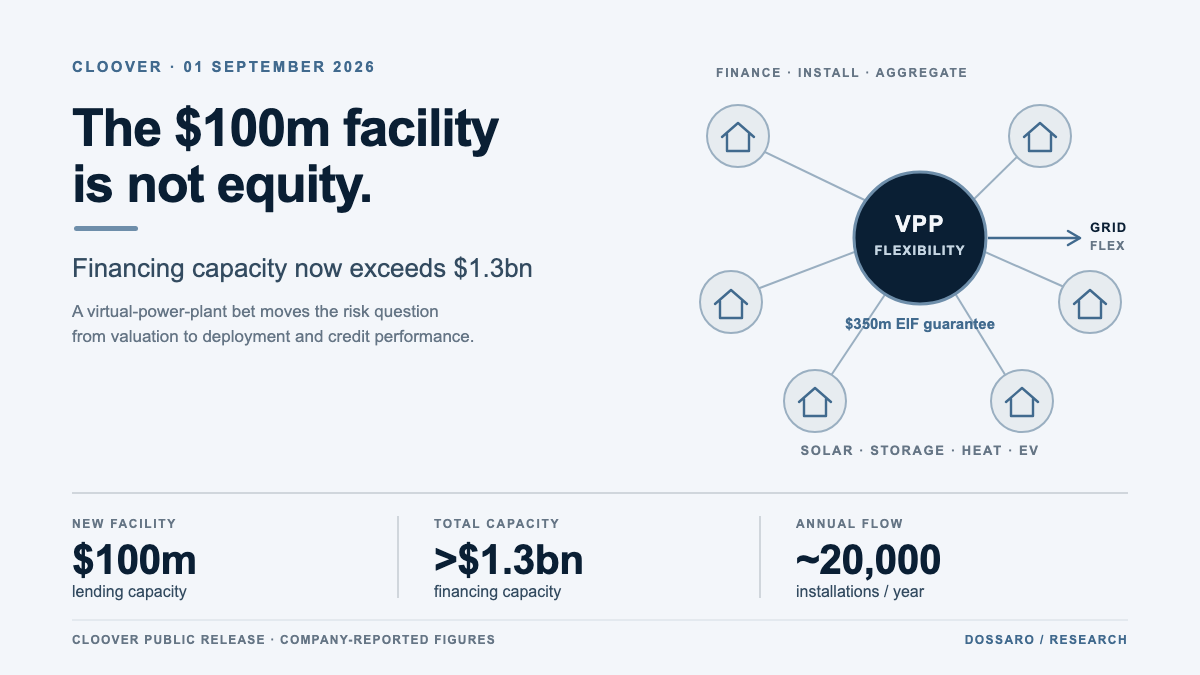
Cloover's latest capital announcement is about financing capacity, not a new equity round. In its 1 September release, the Berlin energy platform says a further $100 million facility takes its total financing capacity above $1.3 billion, backed by a $350 million European Investment Fund guarantee. It also says it is profitable at a revenue run rate above $350 million and routes around 20,000 installations a year through independent installers. Tech.eu independently reported the same headline figures.
That combination changes the commercial question. The public record does not show a priced share issue, a new valuation or a holder-level ownership change. It shows a company trying to finance a large installed base, then pool the resulting solar, batteries, heat pumps and electric-vehicle chargers into a virtual power plant. The test is whether capacity can become repeatable asset performance and grid value, not whether another venture round reset the price of the company.
The new $100m is a lending facility, not a priced round
In its 1 September 2026 release, Cloover described the $100 million as a further facility that pays for energy equipment and installations. The wording matters. A facility is a commitment to lend under defined conditions. It is not the same as cash already drawn, revenue already earned or equity issued to shareholders. The release gives no lender name, interest rate, maturity, borrowing base, collateral package or draw schedule.
The same release says the additional facility takes total financing capacity above $1.3 billion and is underpinned by a $350 million EIF guarantee. Tech.eu's contemporaneous report corroborates those figures and describes the facility as financing equipment and installations across Cloover's markets. Neither source says that the full capacity is outstanding or that the guarantee is a cash contribution. The clean reading is therefore a capacity expansion with credit support, not a $100 million funding round.
| Public disclosure | What it supports | What it does not prove |
|---|---|---|
| $100m facility | New lending capacity for equipment and installations | Equity raised, cash drawn, lender terms or valuation |
| More than $1.3bn capacity | Stated aggregate capacity after the facility | Debt outstanding, deployment or undrawn availability |
| $350m EIF guarantee | Credit support described by Cloover | A loan, equity cheque or investor ownership |
| More than $350m run rate | Company-reported revenue scale | Audited profitability or debt-service capacity |
| About 20,000 installs/year | Reported annual installer throughput | Cumulative financed assets or VPP capacity |
For comparison, an earlier January announcement from Cloover described a $1.2 billion debt facility alongside $22 million of Series A equity, more than $30 million of cumulative equity and more than $1.3 billion of debt. It also referred to a €300 million EIF guarantee. Those are dated company statements in a different currency and context. They should not be mechanically added to September's $100 million, $1.3 billion capacity or $350 million guarantee. The public materials do not reconcile the stacks.
The distinction is familiar in asset finance but easy to lose in startup coverage. Equity changes the ownership ledger. Debt capacity changes how quickly a company can fund assets, and who bears the first loss if customers, projects or asset values underperform. Until a draw schedule or accounts appear, the economic event is an option to finance growth, not proof that $1.3 billion has been deployed.
The balance sheet now carries the operating story
Cloover began by supplying independent installers with financing, software and energy products. The September release says installers keep their brands, customers and hardware choice, while Cloover embeds financing at the point of sale. The company says around 20,000 installations a year pass through those partnerships and that it is opening offices in the UK, France and Poland.
That model creates several linked performance questions. How much of the facility is advanced before installation, and how long does it remain outstanding? Who bears the gap between an installer's invoice and a homeowner's payments? How are subsidies, cancellations, equipment defects and early repayment handled? The announcement says households can pay nothing upfront and spread costs for up to 25 years, but it does not disclose underwriting cut-offs, loss history or the terms passed to lenders.
The commercial implication is that scale can magnify both operating leverage and credit exposure. More installers can produce more originations without a large direct sales force. They can also introduce more variation in project quality, customer affordability and servicing. A guarantee may make capital cheaper or expand eligible lending, but it does not remove the need to monitor defaults, recoveries and utilisation. Those are analytical consequences of the disclosed structure, not claims that Cloover has suffered losses or that a facility is distressed.
This is why the September announcement should not be framed as a simple “profitable startup raises $100m” story. The reported run rate may show commercial momentum. The financing structure determines whether that momentum converts into cash generation after equipment costs, installer funding, customer credit and energy-market costs. The public record currently cannot answer that conversion question.
A virtual power plant adds a second monetisation layer
Cloover says its next step is to pool financed systems into a virtual power plant. In the release, that pool includes distributed solar, batteries, heat pumps and EV chargers. A home-energy management system can forecast generation and consumption, schedule flexible loads within household limits and aggregate the resulting flexibility for tariffs or intraday trading.
The strategic move is significant because the installed base becomes more than a set of financed projects. It can become a controllable network whose value depends on availability, dispatch and market access. The company calls this an AI-native neo-utility. The description is an operating ambition, not evidence that Cloover owns every device or has booked a particular stream of grid revenue.
The virtual-power-plant layer also changes what “capacity” might mean in practice. Financing capacity measures how much equipment and installation activity can be supported by lenders and guarantees. Grid capacity measures how much flexible load or storage can be scheduled at a given moment. The two can reinforce each other, but they are not interchangeable. A large financing commitment does not establish a large dispatchable fleet, and a large installation count does not establish a profitable flexibility business.
The €43m Series A and 1 GWh offtake story at Ore Energy illustrates the same analytical discipline from a different angle: a headline capital figure and a physical deployment target answer different questions. Cloover's public release gives a capacity stack and an annual installation flow. It does not give the cumulative fleet's megawatt-hours, contracted tariffs or realised trading margin.
Scale is now an execution test
The new offices and installer-led distribution make the 20,000-installation claim commercially important. Cloover says it operates in five European markets and that every project was sold by an independent installer. That can lower customer-acquisition costs and make expansion repeatable, provided underwriting, installation quality and servicing remain consistent across jurisdictions.
Expansion also introduces regulatory and operational variance. Customer-credit rules, subsidy timing, grid tariffs and flexibility-market access differ across Europe. The release says the UK, France and Poland are next offices, but does not disclose country-by-country originations, financing partners or the share of the $1.3 billion capacity available in each market. A facility can be large on paper while deployment remains constrained by eligibility, warehouse limits or installer throughput.
That is the point at which the headline numbers become useful. They define the size of the opportunity and the resources available to pursue it. They do not settle whether Cloover can earn a risk-adjusted return on each additional installation or turn those installations into dependable grid flexibility.
What the public record still cannot show
The accessible public trail contains no shareholder ledger, valuation, new-share allotment or holder-level financing allocation linked to the September announcement. The German register identity is exact, but the sourcing run could not retrieve a parseable shareholder list or the July 2026 applications. The article therefore makes no ownership or dilution claim.
It also cannot establish whether the $100 million has been drawn, how the EIF guarantee is structured, who holds the receivables, or how the January and September capacity descriptions fit together. The $350 million run rate and profitability remain company-reported; no audited accounts were available in the reviewed sources. Those limits are material because they separate a credible capacity headline from proof of cash flow, solvency or control.
The next decision-changing document is a facility or guarantee disclosure paired with audited accounts and a refreshed German filing set. It could show pricing, maturity, security, drawdown and performance, while a shareholder list could reveal whether the financing coincided with any ownership change. Until then, Cloover's announcement is best understood as a debt-capacity expansion that puts execution and credit performance at the centre of its virtual-power-plant thesis.
For readers tracking how public support and private capital combine around industrial deployment, Advanced Electric Machines' equity-and-debt stack offers a useful contrast. That case makes the instruments explicit. Cloover's case is more open-ended: a guarantee-backed facility and a growing installation network, with the economics of the balance sheet still to be documented.
Continue reading
Related Research
Ore Energy Paired a $43m Round With a 1 GWh Deployment Agreement
Ore Energy paired a $43m Series A with a 1 GWh Budget Thuis agreement, moving iron-air storage from pilot evidence toward factory-scale delivery.
Advanced Electric Machines’ £16m Funding Is a Parent-Level Equity and Debt Stack
AEM's £16m funding headline combines parent-level preferred equity with government-backed debt secured over the operating company's IP, receivables and assets.
BIOWEG's €30m Series A Mixes Rabo Equity With a €10.3m Grant
BIOWEG’s €30m Series A combines Rabo equity with €10.3m of NRW-linked grant funding, while its register shows Rabo Ventures B.V. at 5.16% in new shares.
Hackuity's $19m Round Carries a 243,860-Share Ratchet
Hackuity's $19m round includes a €7m cash tranche, a bond conversion and a ratchet ceiling that could add 243,860 shares to the capital structure.