
Ore Energy Paired a $43m Round With a 1 GWh Deployment Agreement
Ore Energy paired a $43m Series A with a 1 GWh Budget Thuis agreement, moving iron-air storage from pilot evidence toward factory-scale delivery.
On this page
Conduct your own private market research
Add dossaro to Claude or ChatGPT and run source-backed register research from your own workspace.
 Add to Claude
 Add to ChatGPT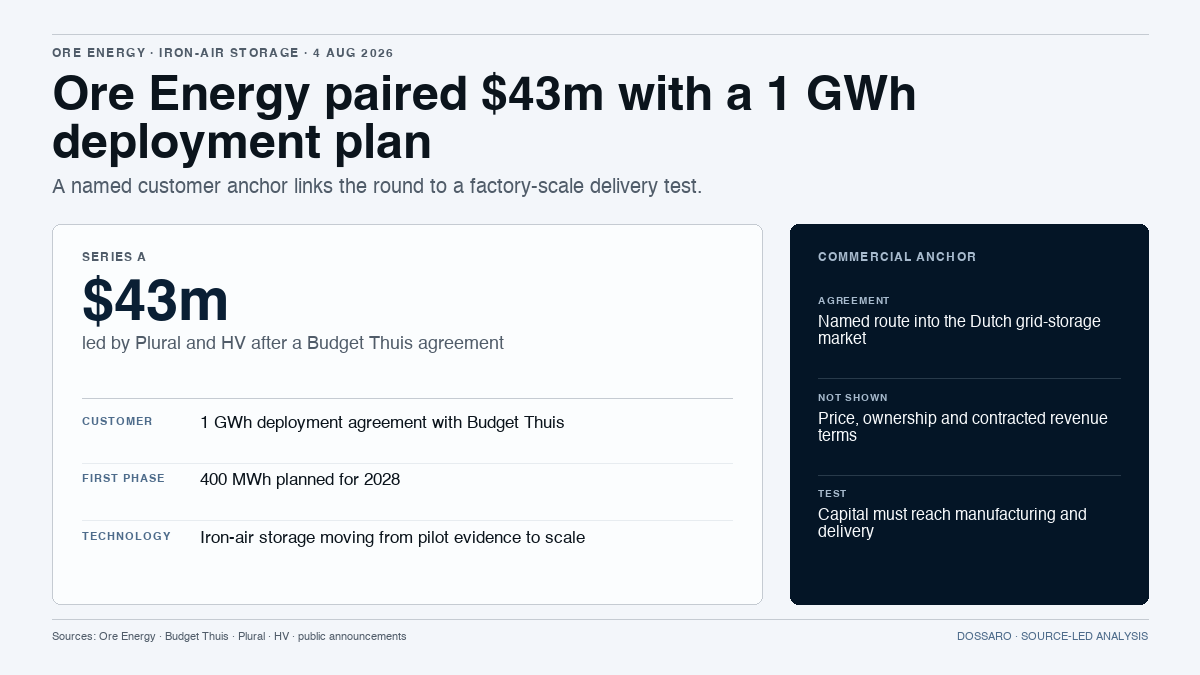
Ore Energy has linked its largest public financing to a concrete customer deployment. The Delft battery developer announced a $43 million Series A led by Plural and HV on 4 August 2026, after announcing a 1 GWh agreement with Dutch utility and telecoms supplier Budget Thuis. The first phase is described as 400 MWh, planned for 2028.
That pairing makes the round more than a generic climate-tech funding headline. It connects capital to a manufacturing step and to a named route into the grid-storage market. The public record still does not show the price paid for the new shares, the ownership percentage acquired by each investor, or whether the agreement creates a contracted revenue stream. Those limits matter because a customer announcement can validate a market need without settling the private economics of the company supplying it.
The round is aimed at a manufacturing bottleneck
Ore’s official Series A release says the company raised $43 million from Plural and HV, with participation from Positron Ventures. It puts total funding since founding at more than $61 million. The release says the money will establish Ore’s first manufacturing facility, expand the team and support a target of gigawatt-hour-scale manufacturing in 2028.
The use of proceeds is therefore operationally specific. Ore is not presenting the money only as research capital. It is describing a move from a working technology and pilot projects to factory validation, supply-chain execution and repeatable delivery. Independent coverage by ESS News confirms the round size, lead investors, Positron’s participation and the first-factory objective.
That distinction changes how to read the $43 million. A round can extend runway, fund equipment, or buy time to prove unit economics. Ore’s own allocation language points to all three pressures, but it does not provide a capex budget, production cost, contracted price or revenue forecast. The announcement supports a manufacturing transition, not a completed scale-up.
Budget Thuis supplies a customer anchor, not a disclosed valuation
On 22 June 2026, Ore and Budget Thuis announced an agreement to deploy 1 GWh of multi-day iron-air storage. Ore’s news page describes a committed first phase of 400 MWh planned for 2028. The funding announcement repeats the 1 GWh figure and identifies Budget Thuis as a Dutch-based challenger energy and telecoms utility supplier.
The sequence is commercially meaningful. A first phase of 400 MWh would give Ore a defined deployment objective against which manufacturing, permitting, performance and customer acceptance can be tested. The remaining 600 MWh is a larger stated programme, but the public material does not provide a delivery schedule for that portion, a price, take-or-pay terms, milestones, or consequences if the plan changes.
The signals can be separated without weakening either one:
| Public signal | What is stated | What remains open |
|---|---|---|
| Series A | $43m, led by Plural and HV; Positron participated; total funding above $61m | Valuation, issue price, investor percentages and instrument terms |
| Commercial agreement | 1 GWh with Budget Thuis; 400 MWh first phase planned for 2028 | Price, binding conditions, delivery milestones and revenue timing |
| Scale milestone | First manufacturing facility and gigawatt-hour-scale target for 2028 | Factory location, capacity ramp, capex and achieved production economics |
This is the useful economic bridge in the story. The agreement can function as customer validation and give the factory plan a target market. It does not, on its own, turn a planned deployment into booked revenue or reveal how the financing is shared between founders and investors.
Iron-air storage targets the multi-day gap
Ore says its systems store renewable electricity for up to 100 hours by rusting and unrusting iron electrodes. The company’s news archive describes the chemistry as using iron, water and air, without lithium or cobalt. Its funding release claims a cost per unit of energy capacity that is 10 times lower than lithium-ion for long-duration storage. That comparison is a company claim, not an independently audited cost curve.
The proposed use case is also specific. Ore says batteries can be co-located with wind farms to reduce curtailment, then dispatch power during periods of low wind or high demand. In the company’s framing, long duration could provide a bridge between intermittent renewable generation and the steady output required by industrial users and data centres.
An EDF pilot in France gives the story a prior operating reference. Ore’s February 2026 news item says a 100-hour iron-air battery energy-storage pilot was completed at EDF Lab les Renardières under the EU’s StoRIES programme. ESS News also reports the EDF pilot. A pilot demonstrates that the system can be run in a real utility setting; it does not establish that a 400 MWh or 1 GWh deployment will meet a commercial availability guarantee.
The financing therefore sits at a consequential point in the technology cycle. The public evidence moves from laboratory and pilot validation toward a customer-linked manufacturing plan, while the hard metrics that determine bankability remain private.
The Dutch register confirms the entity, not the cap table
The exact legal entity resolved in the Dossaro research run is Ore Energy B.V., a Dutch besloten vennootschap with KVK number 87899728 and native KVK reference 000053790375. The profile places the company at Molengraaffsingel 10 in Delft. The available KVK source exposed an entity profile but did not provide a public historical document set or a holder-level ownership filing in this run.
That result sets a clear evidence boundary. No investor percentage, share issuance, transfer, pledge, valuation or dilution is asserted here. Plural, HV and Positron are named in the public funding material, but the sources do not establish which legal vehicles subscribed, whether any investor converted an earlier instrument, or whether any founder sold secondary shares.
The gap is not unusual for a private Dutch company. A financing announcement is designed to communicate momentum and use of proceeds. A register profile answers legal identity. Neither is a substitute for the subscription agreement, an updated shareholder register or financial statements that reconcile the round to the balance sheet. In a different financing context, Advanced Electric Machines’ capital-stack analysis shows why parent-level equity and operating-company debt must be separated before a funding headline can be translated into risk. Ore’s public material has not yet exposed that layer.
The commercial consequence is a sequencing test
Ore’s two announcements create a credible sequence: a named customer programme in June, then a $43 million round in August that is explicitly earmarked for the first factory. That sequence may reduce customer-acquisition risk and give investors a visible deployment milestone. It also concentrates execution risk in the next stage. The company must turn an agreement into permitted sites, manufactured units, measured performance and repeatable cash collection.
For Budget Thuis, the public commitment signals an intention to build a large long-duration-storage programme with a technology supplier that is still scaling its production system. For Ore, the agreement gives the factory a commercial destination but may require further capital before the full 1 GWh programme is delivered. For the investors, the public upside is a route from pilot evidence to infrastructure-scale adoption; the missing downside detail is how much equity was issued and how much senior or contingent capital sits alongside it.
That is why the story should not be reduced to “iron-air startup raises $43m.” The stronger finding is that Ore has paired financing with a 1 GWh deployment plan, and the plan is structured around a 400 MWh first phase in 2028. The public record supports a customer-linked manufacturing thesis. It does not support a valuation, a dilution percentage or a claim that the agreement has already de-risked delivery.
The next document should connect the round to ownership
The decision-changing evidence would be an updated KVK extract, shareholder record or filed financial statement that identifies the post-round ownership and instrument structure of Ore Energy B.V. A subscription filing or accounts note could show whether Plural, HV or Positron invested directly, through a special-purpose vehicle, or through a mixture of equity and convertible instruments. It could also show whether the founders’ economic position changed and whether any security was granted over the company’s assets or contracts.
Until that document is public, the bounded conclusion is straightforward. Ore Energy announced $43 million of Series A funding led by Plural and HV, taking reported lifetime funding above $61 million. The company also announced a 1 GWh Budget Thuis agreement with a committed 400 MWh first phase planned for 2028. Together, those facts mark a move from pilot evidence toward factory-scale delivery. They do not disclose the cap table, the financing price, binding revenue terms or the final allocation of commercial risk.
Sources and method
This analysis uses Ore Energy’s 4 August 2026 Series A release, Ore Energy’s news archive, and ESS News’ independent account published 5 August 2026. Entity resolution uses the Ore Energy B.V. KVK profile, number 87899728. The research run returned no public historical KVK document set or holder-level filing, so no Dossaro document ID was used or materialized. All ownership, valuation, issue-price, binding-contract and dilution questions remain open.
Continue reading
Related Research
Advanced Electric Machines’ £16m Funding Is a Parent-Level Equity and Debt Stack
AEM's £16m funding headline combines parent-level preferred equity with government-backed debt secured over the operating company's IP, receivables and assets.
Enpulsion's Lift Me Off Deal Exposes A Funding-Dependent Handover
Enpulsion's Lift Me Off deal coincided with a founder exit, buyer-side appointment and accounts warning that funding and sale completion still mattered.
Sonnen's Sale Put 98.33% Of Its Holding Company Into YUMA
Shell sold sonnen to TIVEN, but filings show a new YUMA vehicle held 98.33% of sonnen Holding weeks before the completion statement went public.
Cloover's $100m Facility Tests Whether Financing Capacity Can Become a Virtual Power Plant
Cloover says a $100m facility lifts financing capacity above $1.3bn as it scales a virtual power plant, but the debt is not a new equity round.