
Cashbee's 2026 Control Deal Followed MIF's 86% Share of the 2024 Round
MIF's 85% Cashbee deal followed a 2024 financing in which it supplied 85.6% of the round, turning a new control headline into a consolidation story.
On this page
Conduct your own private market research
Add dossaro to Claude or ChatGPT and run source-backed register research from your own workspace.
 Add to Claude
 Add to ChatGPT
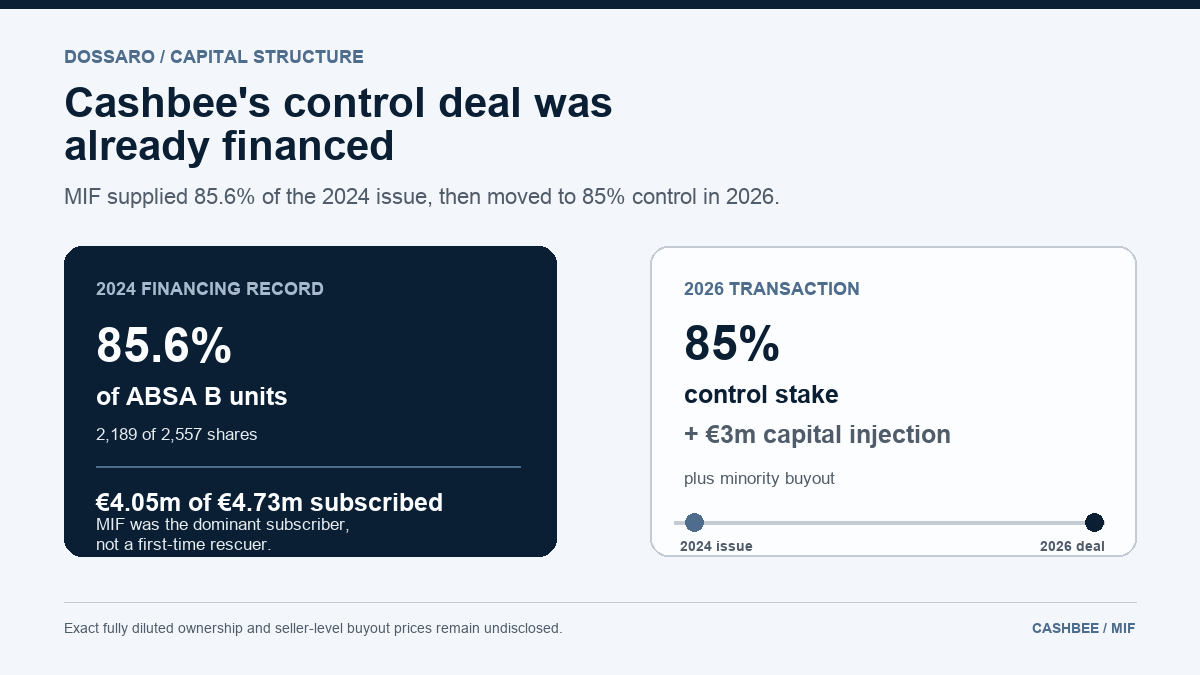
Mutuelle d'Ivry-La Fraternelle (MIF) did not first appear as Cashbee's rescuer in 2026. The French mutual insurer had already supplied 2,189 of the 2,557 ABSA B shares in Cashbee's August 2024 financing, putting €4.05 million of the €4.73 million issue into the savings platform. That is 85.6% of both the new units and the cash recorded in the filing.
The finding changes how the later transaction should be read. On 22 October 2026, MIF said it had acquired 85% of Cashbee, combining a €3 million capital injection with the buyout of minority shareholders. Public materials describe a move from a 20-21% minority position in 2024 to majority control. The register-backed financing sequence shows that the earlier minority stake was not the same thing as a small economic commitment. MIF was already the dominant subscriber to the round that created the relevant preferred shares.
That does not establish MIF's exact fully diluted ownership in 2024, the price paid to each seller, or the allocation of every later instrument. The filing records ABSA B shares, later BSA AIR and BSPCE exercises, and multiple share classes. The supported thesis is narrower: the 2026 deal consolidated a financing and commercial position that MIF had already built, rather than introducing a new investor to Cashbee for the first time.
The 85% announcement is the end of a financing sequence
The Joffe & Associés transaction notice says MIF acquired an 85% stake in Cashbee. It describes Cashbee as a digital savings and investment platform founded in 2018 and says MIF first joined the capital in 2024 with a 21% stake to build a retirement-savings partnership. The new transaction combined a €3 million capital injection with the buyout of minority shareholders. Cashbee's cofounders, Cyril Garbois and Marc Tempelman, remain responsible for developing the platform.
Independent coverage carried by Boursorama and Zonebourse describes the same structure: MIF became the majority shareholder through a capital increase and a purchase of minority positions. The MIF's ESG report lists Cashbee at 20% among its participations, illustrating why the public record uses a 20-21% range rather than one reconciled cap-table percentage.
Those sources answer what changed in 2026. They do not show how much of the earlier round MIF financed, which is why the 2024 capital-increase record is decisive for the economic reading.
MIF supplied most of the 2024 issue
The 6 August 2024 French RNE financing document records a reserved issue of 2,557 ABSA B shares for total subscriptions of €4,731,958.63. MIF subscribed for 2,189 units and €4,050,941.51. The remaining 368 units and €681,017.12 were spread across six other named subscribers.
| 2024 subscriber | ABSA B shares | Subscription amount | Share of issue units |
|---|---|---|---|
| MIF | 2,189 | €4,050,941.51 | 85.6% |
| 115K | 189 | €349,761.51 | 7.4% |
| Jean-Pierre Aubin | 67 | €123,989.53 | 2.6% |
| Thierry Porté | 27 | €49,965.93 | 1.1% |
| Secure Processing Holding Limited | 37 | €68,471.83 | 1.4% |
| Initiatives | 27 | €49,965.93 | 1.1% |
| Loïc Guilloux | 21 | €38,862.39 | 0.8% |
| Total | 2,557 | €4,731,958.63 | 100.0% |
The arithmetic is direct. MIF's 2,189 units divided by 2,557 equals 85.608%, and its €4,050,941.51 divided by €4,731,958.63 gives the same percentage because the issue price was consistent across the listed subscriptions. The document also records €4,382,197.12 paid by bank transfer and €349,761.51 settled by debt set-off, which together equal the full issue amount.
This is not an inference about an undisclosed side agreement. It is the subscriber schedule in the financing record. What remains uncertain is how those ABSA B shares, later exercises and the company's other classes translated into ordinary ownership and voting power.
Financing share is not the same as fully diluted ownership
The difference between the 85.6% financing share and the public 20-21% participation is the article's most important boundary. The 2024 filing concerns a reserved issue of ABSA B shares. It also records later BSA AIR and BSPCE exercises and a capital structure with more than one class. A simple count of the new units therefore cannot be presented as MIF's final percentage of Cashbee.
The public 20-21% figures may reflect a post-issue ordinary share position, a different point in time, or a denominator that includes instruments not captured by the issue schedule. The available evidence does not show the conversion, option or voting terms needed to reconcile those bases. Saying that MIF financed most of the 2024 issue is safe. Saying that it owned 85.6% of Cashbee in 2024 is not.
That distinction also separates this article from a claim that the 2026 transaction was preordained. MIF may have held a minority stake with contractual rights that limited its immediate voting position. The records support dominant financing exposure, not a claim that MIF controlled the company before the buyout.
The commercial partnership made the consolidation logical
MIF's first investment was tied to a distribution relationship. Joffe says the partnership around retirement-savings plans allowed MIF to receive a growing flow of clients opening or transferring their PER accounts through Cashbee's digital channel. The 2026 deal therefore joins two assets: fresh capital for Cashbee and a larger strategic channel for MIF's savings and wealth-management offer.
The transaction's capital injection is new money for the company. The minority buyout is a different economic leg. It transfers exposure from the other 2024 subscribers and any later holders to MIF, but the public notices do not give each seller's price, return or percentage. Treating the entire €3 million as a purchase price would be wrong because the announcement says it includes a capital increase as well as the buyout.
The result resembles the distinction in Skeleton's holding-group investment: a strategic transaction can combine a legal equity position with a commercial channel, while the operating relationship and the ownership layer are not identical. For Cashbee, the immediate operating consequence is clear. The platform gets capital to accelerate customer acquisition, and MIF gains a larger claim on the digital route into mass-affluent and wealth-management customers.
The minority holders carry the undisclosed exit economics
The seven names in the 2024 schedule make the later buyout more concrete. MIF was the largest subscriber by a wide margin. 115K and the other five named investors supplied the balance of the issue, and the 2026 announcement says minority stakes were bought out. Those holders are the obvious counterparties to the consolidation, but the record does not identify which of them sold, whether every minority holder sold, or whether new holders entered through later instruments.
The founders' continuing operating role is also not the same as a disclosed economic stake. MIF's notices say Garbois and Tempelman continue to develop Cashbee, but they do not publish their post-transaction holdings or the terms of any rollover. The article can therefore distinguish management continuity from ownership continuity without assuming that the founders were cashed out or retained a specific percentage.
For MIF, the combination is a way to align capital, distribution and control around a partnership it had already financed. For Cashbee, the €3 million injection may extend runway and accelerate the channel. For the other investors, the value of the exit depends on the undisclosed purchase prices and on whether later preferences or instruments changed the payout order.
The next document should show the buyout price and instrument map
The next decision-changing source is a transaction document or post-closing filing that identifies the minority sellers, the capital-increase terms and the fully diluted denominator. A new RNE act could show the post-transaction classes or allotments. An investor notice or shareholder agreement could show whether MIF received conversion, preference or governance rights that explain the 20-21% to 85% progression.
Until that evidence appears, the strongest conclusion is the one the financing schedule supports. MIF did not suddenly arrive as Cashbee's rescuer in 2026. It had already put about 86% of the 2024 round's money into the fintech, then used a €3 million injection and minority buyout to consolidate control. The amount paid to the exiting holders, and the exact preference economics behind that consolidation, remain open.
Continue reading
Related Research
Skeleton’s Siemens Deal Puts an 11.25% Stake Beside an Exclusive Data-Centre Channel
Estonian filings list Siemens International Holding with 11.25% of Skeleton’s holding group as Siemens gains an exclusive data-centre sales channel.
XRlabs Added Seed-2 Preference Rights While Its Founder Kept Statutory Control
XRlabs raised an $8.4m Playground-led seed while filings show 621,130 Seed-2 shares and a founder still above 50% with majority board rights.
Hansetherm’s €10m Seed Put Two Near-25% Blocks at the Center of Its Cap Table
Hansetherm’s €10m seed created 65,429 new shares, putting two less-visible blocks near 25% each while G-FUND holds 2.11% before scale-up plans.
Wormsensing’s €9.5m Series A Mixed New Money With Note Conversion
Wormsensing’s €9.5m Series A combined 45,559 new ABSA P2 shares with 19,069 shares issued against earlier ORA notes, changing the cash story.