
Wormsensing’s €9.5m Series A Mixed New Money With Note Conversion
Wormsensing’s €9.5m Series A combined 45,559 new ABSA P2 shares with 19,069 shares issued against earlier ORA notes, changing the cash story.
On this page
Conduct your own private market research
Add dossaro to Claude or ChatGPT and run source-backed register research from your own workspace.
 Add to Claude
 Add to ChatGPT
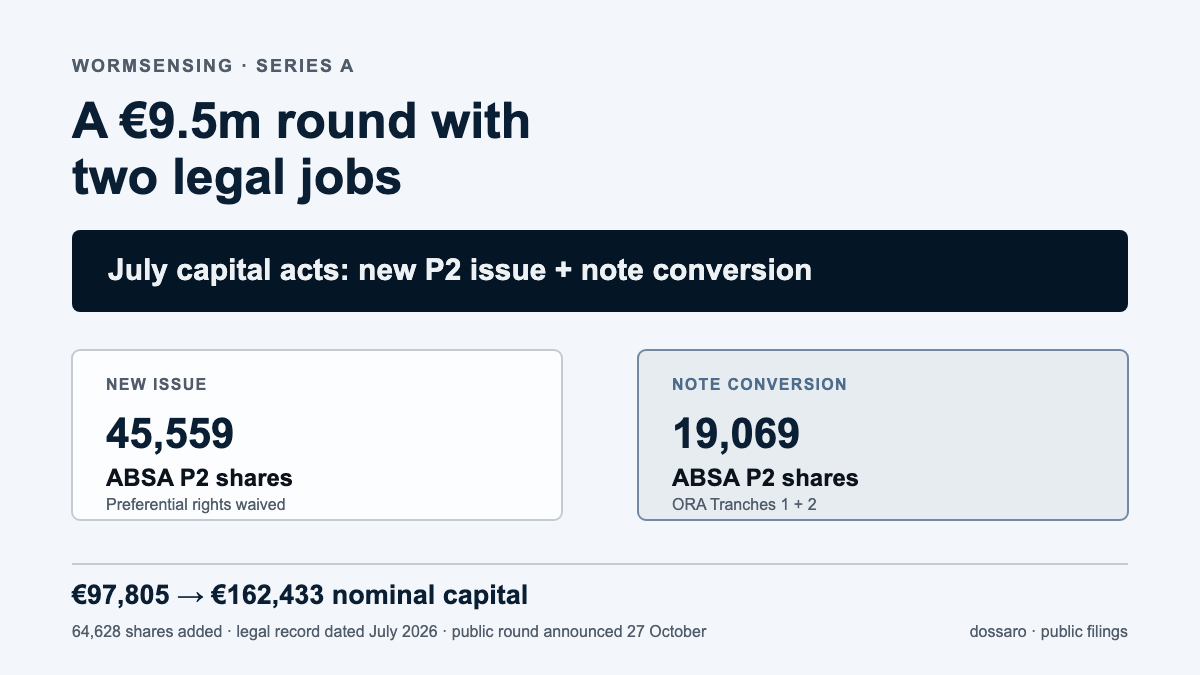
Wormsensing’s €9.5m Series A was announced as one industrialisation round. Its legal capital record shows two different events: 45,559 new ABSA P2 shares issued with existing holders’ preferential rights waived, and 19,069 more ABSA P2 shares issued against two earlier note tranches.
That split changes the financing story. The Grenoble sensor company is raising new money, but it is also converting earlier obligations into the same preferred class. The public record does not disclose the cash issue price, the ORA conversion ratios, the investor allocation or the post-money valuation. It does establish that the headline amount sits on top of a recapitalisation, not only a fresh subscription.
The legal capital trail predates the public round
Wormsensing announced the Series A on 27 October 2026. The company says Orano Venture Fund, managed by Supernova Invest, led the round, with participation from the French Tech Seed fund managed by Bpifrance, the Avenir Industrie regional fund, and existing investors Innovacom, KBC Focus Fund and CEA Investissement. The stated uses are sensor production, digital services and international expansion.
The public legal notice appeared earlier. The Pappers capital history records an agreement dated 10 July 2026 and presidential decisions dated 23 July. Those acts lifted the company’s nominal capital from €97,805 to €162,433 and split the increase into a new ABSA P2 issue and a conversion of earlier ORAs. ABSA is the French form of a share issued with attached warrants. ORA means an obligation repayable in shares, a note that can be settled with equity rather than cash.
| Date | Public record | What it establishes |
|---|---|---|
| 17 October 2022 | Innovacom announces a €3.5m financing | The earlier industrialisation round was led by Innovacom with KBC Focus Fund and CEA Investissement |
| 10 July 2026 | Shareholders approve the capital operation | The legal decision precedes the public Series A announcement |
| 23 July 2026 | Presidential decisions implement the operation | The company records two ABSA P2 increases with different economic origins |
| 27 October 2026 | Wormsensing announces a €9.5m Series A | The financing becomes public with a scale-up and international-expansion narrative |
The timing matters because the announcement presents one €9.5m round, while the register already describes how the company’s share capital was assembled. The legal acts do not identify the investors behind each allotment, but they do prevent the round from being treated as a single cash subscription without qualification.
Two P2 events sit inside the July increase
The first increase created and issued 45,559 new ABSA P2 shares with a nominal value of €1 each. The notice says existing holders’ preferential subscription rights were suppressed. That is a new-issue event: the company created a new position in the P2 class and opened the subscription to parties not identified in the public notice.
The second increase created 19,069 ABSA P2 shares of the same €1 nominal value in repayment of ORA Tranche 1 and ORA Tranche 2. Those shares were not described as a new cash subscription. They were the equity settlement of obligations already in the company’s capital history.
| Component of the July operation | Shares | Legal meaning | What remains unknown |
|---|---|---|---|
| New ABSA P2 issue | 45,559 | New shares issued with preferential rights waived | Subscription price, investors, premium and valuation |
| ORA Tranche 1 and 2 conversion | 19,069 | Notes repaid through ABSA P2 shares | Note principal, conversion ratios and holders |
| Total added | 64,628 | Capital rose from €97,805 to €162,433 | Post-money ownership, preferences and voting outcomes |
The two events added 64,628 shares to the previous 97,805. The post-allotment company therefore had 162,433 shares and the same number of stated voting rights. The public notice describes the variation as 39.79 percent of the post-allotment count. That is not a dilution percentage for any named holder. It is a description of how much of the final nominal share count was added in the operation.
The distinction is important for investors. A new share issue brings capital into the company, but an ORA conversion changes the form of an earlier claim. One part of the July operation can fund the next production and sales phase. The other part can reduce the company’s outstanding note exposure while giving the noteholders equity in the P2 class. Without the subscription price and ORA terms, the public record cannot say which effect dominates the economics of the €9.5m announcement.
The 2026 round builds on an earlier industrialisation financing
The July operation also makes more sense against Wormsensing’s prior capital history. In its 2022 financing release, Innovacom said its Technocom3 fund led a €3.5m round with KBC Focus Fund and CEA Investissement. The company planned to use that money to finance its first manufacturing site and start a French production line.
The related legal notice recorded 39,147 new ABSA P shares and 658 Actions P, taking nominal capital from €58,000 to €97,805. That earlier record already showed Wormsensing using more than one preferred class as it moved from CEA-Leti research spinout to industrial production.
The 2026 announcement describes the next step as a broader operating system around the sensor. Wormsensing says it now has a 50-patent portfolio, a French Hyperion production line and capacity for up to two million Dragonfly sensors a year. It plans to add digital services, work with more integrators and distributors, and expand across Europe, North America and Asia. Those are company statements, not a filed revenue or valuation record, but they explain why a mixed financing could be useful: new cash can support expansion while earlier bridge instruments are converted into the capital stack that will fund it.
The Voltr capital-repair analysis shows the same distinction from another angle. A headline industrial round can be inseparable from the legal work that makes the balance sheet financeable. Adsilico’s preferred-share architecture likewise shows why a round amount alone cannot explain who sits in front of ordinary holders. Wormsensing’s July acts do not provide a full preference waterfall, but they make the class change visible.
The register answers the class question, not the price question
The strongest safe conclusion is therefore narrower than “six investors supplied €9.5m of fresh cash.” The public record shows a new P2 issue and a P2 conversion of two existing ORA tranches. It does not identify which named investor subscribed for the 45,559 shares, whether the ORA holders were among the participants in the announcement, or how the new class ranks against the 2022 P and Actions P shares.
There is a straightforward commercial explanation. Converting bridge notes can be a planned step before an industrial scale-up, and a rights-waived P2 issue can allow a new lead investor to subscribe without reopening the entire shareholder base. That would make the July acts ordinary financing mechanics rather than evidence of a distressed recapitalisation. The public record supports that possibility, but it does not prove the cash issue represented most of the €9.5m.
The same boundary applies to control. Orano Venture Fund is the named lead, but the filing does not assign Orano a percentage, a board right or a veto. French Tech Seed and the regional fund are named participants, but their economic positions are not disclosed. The capital acts show the structure of the issuance, not the resulting control map.
For growth investors and industrial acquirers, that is still useful information. The round has two underwriting questions instead of one. The first is how much cash reaches Wormsensing and what production or commercial milestones it funds. The second is how the converted ORAs and the P2 class change the rights attached to the company’s earlier capital. A company can have a larger nominal share count without giving the public enough information to price the new equity or the converted claims.
The next documents are the subscription terms
Wormsensing’s €9.5m Series A is a documented combination of new issuance and note conversion. The July acts add 45,559 ABSA P2 shares with preferential rights waived and 19,069 P2 shares issued against ORA Tranches 1 and 2. The capital record therefore changes the public story from a simple cash raise into an industrialisation round with a recapitalisation component.
The next decision-changing records are the updated statutes, the shareholder resolutions and the ORA terms. They should identify the subscription price, the conversion ratios, the holders of the new and converted shares, and the preference rights attached to P2. Until those records are public, the defensible reading is precise: Wormsensing has created a new preferred position and converted earlier notes, but the public €9.5m still does not reveal how much money was new, who received the resulting rights or how the final capital stack ranks.
Sources
Continue reading
Related Research
VoltR's €22m Industrial Push Follows a Documented Capital Repair
VoltR's €22m industrialisation package follows a 2025 capital repair: an emergency €400,002.76 issue, a rejected dissolution vote and a founder SPV.
Adsilico’s £10m Series A Made Series A 47.24% of Issued Shares
Adsilico’s £10m Series A created two large Series A allotments, but Companies House leaves the investor-by-investor ownership map unresolved.
StandardX's £10m Seed Round Put Two Preferred Classes Ahead of Ordinary Shares
StandardX announced a £10m isotope seed. Companies House filings show £9.81m of priced allotments, senior preferred rights and a pre-round funding gap.
CarbonFarm's €7m Series A Left a Two-Tranche Equity Trail
CarbonFarm's €7m Series A left two 2026 equity tranches and €3,904.96 of capital, but public acts do not map named investors to legal positions.