
Z_One's €35m First Close Is Also a Test of Italy's Public-Private VC Model
Z_One's first close pairs CDP and regional capital with Zest's 20% stake in its manager, while public notices disagree on the €55m or €60m target.
On this page
Conduct your own private market research
Add dossaro to Claude or ChatGPT and run source-backed register research from your own workspace.
 Add to Claude
 Add to ChatGPT
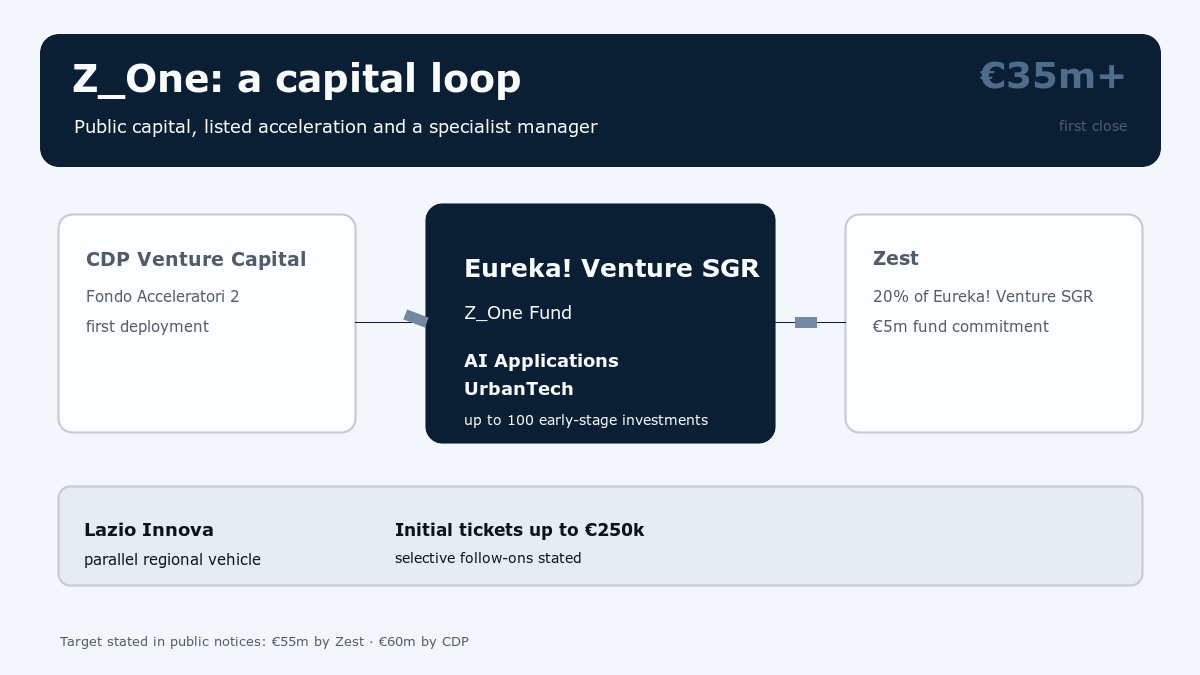
Z_One Fund's first close is being presented as a €35m-plus launch, but the more consequential fact is the capital loop underneath it. CDP Venture Capital says its Fondo Acceleratori 2 made its first investment through Z_One. Zest says it owns 20% of Eureka! Venture SGR and committed €5m to the fund. Lazio Innova adds a parallel regional vehicle, while Fondazione Compagnia di San Paolo and private investors complete the disclosed backer set.
That structure gives Italy's early-stage market a testable proposition: public capital can use a specialist manager and an accelerator-owned operating network to reach more pre-seed and seed companies. It also leaves a material question open. CDP describes a €60m target, while Zest describes €55m. The close is source-backed, but its final fund-size target is not yet one number.
The close matters because the capital comes with an operating network
The CDP Venture Capital announcement dated 28 October 2026 says Z_One Fund started its investment period after a first close above €35m. It names CDP Venture Capital SGR, Zest, Lazio Innova through a Lazio-focused parallel fund, Fondazione Compagnia di San Paolo and other private investors. The fund is managed by Eureka! Venture SGR and led by Luigi Capello, Giulio Montoli and Giulia Fazzini.
CDP describes the strategy as a response to a shortage of institutional capital at the earliest stages of Italian company building. Z_One is designed to invest as the first institutional backer in early-stage companies working on AI applications and UrbanTech. Its stated plan is up to 100 investments, with initial tickets of up to €250,000 and selective follow-ons for companies that reach concrete milestones.
That is different from a later-stage fund that mainly prices growth risk. The commercial proposition is to provide a first cheque, acceleration and a route to later capital at the same time. CDP also says the Fondo Acceleratori 2 can invest directly in the most promising companies in subsequent rounds. The public-capital role therefore has two layers: backing a specialist manager and keeping a path to direct portfolio exposure.
Zest is both an investor and part-owner of the manager
The Zest announcement makes the ownership relationship unusually explicit. Zest says it holds 20% of Eureka! Venture SGR, acts as sponsor and advisory company for Z_One, and is the first private investor with a €5m commitment. The company is listed on Euronext Milan, so the relationship links a listed accelerator platform to a private fund manager and a new fund vehicle.
The disclosure does not establish that Zest controls Eureka! Venture SGR or that it controls Z_One's investment committee. It does establish an economic alignment that a normal fund announcement would often leave implicit. Zest can contribute deal flow, acceleration capability and network access while also receiving economics from its manager stake and its LP position. Fund Momentum's independent structural analysis describes the arrangement as the clearest evidence yet of the Zest-Eureka tie-up becoming a dedicated institutional fund.
This is a platform story, not a claim that the listed company owns the fund's assets. The distinction is the same one visible in AP Ventures' manager-level control architecture: a fund headline and the entity that manages it can sit on different legal and economic layers. Z_One's public record shows the connection between those layers, but not every right that governs them.
The Lazio vehicle extends the same model into regional capital
CDP says the main fund is accompanied by Z_One Fund Lazio, created through Lazio Venture 2, an initiative of the Lazio regional government under the PR FESR 2021–2027 programme and managed by Lazio Innova. The parallel vehicle applies the same investment strategy and operating model to startups connected to Lazio.
The regional vehicle changes the reach of the structure. It lets public development capital target a defined geography without turning the main fund into a regional mandate. Fund Momentum notes that the parallel vehicle is backed by Lazio Innova and sees it as part of a broader platform pattern around Eureka! Venture.
The public notices do not disclose the vehicle's commitment size, fee terms, investment committee, carry allocation or follow-on reserve. Those omissions matter because a parallel fund can share a manager and strategy while having different concentration limits, public-policy conditions or portfolio rights. The evidence supports the existence and purpose of Z_One Fund Lazio, not a conclusion that its economics are identical to the main fund.
The target is €55m or €60m, depending on the source
The first-close figure is consistent: more than €35m. The final target is not. CDP's notice says Z_One aims to raise €60m. Zest's notice says the target is €55m. Neither notice explains whether the difference reflects a revised target, a different perimeter, a rounding convention or the treatment of the parallel Lazio vehicle.
That discrepancy should remain visible. It is not a reason to discard the story, but it is a reason to avoid presenting one target as settled. The two figures also change the implied reserve conversation. At the disclosed upper-bound initial ticket, 100 investments would represent:
| Portfolio measure | Calculation | Source-supported reading |
|---|---|---|
| Maximum initial-ticket deployment | 100 × €250,000 | €25m before follow-ons, fees and other reserves |
| Remaining capital against a €55m target | €55m − €25m | €30m for follow-ons and other fund uses, if every ticket reached the upper bound |
| Remaining capital against a €60m target | €60m − €25m | €35m on the same illustrative basis |
This is a construction exercise, not a disclosed budget. Not every company will receive €250,000, and the sources do not state a reserve ratio. The simple arithmetic does show why the strategy depends on selective follow-ons and why the target mismatch is economically relevant rather than cosmetic.
What the structure means for founders and public investors
For founders in AI applications or UrbanTech, Z_One offers more than a first cheque on paper. The fund combines early-stage investment with the Zest group's acceleration advisory, deal flow and corporate network. The stated initial tickets are small enough to support pre-seed and seed formation, while the follow-on language directs extra capital toward companies that hit milestones.
For public investors, the experiment is different. CDP is not only committing to a fund. It is using a specialist manager as the first deployment of Fondo Acceleratori 2 and keeping the option to invest directly in portfolio companies later. Lazio Innova is using a parallel vehicle to direct the same broad model toward regional companies. That is a way to distribute public capital through an operating network rather than through a single accelerator cohort.
The trade-off is execution capacity. A 100-company ambition across AI applications and UrbanTech is broad, and the public sources describe a three-person key team. Zest's acceleration infrastructure may help with sourcing and support, but the fund's differentiation will ultimately show in diligence depth, follow-on discipline and the quality of the companies that earn additional capital. Fund Momentum flags the same volume-versus-depth question in its independent analysis.
The next document must reconcile the platform
The public record supports a precise conclusion: Z_One is a state-backed, accelerator-linked venture fund whose manager relationship is part of the investment thesis. Zest's disclosed 20% stake in Eureka! Venture SGR and €5m commitment make the capital loop visible. CDP's first Fondo Acceleratori 2 deployment and the Lazio parallel vehicle show how public money is being routed through that loop.
The record does not yet show the legal fund documents, the complete LP map, the investment committee rights or a settled target size. The next useful document is an Italian fund or manager filing that reconciles the €55m and €60m figures, identifies the vehicles and maps the commitments. Until then, Z_One is best understood as a public-private platform under construction, not as a fully disclosed fund architecture.
Continue reading
Related Research
AP Ventures’ $300m Fund III Leaves Manager-Level Control Concentrated on Andrew Hinkly
AP Ventures’ $300m Fund III has backed 13 companies, while Companies House records 75%+ manager voting and surplus rights with Andrew Hinkly.
Entourage Fund II’s €100m Close Sits in a Newly Formed Belgian LP Vehicle
Entourage says Fund II closed at €100m, while its Belgian LP vehicle was formed months earlier and public filings do not map commitments to paid-in capital.
XRlabs Added Seed-2 Preference Rights While Its Founder Kept Statutory Control
XRlabs raised an $8.4m Playground-led seed while filings show 621,130 Seed-2 shares and a founder still above 50% with majority board rights.
Seaya's €600m Nova Close Raises a Fund-Identity Question for Europe's Growth Capital
Seaya says Nova reached a €600m first close, while EIF earlier named a €1bn-target Growth Tech Fund I; the public names are not yet reconciled.