
Before Advent's Vermeg Deal, a UK Unit Converted a £2.519m Parent Receivable Into One Share
A new Vermeg Systems filing shows a £2.519m parent receivable converted into one share before Advent's planned acquisition, not a cash round.
On this page
Conduct your own private market research
Add dossaro to Claude or ChatGPT and run source-backed register research from your own workspace.
 Add to Claude
 Add to ChatGPT
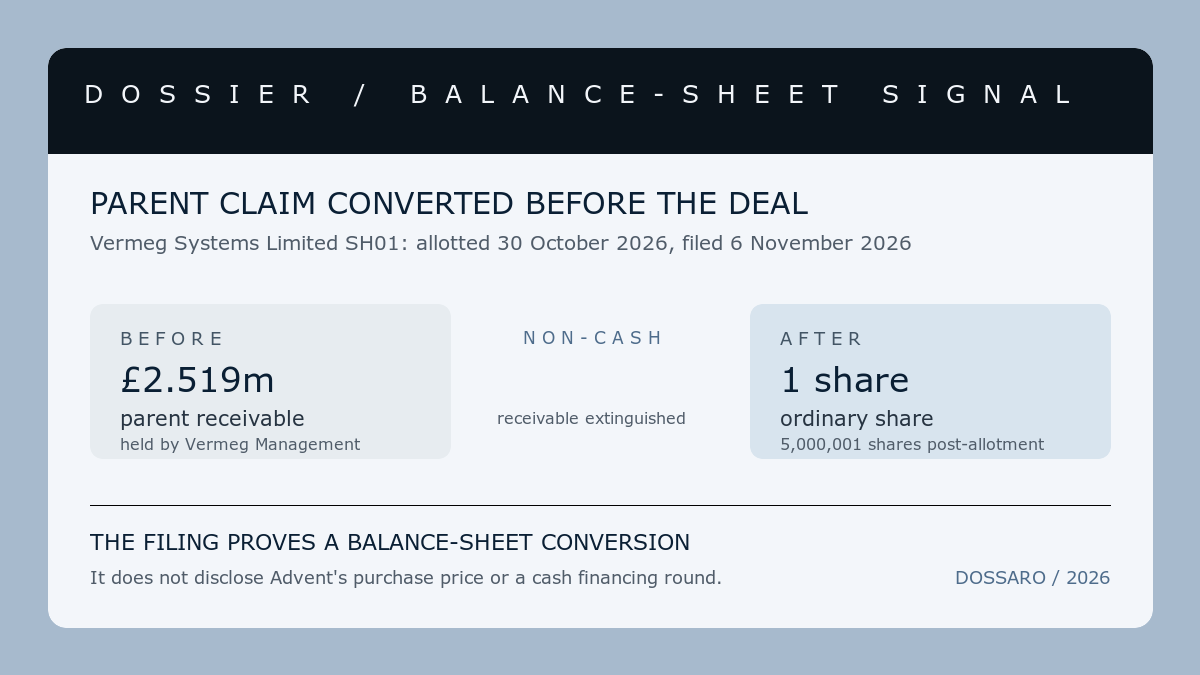
Just before Advent agreed to acquire Vermeg, its UK operating company converted a £2.519m receivable owed to its parent into one ordinary share. The SH01 filed at Companies House on 6 November 2026 records an allotment dated 30 October: one £0.10 share, paid at £2,519,028.12, with non-cash consideration described as extinguishing a receivable held by Vermeg Management Limited.
That is a different economic event from a new-money financing. The filing removes a parent claim from the UK company and adds one share to a 5m-share capital structure. It does not disclose Advent's purchase price, the allocation of value between Charterhouse Capital Partners and founder Badreddine Ouali, or the terms of the announced ADIA co-investment.
The timing makes the filing important. Advent announced the acquisition on 2 November, saying it had signed an agreement to acquire Vermeg from Charterhouse and Ouali, with an ADIA subsidiary joining as a minority co-investor. Ouali is expected to remain a shareholder and vice chairman, and completion is expected in the first half of 2027. The independent M&A News account confirms the buyer, co-investor, seller and undisclosed price, but does not mention the UK filing.
The register therefore adds a narrow but material finding to the takeover story: the UK operating company entered the announced control transfer after a substantial intercompany claim had been converted into equity, while its latest accounts still showed negative net liabilities.
The filing that changes the deal question
The legal entity is VERMEG SYSTEMS LIMITED, company number 02322432. It was previously named Lombard Risk Systems Limited. The filing history shows the relevant SH01 was filed on 6 November 2026, four days after Advent's announcement.
The form is unusually precise about consideration. It says the share was allotted on 30 October 2026, has a nominal value of £0.10 and was fully paid. The amount paid is £2,519,028.12. Under non-cash consideration, the form says the payment was “the extinguishing of a £2,519,028.12 receivable held by Vermeg Management Limited against the company.” The post-allotment statement of capital is 5,000,001 ordinary shares with an aggregate nominal value of £500,000.10.
That language supports three conclusions and rules out several others. First, the parent claim was extinguished in exchange for equity rather than cash. Second, the filing is a liability-to-equity conversion at the operating-company level. Third, the allotment is not a material change in the legal share count. It does not show a cash subscription by Advent, a transfer of shares to ADIA, a seller payout or a negotiated purchase-price adjustment.
| Filed item | What the SH01 says | Economic reading |
|---|---|---|
| Allotment date | 30 October 2026 | The conversion occurred before the public acquisition announcement |
| New shares | 1 ordinary share | The parent received one additional share, not a new block of operating-company shares |
| Amount paid | £2,519,028.12 | A material claim was settled through non-cash consideration |
| Post-allotment capital | 5,000,001 ordinary shares | The new share is about 0.00002% of the stated post-allotment count |
| Consideration | Extinguishing a Vermeg Management receivable | The filing does not identify Advent, ADIA or a transaction price |
The arithmetic is simple but easy to miss in a takeover headline. One share divided by 5,000,001 is about 0.00002%. The economic significance is therefore not dilution. It is the removal of a £2.519m parent claim from a company whose balance sheet had not yet returned to positive equity.
Why the 2025 balance sheet matters
The 2025 annual accounts, filed 20 August 2026, provide the operating-company context. Vermeg Systems reported turnover of £13.704m, operating profit of £2.201m and profit after tax of £983,564 for the year ended 31 December 2025. The result was profitable, but the balance sheet showed net liabilities of £1.901m. Called-up share capital was £500,000, representing 5,000,000 ordinary shares.
The directors' report says operating profit had fallen from £2.640m in 2024 because a provision was booked on intercompany receivables. It also says the company's equities would become positive again in 2026 and that results through May 2026 were encouraging. Those statements describe a functioning software business with improving equity, not a public insolvency filing. They also make the later SH01 easier to interpret: a parent claim was still large enough to matter to the legal entity's balance sheet, even though the company was generating operating profit.
The accounts state that Vermeg Management Limited controls Vermeg Systems by virtue of a 100% shareholding. The current Companies House PSC record records Vermeg Management as holding at least 75% of the shares and voting rights and the right to appoint or remove directors. The two records use different levels of precision, but they point to the same parent-controlled structure. The accounts also identify Vermeg Group B.V. as the ultimate parent.
The filing's commercial consequence is therefore about balance-sheet priority and transaction readiness. A parent that holds a receivable can leave that claim outstanding, convert it into equity, or settle it for cash. Here the public record proves the conversion, but not why it happened. The parent no longer has the same receivable against the UK company after the allotment, and the company has a larger nominal equity base without bringing in cash.
The Advent announcement is a group transaction, not a UK share-price disclosure
Advent's announcement describes Vermeg as two businesses: capital-markets technology for post-trade processing and collateral management, and life-insurance technology for policy administration. It says Advent will support investment in products, artificial intelligence and customer relationships. Charterhouse has backed Vermeg since 2020, while Ouali will remain a shareholder and adviser after completion.
None of those public statements allocates value to Vermeg Systems Limited. The announcement does not state which group entity issued shares, which entity borrowed acquisition debt, or whether the UK parent-claim conversion was a closing condition. The independent deal coverage likewise reports an undisclosed price and the same expected first-half 2027 completion window without describing the SH01.
This entity boundary matters. A UK operating subsidiary can clean up a parent balance before a global sale without being the vehicle that Advent acquires. The filing is still relevant because it shows a material claim being removed from the operating-company perimeter immediately before the group control event. It is not proof that the UK entity received the sale proceeds or that the conversion changed the global purchase price.
That distinction is also why the article should be read alongside ELEMIS's pre-close lender transfer mechanics, where the UK articles expose a financing-backed transfer path before the buyer can close. Autoneum's Trèves transaction shows the opposite pattern: the public announcement disclosed the share-heavy consideration and debt refinancing directly. Vermeg sits between those cases. The group sale is public, but one important piece of balance-sheet preparation appears only in a subsidiary filing.
A balance-sheet repair is not a sale-price disclosure
The most defensible description is a pre-deal intercompany debt-to-equity conversion. Calling it a “sale preparation” is reasonable as a timing observation, but saying Advent required it would go beyond the evidence. The SH01 does not name Advent, ADIA, Charterhouse or Ouali. It does not say whether the parent claim arose from working-capital support, historic funding, a settlement arrangement or ordinary intra-group accounting.
There is a benign reading. Parent companies routinely settle intercompany balances before refinancing, reorganisations and changes of control. The conversion could have been planned independently of the acquisition agreement. The timing can be reported with high confidence; the reason for the timing remains a medium-confidence inference.
The risk allocation is nevertheless clear enough to matter. Before the filing, Vermeg Management had a £2.519m receivable from the UK company. After the filing, that claim has been exchanged for one ordinary share. The operating company has not raised £2.519m of cash, and the new share does not create meaningful dilution among the 5m existing shares. The practical change is a cleaner liability position for the operating entity and a different form of exposure for its parent.
The next filings should settle the remaining boundary. A charge, share transfer, confirmation statement or PSC update could show whether Advent or an acquisition vehicle enters the UK register, whether the parent relationship changes, and whether the 5,000,001-share structure persists. Group-level transaction documents could also reveal whether the conversion was linked to financing or completion. Until then, the supported conclusion is narrower and stronger: Vermeg's UK operating company converted a £2.519m parent receivable into one share just before Advent announced its planned acquisition, and the filing changes the balance-sheet reading of the deal without revealing its price.
Continue reading
Related Research
ELEMIS Wrote Lender Transfer Mechanics Into Its Articles Before PAI Can Close
ELEMIS’s pre-close articles add secured-institution transfer rules while Reinold Geiger remains the registered controller ahead of PAI’s 2027 acquisition.
Autoneum's Trèves Deal Is a Share Rollover and Debt Refinance, Not a €64m Cash Exit
Autoneum's Trèves acquisition puts about 80% of the €40m upfront into new shares, refinances debt with a CHF200m loan and leaves earn-out risk open.
Supa's £21m Headline Masks a £13m Equity Round and a Founder Control Reset
Supa's £21m block-management funding includes about £13m of filed equity, an undisclosed debt gap and a founder control reset for acquisitions.
Circuit Mind's $25m Financing Appears in the UK OpCo as a £7.15m Parent Allotment
Circuit Mind's $25m financing was announced publicly, but the UK filing shows a £7.15m share allotment to its US parent, not a direct investor cap table.