
Supa's £21m Headline Masks a £13m Equity Round and a Founder Control Reset
Supa's £21m block-management funding includes about £13m of filed equity, an undisclosed debt gap and a founder control reset for acquisitions.
On this page
Conduct your own private market research
Add dossaro to Claude or ChatGPT and run source-backed register research from your own workspace.
 Add to Claude
 Add to ChatGPT
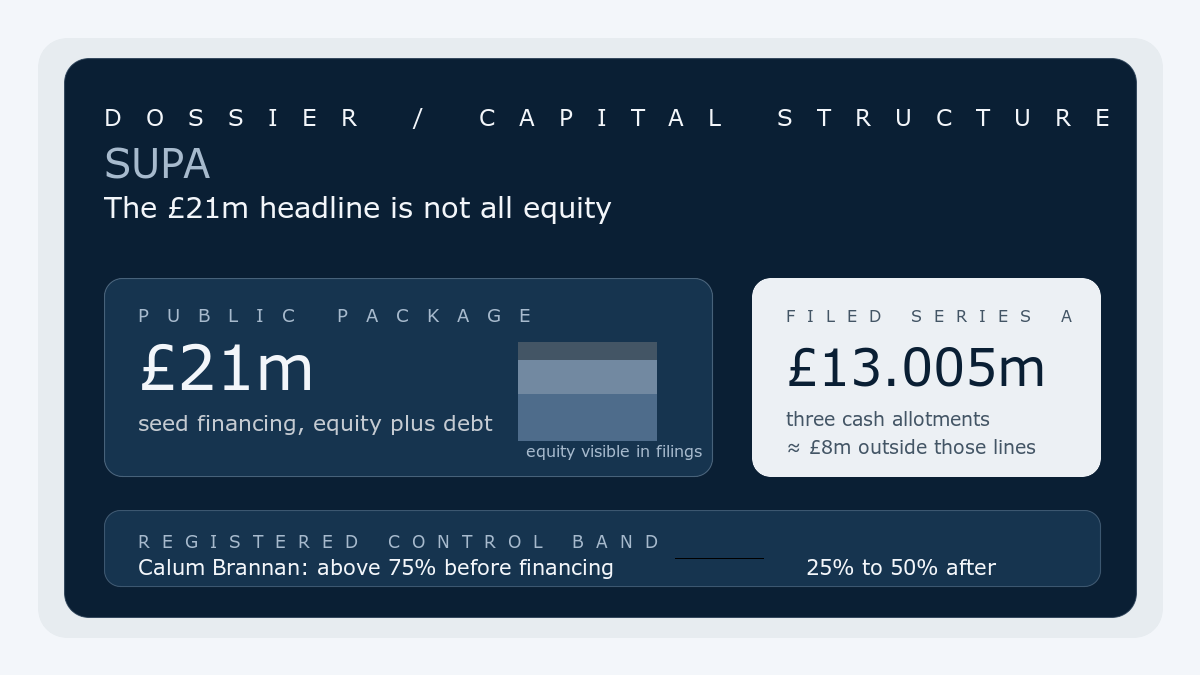
Supa's £21 million seed headline describes a financing package, not £21 million of disclosed equity. The UK register for SUPA TECHNOLOGY HOLDINGS LTD records three Series A allotments whose filed issue prices add up to about £13.005 million. Public reporting says the package also contains debt, but the lender and the equity-debt split remain undisclosed.
The same filings show a control reset. Calum Brannan was recorded above the 75% threshold before the financing. A person-with-significant-control filing gives his new band as more than 25% and not more than 50%, with the change dated 13 April 2026. The register does not publish the other holders' exact stakes or say who controls the board after the round. It does show that Supa's acquisition strategy is being funded alongside a material change in the founder's registered position.
That distinction matters because Supa is not using the capital only to build software. OpenOcean says the company has acquired seven managing agents covering around 20,000 homes in its first year. Sky News and Tech.eu describe more acquisitions, technology and a debt tranche. The legal evidence therefore points to a roll-up whose financing changes both the acquisition budget and the governance question.
The £21m package is larger than the filed equity
OpenOcean's portfolio page for Supa records a £21 million seed round in 2026 and describes the business as an acquirer of established block-management firms that moves their teams onto an AI-enabled operating system. Sky News reports that the round was led by 2150 and OpenOcean, included KOMPAS VC, Actia Capital Partners and HEARTFELT, and contained a debt tranche from an undisclosed provider. Tech.eu repeats the combined equity-and-debt structure.
Those sources establish the public event and its commercial purpose. Supa says it retains the acquired firms' identities and teams while using software for repairs, service-charge reconciliation, safety records and contractor coordination. The company reports seven acquisitions and about 20,000 homes, while Tech Funding News reports revenue growth of more than 700% since the initial acquisitions in late 2025. The operating ambition is clear. The funding mix is not.
The Companies House filing history for SUPA TECHNOLOGY HOLDINGS LTD, company number 16268091 supplies the missing equity leg. The company was incorporated as LEVELS TECHNOLOGIES LTD on 21 February 2025 and changed its name to Supa Technology Holdings Ltd on 5 November 2026. Its 20 February 2026 confirmation statement recorded 10,000 ordinary shares before the Series A issue.
| Filed financing element | Calculation from the register | What it establishes |
|---|---|---|
| First Series A allotment | 7,818,821 × £1.273849 plus 5,896,880 × £0.509539 | About £12,964,688 of gross issue proceeds |
| Second Series A allotment | 31,402 × £1.273849 | About £40,001 of gross issue proceeds |
| Total filed equity | Three cash allotments | About £13,004,689, not £21m |
| Difference to public headline | £21,000,000 minus filed equity | About £7,995,311 still outside these allotments |
The arithmetic uses the issue prices printed on the two 11 May 2026 and 13 May 2026 SH01 returns. The first return records 7,818,821 Series A shares at £1.273849 and 5,896,880 at £0.509539. The second records 31,402 shares at £1.273849. Rounded to the nearest pound, the three lines imply £9,959,997, £3,004,690 and £40,001 respectively.
The approximately £8.0 million difference is not automatically a debt amount. Public sources say the £21 million combines equity and debt, but the register does not disclose the lender, facility size, interest, security or whether another instrument sits in the package. Timing, fees, commitments and other closing mechanics could also affect a reconciliation. The defensible conclusion is that the public headline is larger than the equity directly visible in these allotments.
The founder's registered control band moved during the financing
The pre-round baseline is unusually clear. The confirmation statement, made up to 20 February 2026, records Calum Brannan with 8,091 ordinary shares, Alexis Maria Cavanagh Johnson with 1,734 and Keith Vella with 175. At that point the company had 10,000 ordinary shares and Brannan held 80.91% of the filed count.
The control record then changes with the financing authorisation. Members passed written resolutions on 13 April authorising directors to allot up to £166.63103 of shares with a £0.00001 nominal value. The resolutions created the Series A structure and disapplied pre-emption rights. The later allotments issued 13,747,103 Series A shares alongside 10,000,000 ordinary shares in the resulting statement of capital.
That capital statement is not a complete investor cap table. It identifies classes and totals, but not the subscriber names behind the Series A positions. It does, however, line up with the PSC filing dated 15 May, which records Brannan's change date as 13 April and moves him into the source-native band above 25% and up to 50% of shares and voting rights.
The change should be described as a registered control-band reset, not as proof that Brannan lost board control or sold a particular percentage. The PSC form reports a range. It does not disclose the exact denominator used for the band's assessment, the other holders' stakes, reserved matters, investor consents or director appointment rights. The live Companies House PSC page currently shows Brannan in the same more-than-25%-to-50% band and identifies him as the only active person with significant control on that page, but that page does not replace the historical allotment documents.
This is the key economic asymmetry. The founder appears to have remained a large holder, but the register no longer supports the earlier founder-dominant picture. New capital created a Series A block large enough to move the founder out of the 75%+ band, while the public financing story does not identify who received that block. The capital and control changes are visible; the investor allocation is not.
A roll-up needs both acquisition capital and operating discipline
Supa's use of funds makes the structure commercially consequential. The company buys local block-management businesses, keeps their brands and teams, and centralises repetitive work. That model can accelerate distribution because each acquisition arrives with buildings, contracts and operating data. It also creates a financing need that differs from a pure software startup. Purchase prices, integration costs and working capital must be funded before software efficiencies are proven across the acquired portfolio.
The debt tranche is therefore more than a footnote. If the missing portion of the £21 million package is primarily acquisition debt, Supa can buy more firms without issuing as much equity. The trade-off is a lender claim that sits ahead of ordinary and preferred equity in a downside scenario. The public sources do not disclose security or priority, so no lender-ranking conclusion is made. The filing does show why the equity and debt legs should be analysed separately.
That separation is also visible in Dwelly's financing stack, where primary equity, a limited founder secondary and secured debt served different economic functions. Rabot Energy's Series B provides a different comparison: its register exposed named recipients and dilution at an operating-company node, while Supa's filings expose the class issuance and founder control band but not the Series A holders. The group-level question remains open, much as the Circuit Mind parent allotment leaves investor economics one layer above the UK operating company.
For Supa, the practical test is whether acquired firms retain residents, staff and service quality while the central platform scales. Tech Funding News reports that Supa says administration time can fall by up to 90%, but that is a company claim, not an audited operating result. The capital structure creates the conditions for faster consolidation. It does not prove that the promised efficiency, acquisition returns or resident outcomes will follow.
What the next filings should settle
The next decision-changing documents are a post-round confirmation statement or shareholder list that names the Series A holders, plus any charge or loan filings that identify the UK lender and the assets supporting the facility. Those documents could distinguish a primary-only round from any transfers, show whether the founder's band narrows further and reveal whether the debt is secured against the operating group or only the holdco.
Until then, the strongest source-backed reading is precise. Supa announced a £21 million seed package to fund acquisitions and technology. The UK register records about £13.005 million of cash equity across three Series A allotments and a founder control band moving from above 75% to 25% to 50%. Public sources say debt fills part of the wider package, but the amount, lender and rights remain undisclosed. The financing is therefore a control and leverage reset whose legal economics are only partly visible.
Sources
- Supa's OpenOcean portfolio page, accessed 7 November 2026.
- Sky News funding report, 4 November 2026.
- Tech.eu funding report, 4 November 2026.
- Tech Funding News independent coverage, 4 November 2026.
- Companies House profile and filing history.
- 20 February confirmation statement, 13 April written resolutions, 11 May SH01, 13 May SH01, and 15 May PSC filing.
Continue reading
Related Research
Dwelly's $170m Round Mixed Founder Liquidity With Secured Debt
Dwelly's filings show £44.3m of new Series B cash, 19,406 founder shares sold to EQT and General Catalyst, and Trinity secured across the business.
Rabot Energy's $50m Series B Reweighted Its Investor Coalition
Rabot Energy's public €50m Series B maps to 26,816 new shares in RABOT Charge, diluting Rabe Venture from 21.90% to 16.34% on issued shares.
Circuit Mind's $25m Financing Appears in the UK OpCo as a £7.15m Parent Allotment
Circuit Mind's $25m financing was announced publicly, but the UK filing shows a £7.15m share allotment to its US parent, not a direct investor cap table.
VoltR's €22m Industrial Push Follows a Documented Capital Repair
VoltR's €22m industrialisation package follows a 2025 capital repair: an emergency €400,002.76 issue, a rejected dissolution vote and a founder SPV.