
Stability AI's $76m Round Leaves Its UK Operator Reliant on the Parent
Stability AI's $76m strategic round follows a parent-level control shift, while 2024 accounts show a loss-making UK operator owing its parent $69.71m.
On this page
Conduct your own private market research
Add dossaro to Claude or ChatGPT and run source-backed register research from your own workspace.
 Add to Claude
 Add to ChatGPT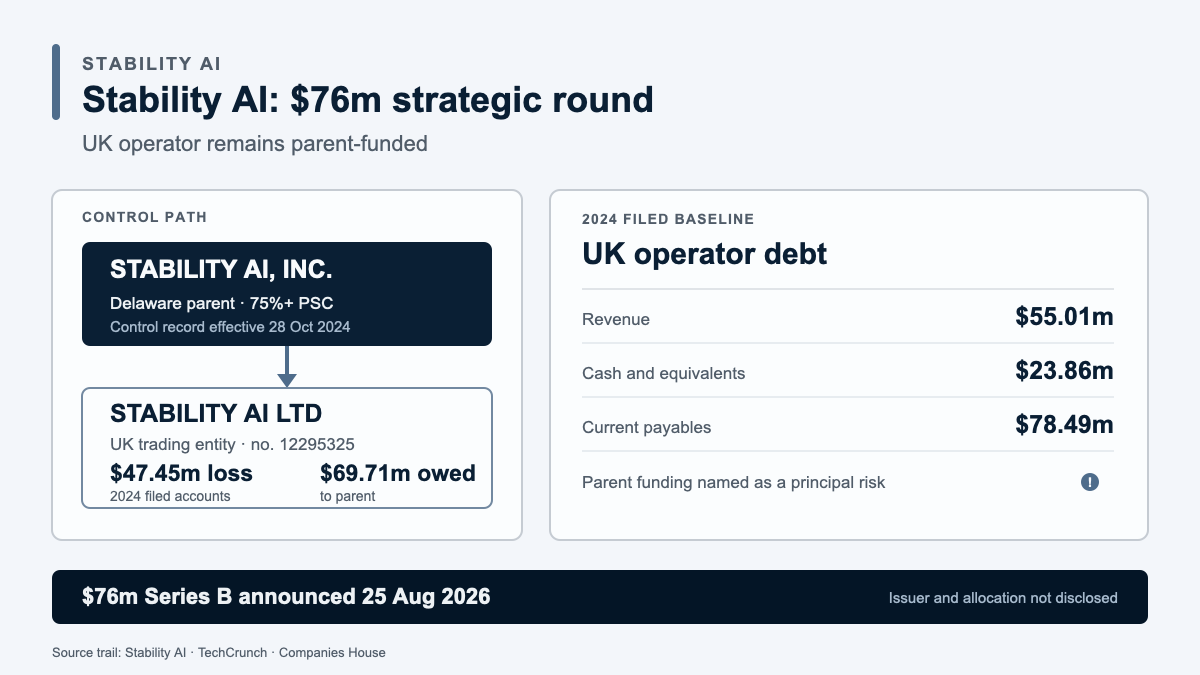
Stability AI's new $76 million strategic round arrives at the group level while the UK company that accounts for the operating work remains a wholly controlled, loss-making subsidiary with $69.71 million owed to its Delaware parent. The public financing changes the group's resources and commercial reach. It does not, on the available evidence, change who controls the UK operating company or show that new cash has reached its balance sheet.
Stability AI announced the Series B on 25 August, saying the round brings total funding to $232 million. Electronic Arts, Sony Music Group, Universal Music Group, Warner Music Group, AMD Ventures and Pacific Alliance Ventures joined returning investors. TechCrunch independently reported the $76 million raise and the unusual concentration of entertainment and technology partners.
The legal and financial perimeter is different from a simple startup-round headline. Companies House records identify STABILITY AI LTD, company number 12295325, as the main trading entity for the group. Its 2024 audited accounts say the company is 100% owned by Stability AI, Inc., a Delaware parent with no trading activities of its own. Those accounts also show a $47.45 million loss for 2024, $23.86 million of cash and $78.49 million of current payables. A related-party note identifies $69.71 million owed to Stability AI, Inc.
That combination makes the useful question narrower than whether Stability AI has raised enough money. It is whether the new strategic capital is deployed through the parent, passed into the UK operator, or used through another group entity. The public announcement does not say. The filings show why that distinction matters.
The round is public, but the issuing perimeter is not
Stability AI's announcement says the Series B adds $76 million in new capital and lifts cumulative funding to $232 million, including two equity rounds and convertible notes. It names a group of strategic participants and says the money will support creative-production products, applied research and professional services. Coatue co-founder Thomas Laffont also joined the board of directors.
TechCrunch's account confirms the amount, participants and product plans. It also describes the investors as companies Stability now depends on for content licensing and distribution relationships. That is an important commercial dimension: the round can bring customer access and rights-holder credibility as well as financing.
Neither public account identifies the legal entity that issued the securities, each investor's allocation, the rights attached to those securities or any amount transferred to STABILITY AI LTD. The headline therefore belongs to the Stability AI group, not automatically to the UK company whose accounts are filed at Companies House. This is the same perimeter problem visible in Callosum's holdco financing, where the registered preferred class sat in a UK parent above the operating business.
The absence of an allocation is not evidence of a shortfall. Strategic rounds can close across entities, use several instruments or include commitments that are not yet visible in a subsidiary's accounts. It does mean that a reader should not treat the $76 million as an already documented UK operating-company cash injection.
The UK operator is the trading engine and the funding pressure point
The 2024 group accounts describe STABILITY AI LTD as the main trading entity of the Stability AI, Inc. group. Its principal activities are employing researchers, engineers and other technology specialists to develop generative AI models. The group also owns operating subsidiaries in Germany, Japan and Spain through the UK company.
The same accounts record a very different financial profile from the new financing headline. Revenue was $55.01 million in 2024, made up of $11.42 million of underlying revenue and $43.59 million of non-underlying revenue. The group reported an operating loss of $44.24 million and a loss for the year of $47.45 million.
| 2024 filed position | Amount | Why it matters |
|---|---|---|
| Revenue | $55.01m | The reported scale of the UK-led group |
| Loss for the year | $47.45m | The operator was not self-funding on its reported result |
| Cash and cash equivalents | $23.86m | Cash on the group balance sheet at year-end |
| Current payables | $78.49m | Short-term obligations exceeded cash by a wide margin |
| Owed to Stability AI, Inc. | $69.71m | Most of the related-party balance was payable to the parent |
The accounts show net current liabilities of $52.33 million and net liabilities of $52.23 million at 31 December 2024. Those figures do not predict the group's position in August 2026, but they establish the last filed starting point before the new strategic round. They also explain why parent funding is a principal risk rather than a footnote. The directors specifically identify continued availability of funding from the parent as a key risk facing the business.
The related-party note says the amount payable to Stability AI, Inc. carries monthly interest and that the parent is both immediate and ultimate parent. It also says the UK group directs significant research and intellectual-property activities for the wider group. In commercial terms, the UK company does the work and carries the operating obligations, while the parent supplies an important part of the financial bridge.
Control moved to the Delaware parent before the Series B
The control change in the public register predates the August 2026 financing. A Companies House filing received on 29 October 2024 records Stability AI, Inc. as a relevant legal entity with 75% or more of the shares in STABILITY AI LTD, effective 28 October. The same effective date appears in a filing recording Mohammad Mostaque's cessation as a person with significant control.
The two filings prove a change in the statutory control record. They do not disclose the terms of a founder transaction, the consideration paid, or the complete share structure of Stability AI, Inc. The safest conclusion is that the UK legal and accounts trail places the operating company under the Delaware parent's control from that date. It is not safe to turn that record into a claim about every group company, investor economics or the founder's personal outcome.
This chronology changes how the Series B should be read. The parent-level control structure existed before the new money was announced. A strategic investor can therefore obtain exposure to the Stability AI group, commercial rights or board influence without becoming a direct shareholder of the UK operating company. The group announcement does not tell the public which of those routes applies to Electronic Arts, the music companies, AMD Ventures or Pacific Alliance.
The distinction also matters for employees and suppliers. A parent-controlled operator with accumulated liabilities depends on decisions made above the operating-company balance sheet. New capital may strengthen the whole group and still leave the UK company dependent on intercompany funding, service arrangements and the parent's willingness to keep financing the research base.
Strategic access is valuable, but it is not the same as operating control
The investor roster gives Stability AI more than a cash runway. The company says returning investors Coatue, Greycroft, Kadmos Capital, Sean Parker and Eric Schmidt also participated. It frames the new investors as strategic partners across entertainment and technology, and it points to licensed-data products such as Stable Audio 3.0.
That can improve distribution, licensing and customer validation. It may also make the funding more durable than a purely financial round if the partners have a reason to keep supporting the product suite. But strategic participation is not proof that an investor owns part of STABILITY AI LTD, can appoint its directors or receives a particular preference.
The board change is similarly bounded. Thomas Laffont joined a group board that already included James Cameron, Sean Parker, Dana Settle and CEO Prem Akkaraju. The announcement does not say that Laffont's seat came with investor consent rights over the UK operator. The Companies House PSC record does not connect him or the other new strategic investors to direct control of company number 12295325.
For existing holders, the economic outcome therefore has two layers. At the group level, the Series B may reset the capital base and widen the commercial network. At the UK operating level, the last filed accounts still show a business that spent ahead of reported profitability and relied on its parent to meet obligations. Those statements can both be true without implying that the financing failed.
What the next filing should answer
The round's unanswered questions are specific. Which entity issued the Series B securities, and were they ordinary shares, preferred shares, notes or a combination? Did the parent inject cash into STABILITY AI LTD after 31 December 2024, and on what terms? How much of the $232 million cumulative funding has been committed to the UK operator, and how much remains at the parent or another subsidiary?
The 2024 accounts also disclose litigation in which a claimant seeks a 10% stake in Stability AI, Inc. The company contests that claim, the accounts say no provision has been made and no decision on the merits had been reached when the accounts were signed. It is a disclosed risk, not evidence that the claimant owns a stake or that the Series B is affected.
The next decision-changing documents are the parent-level financing terms, a post-round cap-table or shareholder disclosure for Stability AI, Inc., and updated accounts or intercompany records for STABILITY AI LTD. Those records would show whether strategic participation includes direct equity, distribution rights, board protections or only commercial agreements. Until then, the strongest public conclusion is precise: Stability AI raised new strategic capital at group level while its UK trading company remained controlled by the Delaware parent and materially dependent on it.
That is the commercial watchpoint for the round. The new investors may help Stability AI turn creative-model demand into repeatable revenue, but the operating platform still has to convert that access into cash while servicing a parent-funded balance sheet. The question is no longer whether the group has a headline round. It is whether the capital structure can carry the UK operator from strategic credibility to self-sustaining economics.
Sources
- Stability AI's 25 August 2026 funding announcement reports the $76 million Series B, $232 million cumulative funding, participating strategic investors and Thomas Laffont's board appointment.
- TechCrunch's independent report confirms the amount, investor roster, product plans and group-level context.
- Companies House profile for STABILITY AI LTD identifies company number 12295325, incorporation date, active status and the 2024 accounts date.
- Companies House filing history for STABILITY AI LTD lists the 27 December 2025 group accounts and the October 2024 parent-control filings.
Continue reading
Related Research
Callosum's $100m Seed Put 24.1% of the Holdco Into a New Preferred Class
Callosum's $100m seed maps to a filed £57.20m Series Seed 2 issue for 24.1% of its holdco, while Atomico and Plural-linked directors joined the board.
SoftBank's $200m Gravis Round Created A 12.63% Series A Class
Gravis's $200m SoftBank round created a Series A class equal to 12.63% of nominal shares and added two board members, not a takeover.
Wordsmith's $114m Funding Sits Above A £1 UK Subsidiary
Wordsmith AI has announced $114 million of funding above a one-share UK subsidiary, while Ross McNairn's latest register state preserves founder control rights.
Breedr's $27m Series B Did Not Add Shares to Its UK Operating Company
Breedr announced a $27m Series B, but BREEDR LIMITED's latest UK filed accounts show unchanged capital, £32.6k cash and £2.5m net liabilities.