
Diatech’s SensoQuest Deal Follows Insolvency and Dissolution
Diatech says it acquired SensoQuest, but German filings show insolvency and dissolution came first, leaving Labcycler’s business transfer and creditor outcome unpriced.
On this page
Conduct your own private market research
Add dossaro to Claude or ChatGPT and run source-backed register research from your own workspace.
 Add to Claude
 Add to ChatGPT
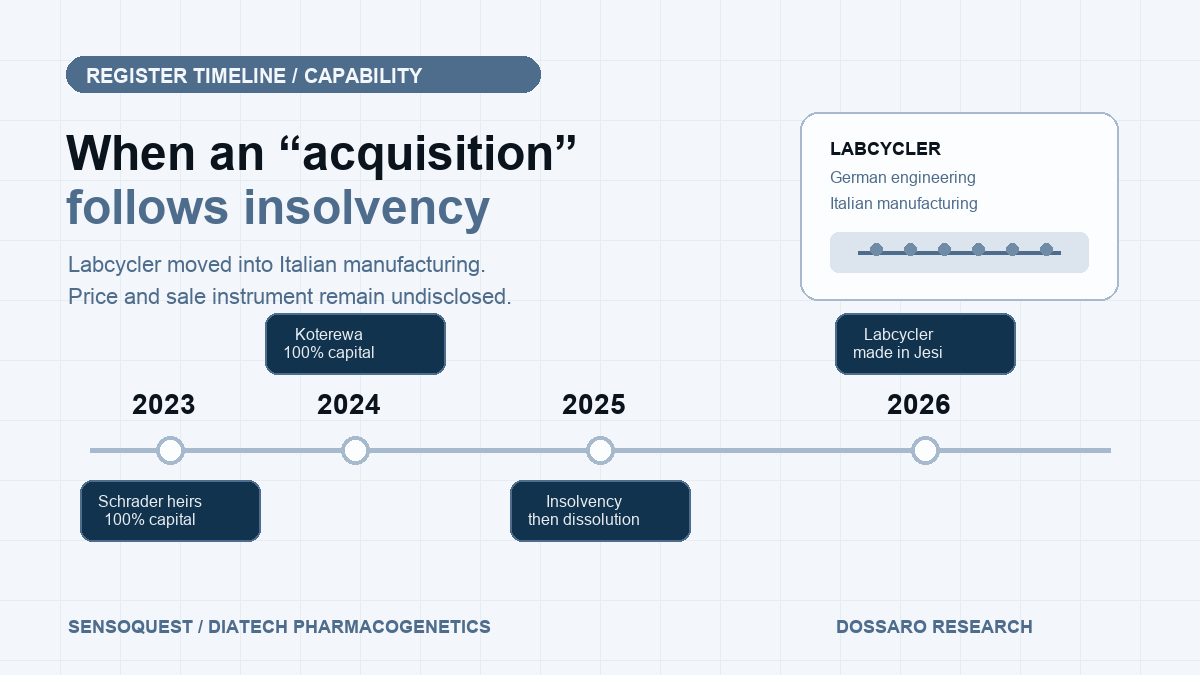
Diatech Pharmacogenetics says it acquired German SensoQuest and has moved Labcycler manufacturing to its Jesi facility. The timing in the German register makes that announcement more consequential than a routine product launch: SensoQuest had already entered insolvency proceedings in 2025, and the register later recorded a dissolution state. The supported finding is therefore narrower than the headline. Diatech clearly took over Labcycler’s manufacturing and development capability. The public record does not prove that it bought SensoQuest’s shares, what it paid, or what creditors recovered.
That distinction changes the economic story. A normal share acquisition would imply that an Italian diagnostics group bought a live German instrument company and inherited its corporate perimeter. The available evidence instead points to a post-distress transfer of a product and operating capability, with the legal instrument still open. For Diatech, the prize is a route from reagents and diagnostic kits into laboratory hardware. For the failed company’s former owners, creditors and counterparties, the value question is what survived the insolvency process and on what terms.
The product handover is public; the deal mechanics are not
The 22 October 2026 BusinessWire announcement describes Diatech’s move into laboratory instrumentation. It says Labcycler was originally developed by SensoQuest and is now manufactured at Diatech’s facility in Jesi, Italy. The release frames the transaction as an acquisition and says Diatech had already used and evaluated the product in its research and development work.
The Diatech product page is more specific about the operating result. It calls Labcycler “German engineering” with Italian manufacturing and says the platform was developed from original SensoQuest engineering. The page describes interchangeable 96 and 384-well thermoblocks, a claimed control accuracy of ±0.01 °C and a design tested for up to 600,000 cycles. Those specifications describe the product Diatech is selling. They do not identify the ownership of the underlying company, patents, inventory, customer contracts or employees.
Sanità33’s independent report repeats the acquisition wording and confirms that Labcycler, originally developed by the German company, is now produced in Jesi. Dealroom’s report describes the outcome as Diatech taking control of Labcycler’s design and development and says the terms were not disclosed. Together, those sources establish a product and capability transfer. None supplies a purchase price or a sale document.
SensoQuest’s legal timeline came first
The German register history for SensoQuest GmbH, Göttingen HRB 4298, creates the timing issue. The independent insolvency record identifies the same company and case number, 74 IN 96/25 GOE. It lists a security measure in July 2025 and the opening of proceedings on 11 September 2025. The Dossaro register extraction records the insolvency sequence in mid-2025, proceedings opened in September, and a dissolution by operation of law with a last register entry on 25 September 2025. Small date differences between a register entry and the court-publication page do not change the order of events.
| Event | Date or state | What it supports | What it does not prove |
|---|---|---|---|
| Preliminary insolvency protection | 30 June to 1 July 2025 in the available register and insolvency record | Distress was visible before the acquisition announcement | The value or outcome of any later sale |
| Insolvency proceedings opened | September 2025 | SensoQuest was in a formal insolvency process | That Diatech bought shares or the whole company |
| Last register entry and dissolution state | 25 September 2025 in the register extraction | The corporate vehicle was no longer a normal live operating target in the public record | That the Labcycler business or IP disappeared |
| Diatech acquisition announcement | 22 October 2026 | Diatech took over Labcycler manufacturing and development | Price, legal instrument, asset schedule or creditor recovery |
The timeline is the article’s central finding. Diatech’s announcement came roughly thirteen months after the insolvency opening and after the register’s dissolution entry. That does not make the announcement inaccurate. Companies and buyers often use “acquisition” as shorthand for buying a business line, assets or know-how from an insolvency process. It does mean that a reader should not silently translate the wording into a share purchase of a solvent company.
The last shareholder change was not a Diatech financing
The historical shareholder lists add another boundary. The 7 August 2023 list recorded all €25,000 of registered capital with the undivided inheritance community of Friederike Schrader and Nora Henrike Schrader. The 9 February 2024 list recorded the same 100% of capital with Katarina Koterewa and attributed the change to a share-purchase agreement dated 24 January 2024. The arithmetic is simple: each list represents 100% of the registered €25,000 capital at its respective date.
That history is useful because it prevents a second shortcut. Koterewa’s 2024 position was the last visible pre-insolvency ownership state in the evidence pack, but nothing in the available record proves that her shares were the asset Diatech acquired in 2026. The historical transfer and the later insolvency are separate events. Without a sale agreement, administrator notice or updated ownership filing, the article cannot name a seller or assign any proceeds.
Diatech is buying a route into instruments
The commercial logic is easier to see than the legal mechanics. Diatech has built its business around molecular-diagnostics reagents, kits and precision-medicine solutions. By taking Labcycler manufacturing and development into its Italian operation, it can sell an instrument alongside the consumables and workflows that use it. The product page positions the machine for research, diagnostic and biotechnology laboratories, while the release says Diatech operates commercially in more than 50 countries.
This is a capability expansion, not just a new SKU. A thermal cycler can sit at the front of the same laboratory workflow as Diatech’s assays and kits. Diatech gets control of a product with an existing engineering history, and customers can receive a more complete offer from one supplier. The benefit depends on the quality of the transferred know-how, the continuity of support and the ability to manufacture reliably in Jesi. The public sources support the handover and availability. They do not support a valuation of the product line or a forecast of sales.
The insolvency context also changes the counterparties’ diligence questions. A lab buying a Labcycler wants to know who now stands behind warranties, service and spare parts. A supplier wants to know which contracts, inventory and receivables moved. A creditor wants to know whether an asset sale generated a recoverable pool. Those are different questions from whether Diatech has announced a strategic product launch, and the announcement does not answer them.
The distinction is similar to the Grüngold asset-rescue case, where an operating asset could continue while the insolvent company and its creditor claims remained a separate economic problem. SensoQuest’s product handover should be read with the same separation between operating continuity and corporate recovery.
The benign reading still leaves a material gap
The strongest counter-reading is straightforward: Diatech or an insolvency administrator may have bought a functioning business or product line, and “acquired SensoQuest” is ordinary press shorthand. That explanation fits the public product result. It also explains why the announcement focuses on Labcycler’s manufacturing, development and availability rather than on a share count or a new Diatech subsidiary.
But the benign reading does not eliminate the economic gap. It leaves open whether the transaction was an asset purchase, a court-approved sale, a licence and manufacturing arrangement, or another structure. It also leaves open whether employees, patents, designs, inventory, customer agreements and warranty liabilities moved together. The absence of a disclosed price is not a reason to invent one; it is the reason to keep the finding at the capability-transfer level.
The next document should show what was bought
The next decision-changing source is likely to come from the insolvency process rather than another launch announcement. An administrator notice, court-approved sale document, asset-purchase agreement or Diatech filing could identify the transferred assets, consideration and liabilities. A later German register document could also show whether any shareholder state changed after the insolvency timeline, but it would not necessarily reveal an asset deal.
Until that evidence appears, the defensible conclusion is precise: Diatech moved Labcycler manufacturing and development from a German-origin product into its Italian operation after SensoQuest had entered insolvency and the register recorded dissolution. That gives Diatech a route from diagnostics consumables into laboratory instruments. It does not prove a share acquisition, a price, or a recovery for SensoQuest’s former owners and creditors.
Continue reading
Related Research
Biogeen Bought Pliening’s Biogas Plant From an Insolvency Estate
Biogeen acquired the Pliening biomethane plant from an insolvent operating KG, retaining six jobs while creditors remain exposed to estate recovery.
Skeleton’s Siemens Deal Puts an 11.25% Stake Beside an Exclusive Data-Centre Channel
Estonian filings list Siemens International Holding with 11.25% of Skeleton’s holding group as Siemens gains an exclusive data-centre sales channel.
Universal Quantum's $100m Round Entered a Negotiated Preference Stack
Universal Quantum's $100m Series A met existing preference, anti-dilution and participation rights, while post-round ownership remains undisclosed.
Bruker Bought Noscendo's Software, Not The Venture-Backed Company
After nearly €40m of venture funding, Noscendo entered insolvency. Bruker acquired DISQVER, patents and selected staff while the laboratory closed.