
Biogeen Bought Pliening’s Biogas Plant From an Insolvency Estate
Biogeen acquired the Pliening biomethane plant from an insolvent operating KG, retaining six jobs while creditors remain exposed to estate recovery.
On this page
Conduct your own private market research
Add dossaro to Claude or ChatGPT and run source-backed register research from your own workspace.
 Add to Claude
 Add to ChatGPT
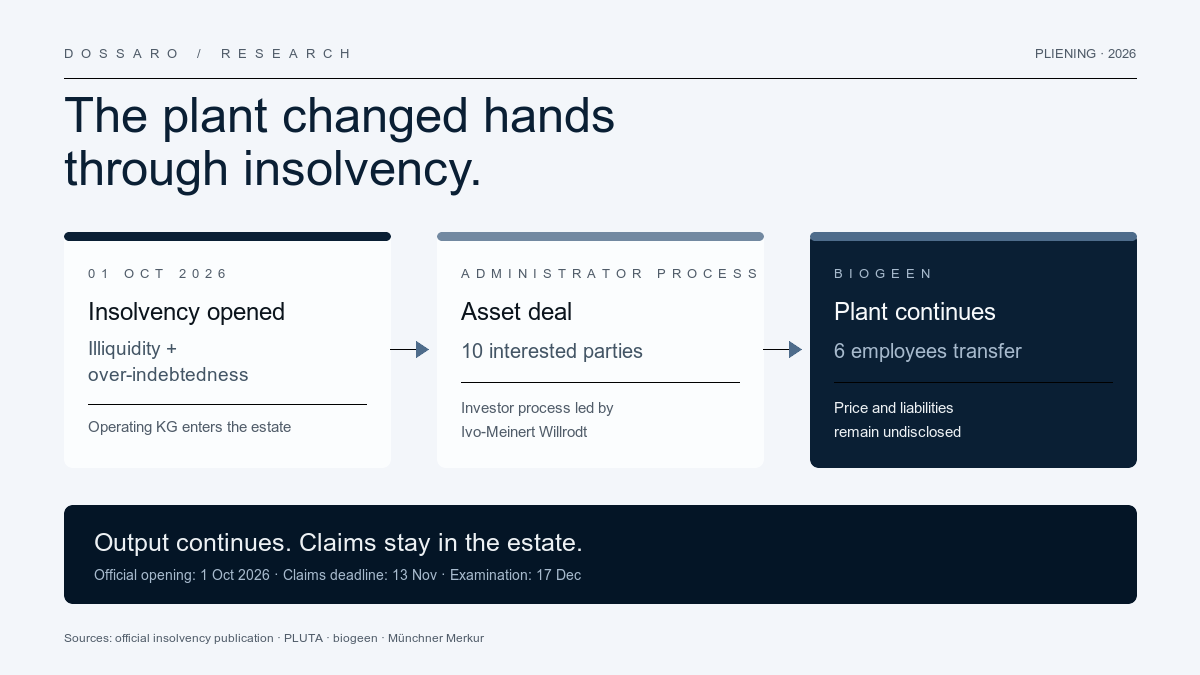
Biogeen’s acquisition of the Pliening biomethane plant is an operating-asset rescue from an insolvency estate, not a normal shareholder handover. The plant’s operating company entered formal insolvency on 1 October 2026 after the court recorded illiquidity and over-indebtedness. Nine days later, the administrator announced an investor solution that keeps the facility running and transfers all six employees to biogeen.
That sequence changes the commercial reading. The public deal material identifies an asset purchase and a continuing plant, but it does not disclose a purchase price, secured claims, the assets excluded from the perimeter or what any creditor will recover. Suppliers and farmers therefore face a different risk position from the business that continues on site: their claims remain inside the estate while the operating asset moves to a buyer.
The legal event came before the rescue announcement
The official insolvency publication for Grüngold Biogasanlage Pliening KG records proceedings opened by Amtsgericht Weilheim in Oberbayern on 1 October at 15:00. The stated grounds are Zahlungsunfähigkeit and Überschuldung, or illiquidity and over-indebtedness. The notice appoints Ivo-Meinert Willrodt as administrator and directs creditors to file claims by 13 November. The court set the creditors’ meeting and examination date for 17 December. An independent case page from InsoTicker reproduces the opening date, grounds and file number.
The notice describes the debtor’s business as setting up and operating biogas facilities to produce and deliver energy from biomass, including acquiring and processing inputs. It also names the personally liable partner chain in the legal notice. That establishes the operating entity and the formal procedure, but not a current shareholder map or which legal entity owns every item at the plant.
The timing matters because the later announcement can otherwise look like a clean strategic acquisition. It was not. The court process created a claims pool, an administrator and a set of deadlines before biogeen’s transaction was presented as the solution for the site.
An investor process converted a distressed operator into a continuing plant
In its 9 October announcement, PLUTA, the administrator’s firm, said it had completed an übertragende Sanierung, the German form of an asset transfer in an insolvency restructuring. The team said it had approached the market broadly and negotiated with ten interested parties. biogeen was the buyer named in the transaction announcement, and the six employees were to be taken on.
The buyer’s public message is about operating continuity. In biogeen’s purchase announcement, the company describes the purchase as a way to build on the existing Pliening structure and says it sees potential in the biomethane facility. PLUTA says the plant is one of Germany’s older biomethane facilities, producing biomethane and electricity from feedstock supplied by regional agricultural partners.
The deal language is important. It points to a transfer of an operating asset or business perimeter from the estate, rather than a disclosed purchase of the insolvent KG’s shares. There is no public evidence in the announcement set that the buyer assumed all historical liabilities of the operator. That is why “the plant continues” and “the creditors are paid” cannot be treated as the same outcome.
| Process milestone | What the public record establishes | Who remains exposed |
|---|---|---|
| 1 October 2026 | Proceedings opened for illiquidity and over-indebtedness; Willrodt appointed | The insolvent operating estate and its creditors |
| 9 October 2026 | PLUTA announced an investor solution after talks with ten parties | The estate still has to administer and verify claims |
| Transaction announcement | biogeen signed the purchase agreement for the biomethane plant | The asset perimeter and assumed liabilities are not disclosed |
| 13 November and 17 December 2026 | Claims deadline, then creditors’ meeting and examination date | Suppliers, farmers and other creditors await estate recovery |
Continuity for six employees does not settle supplier claims
The strongest human consequence is also the easiest to overstate. PLUTA says all six employees will transfer to biogeen. That is a concrete continuity result for the workforce at the facility. It is not evidence that every commercial relationship transfers on the same terms.
Independent reporting by the Münchner Merkur described farmers and other local suppliers waiting for thousands of euros after the operating company’s insolvency filing. The report said supplier, farmer and contractor claims were to be treated as insolvency claims and could be lodged after the proceedings opened. This is consistent with the official notice’s claim deadline, but it does not quantify the claims or predict a dividend.
The distinction is central to an asset rescue. A buyer can need the plant, staff and operating relationships to preserve output while leaving pre-opening liabilities to the estate. Feedstock contracts, maintenance obligations, power sales, land rights and permits may be essential to the continuing operation, yet the public announcement does not say which were assigned, renegotiated or excluded. Nor does it identify any secured lender or priority claim.
For the local agricultural suppliers, the transfer therefore creates an uneven outcome. The facility has a buyer and employees have a reported path to continued work. The people who supplied biomass before the opening date still need the administrator to verify their claims and distribute whatever the estate ultimately realizes.
The administrator’s higher-quote claim is not a payout forecast
Willrodt said the investor solution was beneficial for creditors because it would produce a higher insolvency quota. That is an administrator’s assessment of the agreed solution, not a published percentage or a promise of payment. The announcement gives no purchase price, valuation, claims schedule, secured-debt balance or distribution calculation.
The difference between a higher expected quota and a known recovery is the point. The estate may receive proceeds from the transferred business, but those proceeds will be allocated through the statutory insolvency process after claims, security rights and costs are assessed. The public facts do not show whether the sale covers operating liabilities, secured claims or only a portion of unsecured claims.
This is the same boundary visible in other German rescue transactions. KMB’s Mutares-backed insolvency transfer shows why a new operator and a continuing business do not automatically identify the creditors’ recovery. Freqcon’s asset rescue similarly separates the continuing operating platform from the liabilities left behind. Pliening adds a renewable-energy setting in which local suppliers can be economically important even when they do not control the plant.
What the public record still cannot answer
The transaction has a clear first-order shape: an operating KG entered a court-supervised insolvency process, an administrator ran an investor process, and biogeen took the plant with six employees continuing. That is enough to call the event an insolvency asset rescue. It is not enough to reconstruct the economics of the sale.
The missing questions are practical. What exactly did biogeen buy: the plant equipment, permits, contracts, land rights, inventory, or a combination? Which liabilities did it assume, if any? What consideration was paid to the estate? How much of the estate’s creditor pool is secured, and what amount will remain for unsecured suppliers? The public sources do not answer those questions.
The next document to watch is therefore not another announcement. It is the executed purchase agreement or a later administrator report that describes the transferred perimeter, consideration and claims outcome. The 17 December examination meeting may provide a first public update, but it may still stop short of a final distribution account.
For now, the evidence supports a narrow but consequential conclusion. Pliening’s biomethane operation found a new operator through insolvency, preserving the plant’s six jobs and its energy output. The rescue moved the productive asset forward. It did not erase the old operator’s liabilities, and the recovery available to its suppliers and other creditors remains an estate question.
Continue reading
Related Research
KmB's Mutares Control Chain Was Still Intact When Insolvency Hit
KmB moved from EMAG and Scherer to Mutares' wholly owned FERRAL vehicle before its October 2026 provisional insolvency, clarifying who sat above the risk.
Freqcon's €1.7m Rescue Left The PE-Backed Company Behind
Amper paid €1.7m for Freqcon's operating assets, moving jobs into a €25,000 vehicle while the former PE-backed company stayed in insolvency.
Bruker Bought Noscendo's Software, Not The Venture-Backed Company
After nearly €40m of venture funding, Noscendo entered insolvency. Bruker acquired DISQVER, patents and selected staff while the laboratory closed.
Diatech’s SensoQuest Deal Follows Insolvency and Dissolution
Diatech says it acquired SensoQuest, but German filings show insolvency and dissolution came first, leaving Labcycler’s business transfer and creditor outcome unpriced.