
Pollmann's Restructuring Is Concentrated in Three Austrian Entities
Pollmann put three Austrian entities into restructuring while foreign subsidiaries and Maxxom continue, making it an entity-ring-fenced reset for the auto supplier.
On this page
Conduct your own private market research
Add dossaro to Claude or ChatGPT and run source-backed register research from your own workspace.
 Add to Claude
 Add to ChatGPT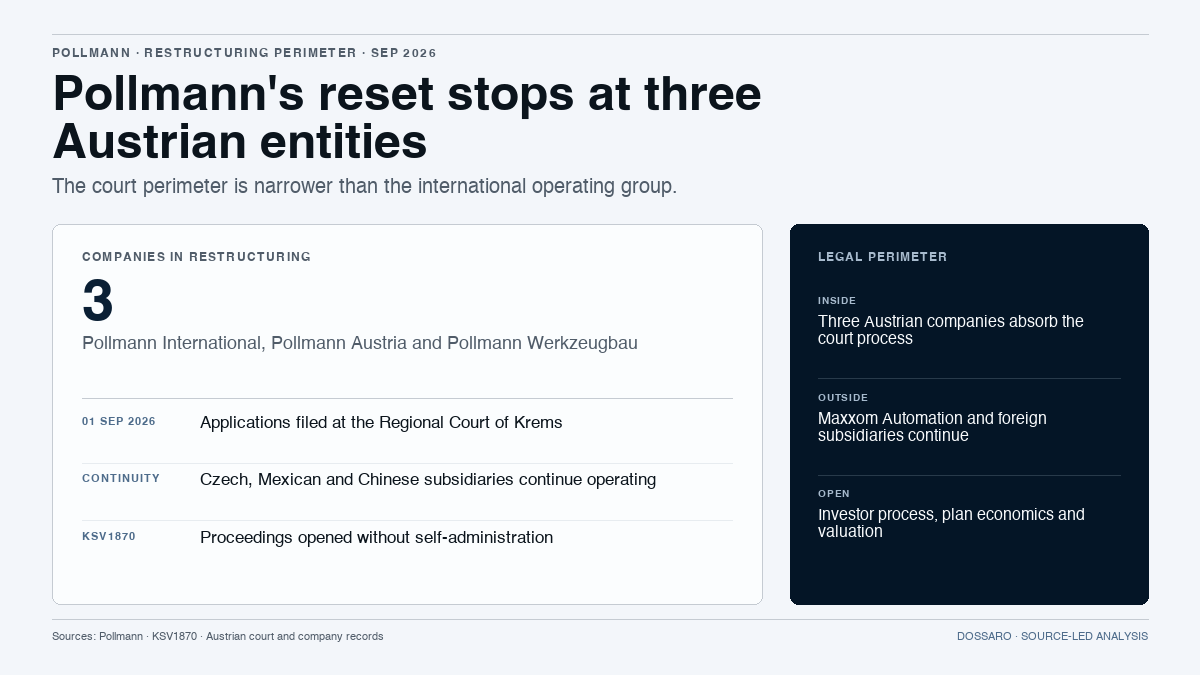
Pollmann’s restructuring is concentrated in three Austrian companies, while the group says its Czech, Mexican and Chinese subsidiaries and Maxxom Automation continue operating. That legal boundary makes the event a potential continuity and carve-out process, not a simple shutdown of the international automotive supplier.
Pollmann International GmbH, Pollmann Austria GmbH and Pollmann Werkzeugbau GmbH applied to the Regional Court of Krems an der Donau on 1 September 2026 for restructuring proceedings. The company says production will continue without interruption. The independent KSV1870 insolvency record confirms that proceedings were opened for the three Austrian entities and classifies them as restructuring proceedings without self-administration.
The commercial question is therefore not only whether Pollmann is distressed. It is which part of Pollmann is being asked to absorb the reset, which operating assets remain outside the Austrian court perimeter, and whether the structured investor process can preserve a functioning supplier platform.
The court perimeter is narrower than the group
Pollmann’s announcement names three Austrian legal entities. It also says that the subsidiaries in the Czech Republic, Mexico and China are not affected by the Austrian proceedings, as is Maxxom Automation GmbH. The wording is unusually important for customers and suppliers because it separates the entities in court from the wider production and automation network that the group says continues.
| Entity or perimeter | Publicly reported position | Commercial consequence |
|---|---|---|
| Pollmann International GmbH | Austrian proceeding; the group’s holding and coordination layer | Management, financing and shared functions sit inside the court process |
| Pollmann Austria GmbH | Austrian proceeding; largest Austrian production operation | Customer delivery and plant continuity depend on the restructuring plan |
| Pollmann Werkzeugbau GmbH | Austrian proceeding; tooling operation | Tooling capacity is inside the same reset as the production entities |
| Czech, Mexican and Chinese subsidiaries | Described by Pollmann as unaffected | Foreign operations remain outside the announced Austrian court perimeter |
| Maxxom Automation GmbH | Described by Pollmann as unaffected | The automation business is not named as one of the three applicants |
KSV’s case record describes Pollmann International as the group holding company with management and financing functions, while Pollmann Austria operates the largest production site and Pollmann Werkzeugbau handles tooling. That distinction prevents a common analytical error: treating the three Austrian applicants as if they were interchangeable operating companies or as if every Pollmann asset were in the same proceeding.
The public record also says that Pollmann International’s property in Karlstein is leased to Pollmann Austria and Pollmann Werkzeugbau. KSV records that the tooling business was transferred into Pollmann Werkzeugbau in 2022 and the plant-engineering business into Maxxom Automation in the same year. Those historical transfers help explain why Maxxom can be described as outside the current proceedings even though it remains part of the broader Pollmann network.
A restructuring plan is being built around continuity
Pollmann says the objective is to keep all three companies operating and production moving without interruption. The announcement says the works council and the Chamber of Labour have been closely involved because a large number of employees are affected. KSV identifies Dr. Christoph Sauer as the insolvency administrator for Pollmann International and says the proceedings are without self-administration, meaning management does not retain the full legal autonomy of a self-administered process.
That combination creates a practical split between operational continuity and financial control. Employees, customers and suppliers may continue to see the same factories and products, while the court process changes who must approve or supervise the restructuring steps. The company’s statement is therefore not a promise that the existing ownership or financing model survives. It is a statement that the operating plan is intended to survive the court filing.
Pollmann’s products are used across the international automotive industry, including components and assemblies for major vehicle brands. A supplier can remain operational while still presenting material counterparty risk: payment terms, tooling ownership, inventory funding and the treatment of intercompany services all matter even if a plant does not stop. The public sources do not quantify those exposures, so the safe conclusion is limited to the stated continuity objective and the legal perimeter.
The investor process is part of the restructuring, not a disclosed sale
Pollmann says a structured investor process is running in parallel with the court proceedings. It also identifies the sale of non-operating real estate, consolidation or relocation of operations to Karlstein, and a change in senior management as measures in the broader realignment.
Those actions point toward a balance-sheet and operating reset rather than a liquidation announcement. The investor process may be designed to recapitalise the Austrian entities, bring in a buyer for selected assets, or create a new ownership solution for the continuing business. But no source used here names an investor, gives a sale price or allocates assets between the Austrian applicants and the foreign subsidiaries.
The real-estate sale is similarly bounded. Pollmann describes the property as non-operating, which suggests an attempt to release capital without selling the production platform itself. It does not establish how much cash the sale could generate, whether the property is encumbered, or how proceeds would be shared among creditors and operating entities.
For a buyer, the distinction between a plant, a tooling company, a group holding company and an unaffected foreign subsidiary is the diligence work. The legal boundary is not a valuation. It is a map of where court approval, creditor negotiations and any investor transaction must occur.
Why the foreign subsidiaries matter
Pollmann’s statement that Czech, Mexican and Chinese subsidiaries continue is economically meaningful because automotive suppliers are organised around cross-border production and customer programmes. The foreign companies may have their own employees, contracts and local cash flows, while still relying on Austrian engineering, tooling, procurement or management services. The sources do not describe those dependencies, so the announcement cannot support a claim that the foreign businesses are insulated from every consequence.
The narrower reading is more useful. The foreign subsidiaries are outside the announced Austrian proceedings, and Pollmann says they continue production. That gives customers and potential investors a starting perimeter for diligence: which legal entity holds a customer contract, which entity owns a tool, which company invoices the programme and which services flow from the Austrian holding layer?
Maxxom Automation is an especially important boundary. Pollmann explicitly says it is unaffected, while KSV records that the plant-engineering business was transferred to Maxxom in 2022. The current filing therefore does not automatically pull every automation asset into the Austrian restructuring. Any buyer or creditor analysis that treats Maxxom as an applicant would go beyond the public record.
The automotive downturn is the company’s stated explanation
Pollmann attributes the need for restructuring to a lasting structural transformation in the European automotive industry. Its release says global production continues to grow, but pressure is concentrated in the European market. KSV separately attributes the proceedings to an industry-wide sales crisis among automotive suppliers.
That explanation is a sector framing, not a quantified diagnosis of Pollmann’s finances. The public sources do not provide a bridge from customer volumes, pricing or plant utilisation to the need for court protection. They do show the operational response: management change, site consolidation, relocation to Karlstein, real-estate monetisation and an investor process.
The distinction matters for stakeholders. A sector-wide downturn can explain why a supplier seeks time and new capital, but it does not tell creditors which assets are worth preserving or customers which legal entity will carry future obligations. The court documents and any investor offer will have to answer those questions.
What the public record still cannot answer
The available sources establish the applicants, the stated continuity objective, the unaffected perimeter and the broad measures being pursued. They do not identify the investor, the proposed ownership structure, the value of the real estate, creditor recoveries, intercompany balances or the treatment of the foreign subsidiaries if the Austrian plan fails.
They also do not establish whether Pollmann International’s shareholders will retain an economic stake, whether the investor process is a sale or a recapitalisation, or whether the Austrian entities will emerge as one group or as separate businesses. The fact that two shareholders are listed in the Austrian EVI record does not answer those post-process questions.
The next documents to watch are the Austrian court filings and any investor or restructuring plan that allocates the assets and liabilities across Pollmann International, Pollmann Austria and Pollmann Werkzeugbau. The foreign subsidiaries and Maxxom should be tracked separately because the company has drawn that perimeter itself.
Pollmann’s restructuring is therefore best read as an entity-ring-fenced attempt to preserve an automotive supplier platform. Three Austrian companies are in court, while foreign production and automation remain outside the announced proceedings. That separation may create the option for a targeted investor solution, but it also makes the eventual allocation of assets, contracts and creditor value the central unresolved issue.
Sources
- Pollmann’s restructuring announcement identifies the three Austrian applicants, continuing production, unaffected foreign subsidiaries and Maxxom, the sector explanation, management change, relocation, real-estate sale and investor process.
- KSV1870 case record for Pollmann International independently confirms the 1 September opening, the no-self-administration procedure, the court, administrator and the roles of the three Austrian entities.
- Austrian EVI record for Pollmann International identifies Firmenbuch 275135k, the Karlstein seat, the two listed shareholders, management and the September 2026 insolvency entry.
- This analysis also links to Lowell’s creditor-equity and DACH carve-out, Sowitec’s minority-stake insolvency and Cycles Lapierre’s rescue liability wall for related restructuring and transaction-perimeter context.
Continue reading
Related Research
Lowell's Recapitalisation Offers Creditors the New Parent as Orlando Takes DACH
Lowell's 2026 reset offers creditors conditional new-parent equity while Orlando buys its DACH platform, linking debt relief to a cross-border carve-out.
Frank Hummel and Vestas Were SOWITEC's Last Visible Owners
The latest visible SOWITEC owner list showed Frank Hummel at 74.91% and Vestas' vehicle at 25.09% when four core group companies entered insolvency.
Cycles Lapierre Had €108m Due Within A Year After Its €60m Rescue
Cycles Lapierre reported €108.2m due within one year and €45.7m of negative equity after a €60m rescue, exposing its dependence on Accell funding.
IFX Technologies Rebuilt Intelligent Fluids' Ownership Perimeter
IFX Technologies emerged from intelligent fluids' restructuring with a €30,096 capital base and a new 33.33% Heing SPV stake, not the old investor map.