
Ominimo's Polish Expansion Lost PLN 415,000 In 2025
Ominimo says Hungary has been profitable since launch, while its first Polish accounts show a PLN 415,000 loss, negative equity and liabilities above assets.
On this page
Conduct your own private market research
Add dossaro to Claude or ChatGPT and run source-backed register research from your own workspace.
 Add to Claude
 Add to ChatGPT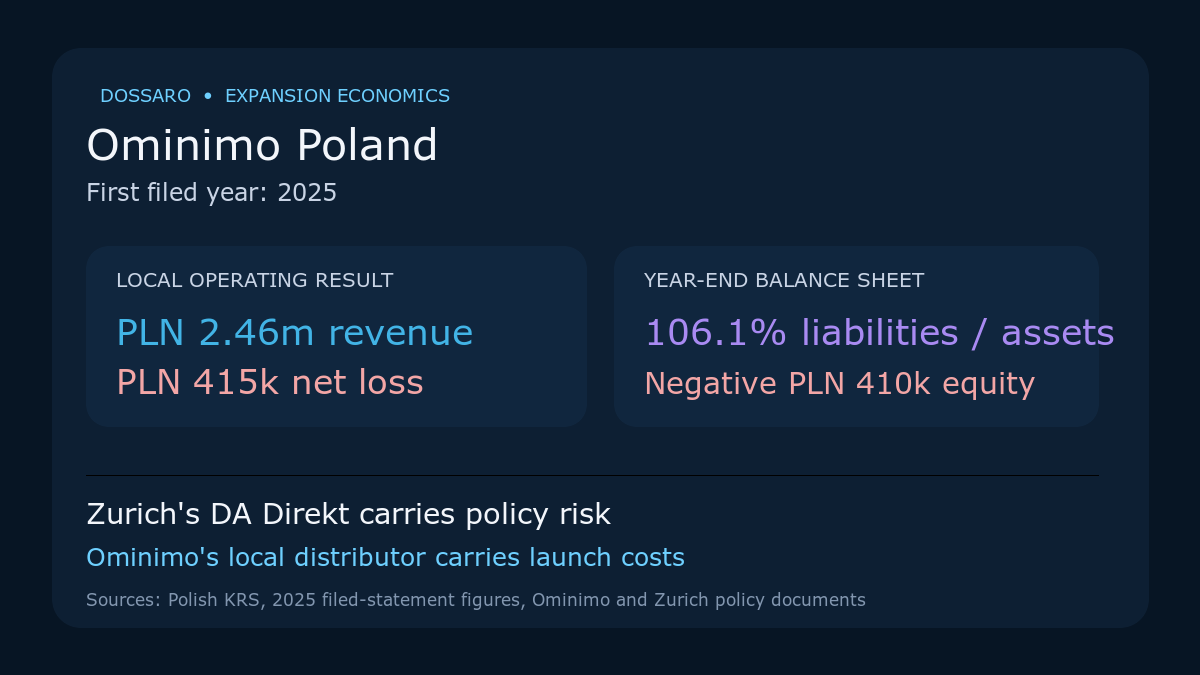
Ominimo Poland generated PLN 2.46 million of revenue in 2025 and lost PLN 414,634. The motor-insurance distributor ended its first filed year with negative PLN 409,634 equity and PLN 7.12 million of liabilities against PLN 6.71 million of assets.
Those figures add a market-level test to Ominimo's fresh unicorn story. On 27 July, the company announced a Series B led by the venture arm of the European Bank for Reconstruction and Development. The Next Web reported a €20.1 million round at a €1.4 billion valuation and said Ominimo has been profitable in Hungary since launch.
Poland shows why that profitability needs a geographic qualifier. The Polish subsidiary's 2025 result does not describe the Ominimo group, and a first-year loss can be normal launch investment. It does show that a capital-light insurance platform can transfer underwriting risk to a partner insurer without transferring away the cost of entering a new market.
For private-market investors, that is the important financing question. Ominimo can expand without building a regulated insurance balance sheet in every country, but each local distributor still has to fund people, distribution and operations until the market reaches break-even.
Poland Was Not Profitable In Its First Filed Year
Ominimo Poland sp. z o.o. was incorporated on 9 September 2024. Its first financial statement, covering the period through 31 December 2025, was filed on 28 May 2026.
BizRaport's figures derived from that statement show PLN 2,462,997 of revenue and a PLN 414,634 net loss. Operating costs were PLN 2,815,185, including PLN 1,387,537 of employee compensation.
| Ominimo Poland 2025 measure | Filed-statement figure | Decision-relevant reading |
|---|---|---|
| Revenue | PLN 2,462,997 | The subsidiary had begun commercial operations |
| Operating costs | PLN 2,815,185 | Launch costs exceeded the first year's revenue |
| Net result | PLN -414,634 | Net margin was approximately -16.8% |
| Employee compensation | PLN 1,387,537 | People costs represented 49.3% of operating costs |
The revenue base matters because this was not a dormant shell absorbing only incorporation costs. The Polish business was trading, employing people and generating premiums-related distribution activity. It had not yet converted that activity into a local accounting profit.
That finding is narrower than saying Ominimo is unprofitable. Ominimo's own Series B announcement says its risk analysis allows the company to grow while remaining profitable, while contemporary coverage specifically says it has been profitable in Hungary since launch. The Polish filing establishes a different result for one expansion market in its first reporting period.
| Public or filed layer | Period or date | What it supports |
|---|---|---|
| Ominimo group announcement | 27 July 2026 | Series B led by the EBRD venture arm and a $1.6bn valuation |
| Independent round coverage | 27 July 2026 | €20.1m round, approximately €1.4bn valuation and Hungary profitability claim |
| Ominimo Poland accounts | Through 31 December 2025 | PLN 414,634 local net loss |
| Ominimo Poland filing | 28 May 2026 | First Polish statement entered the public record |
The two layers can both be true. Ominimo can have a profitable home market and still spend ahead of revenue in Poland. The commercial issue is how repeatable and financeable that launch curve is across the six additional European and US markets the company says it plans to enter.
Zurich Carries The Policy Risk, Ominimo Carries The Launch
The Polish operating model separates the regulated insurer from the technology and distribution platform.
Ominimo's policy document identifies DA Deutsche Allgemeine Versicherung Aktiengesellschaft, trading as DA Direkt, as the insurer. It identifies Ominimo Poland as an insurance agent, distributor and DA Direkt's main representative in Poland. The official full Polish register extract gives insurance-agent and broker activity as the subsidiary's principal business.
Zurich's partnership announcement describes the same division of roles. DA Direkt contributes insurance expertise and the regulated carrier. Ominimo contributes pricing, technology and distribution. Zurich also took a minority stake in Ominimo when the partnership was announced in April 2025.
| Economic function in Poland | Party | Evidenced role |
|---|---|---|
| Insurance contract and policy risk | DA Direkt | Named insurer in Ominimo's Polish policy document |
| Pricing, distribution and customer interface | Ominimo Poland | Agent, distributor and main representative |
| Technology and market-expansion platform | Ominimo group | Company-described pricing and software model |
| Local operating result | Ominimo Poland | PLN 414,634 loss for 2025 |
The takeaway is not that Ominimo avoids risk altogether. It carries technology, pricing, distribution and execution risk. The narrower point is that claims risk sits with DA Direkt, while the cost of making Poland operational still appeared in Ominimo's local company.
This division helps explain the speed of expansion. A distributor does not need to capitalise a full insurer before selling its first policy in each market. That can produce attractive capital efficiency at group level. It can also scatter launch losses and funding needs across local subsidiaries below the valuation headline.
Liabilities Exceeded The Polish Asset Base
Ominimo Poland's year-end balance sheet makes the local funding structure visible.
Assets totalled PLN 6,710,086. Liabilities and provisions totalled PLN 7,119,721, equal to 106.1% of assets. The resulting negative equity was PLN 409,634, the same amount as the gap between liabilities and assets.
| Ominimo Poland balance sheet | 31 December 2025 | Translation |
|---|---|---|
| Total assets | PLN 6,710,086 | Local operating asset base |
| Liabilities and provisions | PLN 7,119,721 | 106.1% of assets |
| Equity | PLN -409,634 | Liabilities exceeded assets by the year's accumulated shortfall |
| Registered share capital | PLN 5,000 | Unchanged since incorporation |
The negative equity should not be read as proof of group-level distress. The subsidiary sits inside a larger structure, and the public summary does not identify how much of the liability balance came from related parties, suppliers, customers or other creditors.
It does show that the Polish operation was not financed through a large increase in registered local equity. The official register keeps share capital at PLN 5,000 from incorporation through the latest state. The next useful document is therefore the full financial statement with notes, which should identify related-party balances and explain how the local loss was funded.
This resembles the analytical distinction in Dossaro's review of QUICKBLOCK's equity-and-grant recapitalisation: the headline financing describes group-level support, while the operating balance sheet shows where risk and accumulated cost actually sit. Ominimo's business and instruments are different, but the underwriting discipline is the same.
The Polish Company Sits Below A Cyprus Holding Company
The official full KRS extract names Ominimo Holding Ltd in Nicosia, Cyprus, as the owner of all 100 shares in Ominimo Poland. That ownership has remained unchanged since the subsidiary was incorporated.
For a repeatable target-list check, the KRS agent workflow resolves the Polish entity, preserves the current or full extract and keeps unavailable document evidence separate from the ownership statement.
The structure places the Polish operating result below a foreign holding company. It does not establish where the Series B shares were issued, which entity received the €20.1 million or how the new money will be distributed across expansion markets.
Those distinctions matter because a local balance sheet and a group valuation measure different layers. The Polish company records the revenue, cost and liabilities of entering Poland. The unicorn valuation reflects the platform's technology, data, distribution footprint and expected expansion economics across multiple countries.
Investors therefore need two views at once. The group may deserve a high price for rapid premium growth and a model that avoids insurer capital in each country. The local accounts still determine how much cash each expansion consumes before it contributes profit back to that group.
A First-Year Loss Can Be The Cost Of Expansion
Ominimo launched in Poland with Zurich in 2025. A PLN 414,634 loss during the first reporting period can be consistent with a deliberate market-entry plan, particularly when staff and distribution have to be built before the customer base reaches scale.
The company's broader operating metrics provide the optimistic case. The Next Web reports annualised gross written premium rising from €26.3 million in 2024 to €157.8 million in 2025 and close to €307 million in 2026 across nearly one million customers. Those are company-level operating figures, not revenue or profit in the Polish statement.
The Series B also gives Ominimo more capacity to absorb launch costs while entering additional markets. The public sources do not allocate any of that capital to Poland, but the group-level financing means one local first-year loss need not threaten the expansion strategy.
The investment case depends on the next step. The Next Web reports that part of the funding will support an insurance licence. Carrying policy risk itself could let the company retain economics currently shared with partner insurers, but it would also introduce regulatory capital requirements and claims exposure that the Polish distributor does not currently carry.
The Next Accounts Will Test The Expansion Model
Ominimo's Polish filing changes the meaning of "profitable expansion." The group can be profitable in Hungary while one new market loses money. Zurich can carry the insurance risk while Ominimo's local company carries the operating cost of launch.
The 2025 figures put numbers on that distinction: PLN 2.46 million of revenue, a PLN 414,634 loss, negative PLN 409,634 equity and liabilities equal to 106.1% of assets. They do not establish consolidated group performance or explain the full liability balance.
The next Polish statement will show whether the loss was a short launch phase or a recurring cost of the model. Its notes should also reveal whether group funding, supplier credit or another source carried the subsidiary through that phase.
For investors paying €1.4 billion for Ominimo's expansion engine, the decisive operating measure is not whether every country is profitable on day one. It is how quickly each local company can move from liability-funded launch costs to durable profit before the next wave of markets demands the same capital again.
Continue reading
Related Research
QUICKBLOCK's £940k Funding Was Also A Recapitalisation
QUICKBLOCK raised £940,000 after reporting £534,213 of net liabilities. Filings map £638,571 to equity, leaving about £301,429 as implied grants.
PaperShell's €40m EU Grant Leaves A €43m Financing Test
PaperShell's signed 2025 annual report links an €83m factory and €40m EU grant to a planned IPO, while private capital must still fund roughly half.
FINN's €140m Round Shows The Financing Stack Behind A Mobility Unicorn
FINN's 2025 shareholder lists show a 17.2% wider share base, Planet First's 18.8% block and a new Picus vehicle before the €140m Series D round.
Spain Put Its Monitoring Director On Multiverse's Board
Spain committed up to €166.2m to Multiverse Computing across two rounds and placed a SETT monitoring director on its board before the €500m raise.