
Everything Technologies' Liquidation Turns £1.74m Capital Into an IP Recovery Test
Everything Technologies is selling software after a CVL. Filings show £1,743,805 of called-up capital, £1,494 cash realization and uncertain IP value.
On this page
Conduct your own private market research
Add dossaro to Claude or ChatGPT and run source-backed register research from your own workspace.
 Add to Claude
 Add to ChatGPT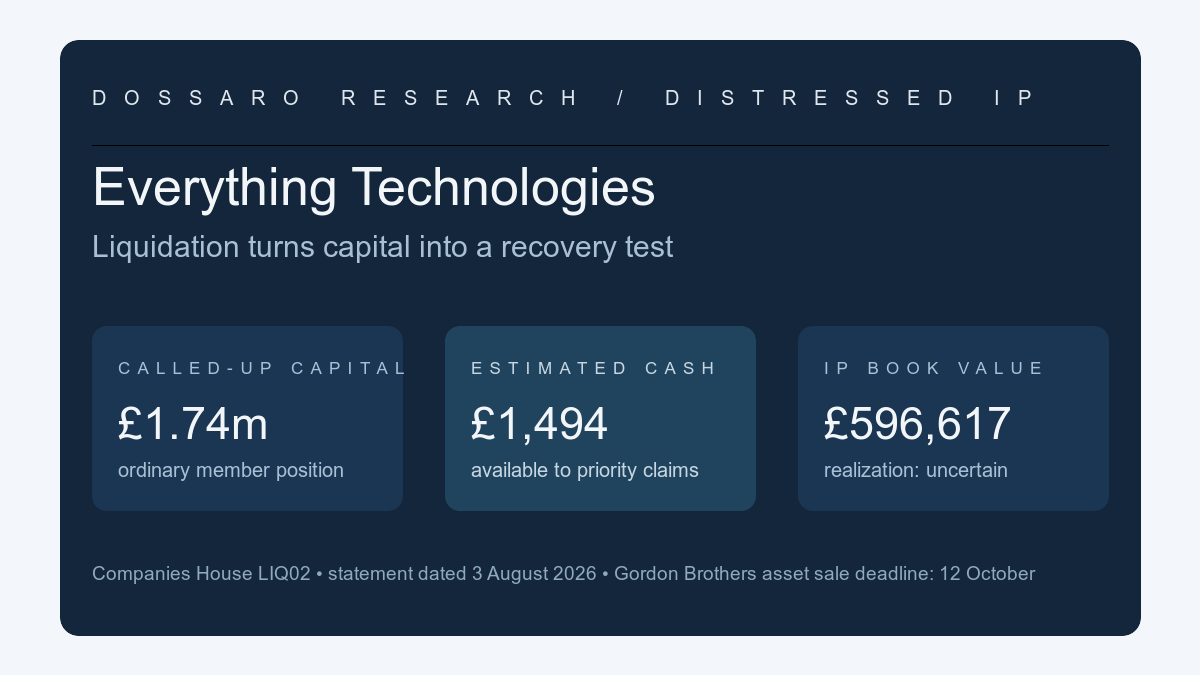
Everything Technologies is being marketed as an asset opportunity, but its Companies House filings describe a much harder economic question: what can a software vehicle recover after its capital has been called up and its operating company has entered creditors' voluntary liquidation?
Gordon Brothers is seeking a buyer for the company's proprietary software, brand assets, intellectual property, domains, documentation and know-how. Its deadline for final offers is 12 October 2026, and bidders must provide proof of funding. The sale page is an acquisition brief, not a valuation. The Companies House LIQ02 statement supplies the missing downside context: a liquidator's statement dated 3 August lists £1,743,805 of issued and called-up ordinary capital, but estimates only £1,494 of cash available to preferential creditors. The company's £596,617 book value for intellectual property is marked “Uncertain”.
That makes this more than a distressed software sale. It is a test of whether a financed intangible-asset company can transfer useful technology to a new owner while leaving its capital history and creditor claims behind.
The sale notice and the liquidation notice answer different questions
Gordon Brothers' private-treaty notice says the assets were developed for a digital rewards and customer-engagement platform. It highlights an established software platform, registered intellectual property, trade marks, brand assets, domain names and supporting technical material. The buyer is invited to acquire assets that could accelerate product development or expand digital customer engagement.
The notice does not say how much the business raised, why it failed or what creditors will recover. It is written for a strategic buyer evaluating a package of assets. It also says further information is available under a signed NDA, which means the public notice is deliberately not a full diligence room.
The independent K2 Partners liquidation notice supplies the procedural frame. Everything Technologies Ltd, company number 13359142, entered a creditors' voluntary liquidation with Gareth David Wilcox and Louise Williams of Opus Restructuring LLP appointed on 11 August 2026. The Companies House profile now records the company as in liquidation and identifies its business as software development. The company was incorporated on 27 April 2021 and was previously named Lit Technologies Ltd.
Together, the sources establish a live asset process after a formal insolvency event. They do not establish a completed sale, a buyer, an enterprise valuation or a reason for failure.
The liquidation statement puts the recovery asymmetry in numbers
The LIQ02 statement of affairs is the clearest public view of the estate. It is dated 3 August 2026 and signed by Simon Luhr as the person providing the statement. The liquidators' summary distinguishes book value from expected realization.
| Liquidation line | Amount | What it means |
|---|---|---|
| Issued and called-up ordinary capital | £1,743,805 | Capital recorded for the member position, not cash available for distribution |
| Intellectual property book value | £596,617 | Accounting value; estimated realization is marked “Uncertain” |
| Cash at bank | £5,038 | Only £1,494 estimated to be realized |
| Total assets available to preferential creditors | £1,494 | Estate value before the priority waterfall, on the filed estimate |
| Listed creditor claims | £80,058.51 | HMRC, pension, loan, trade and employee claims listed in the statement |
| Estimated deficiency as regards members | £1,822,369 | Filed estimate after the listed liabilities and capital position |
The ratio between called-up capital and estimated cash realization is stark. £1,494 is about 0.086% of £1,743,805. That is not a recovery rate for investors, because the two figures describe different things. Called-up capital is a member-side capital figure. Estimated cash realization is what the liquidator expects to have available from the listed assets. The comparison is useful as a measure of the gap between the legal capital record and immediately realizable cash, not as proof of what any investor will receive.
The statement also lists £45,510 of HM Revenue and Customs claims, £5,176.10 of employee claims, a £7,371 loan claim and £21,501 of trade claims. It records no assets specifically pledged and no floating-charge debt. The public filing therefore shows a small, unsecured creditor pool competing with an IP line whose sale value remains unresolved.
The capital path was built in stages, then the denominator stopped helping
The capital record is not a single last-minute entry. Four SH01 filings received by Companies House on 6 October 2025 show a sequence of ordinary-share allotments, with a replacement filing capturing the May 2024 entry.
| Allotment date | Shares allotted | Filing detail |
|---|---|---|
| 29 February 2024 | 103,000 | Ordinary shares, £1 nominal value and £1 paid per share |
| 1 May 2024 | 385,000 | Replacement filing records £385,000 paid including premium; original filing was replaced for an incorrect amount |
| 1 January 2025 | 100,000 | Ordinary shares, £1 nominal value and £1 paid per share |
| 1 June 2025 | 483,148 | Ordinary shares, £1 nominal value and £1 paid per share |
The visible allotments sum to 1,071,148 shares. The replacement May 2024 filing also reports a statement-of-capital total of 1,778,605 shares, while the other electronic returns report 1,843,605. The later LIQ02 reports 1,743,805 ordinary shares held by Lit Tech Holding Ltd. These totals do not reconcile cleanly from the public filings. The article therefore preserves the discrepancy rather than presenting a false single chronology.
The filed member schedule names Lit Tech Holding Ltd as the sole member in the LIQ02, with 1,743,805 ordinary shares of £1 each. That establishes the member recorded in the statement. It does not by itself establish the ultimate beneficial owners behind that holding company.
The 2024 micro-entity accounts provide another checkpoint. They report £582,532 of fixed assets, £49,078 of current assets and £576,718 of net assets at 31 December 2024. Those accounts were approved on 27 October 2025, before the liquidation statement. The later LIQ02 is not a restated set of accounts. It is a liquidation estimate prepared for the insolvency process, with the IP realization explicitly left uncertain.
The buyer can buy the useful layer without buying the old financing
For a strategic buyer, the sale package may be attractive precisely because it is narrower than a company acquisition. The public list includes software, trade marks, domains, technical documentation and know-how. A buyer can evaluate those assets, negotiate access to confidential materials under an NDA and bid for a transfer from the liquidator. The buyer does not need to assume that the £1.74m capital record represents current enterprise value.
That is the commercial separation at the centre of this case. A company can have a substantial called-up capital figure and still present an asset sale in which cash is scarce and the most important intangible is hard to price. In a transaction, the buyer's underwriting question is whether the platform, code, data rights, brands and documentation can produce value after transfer. The creditor question is how much the estate realizes and how the proceeds move through priority claims. The member question is whether anything remains after those claims. Public filings do not merge those questions into one price.
The distinction resembles other distressed transfers tracked on Dossaro. Noscendo's selective asset sale shows why a buyer's perimeter can be different from the failed company's legal perimeter. Dorma-Glas's prepared successor structure is a reminder that continuity claims need a documented transfer path. And Qarma's recapitalization demonstrates how a capital reset can change economic control without proving what every historical investor recovered.
What the public record still cannot answer
The strongest evidence is also bounded. The Gordon Brothers page gives a final-offer deadline, not a transaction result. The LIQ02 gives an estimate, not a final distribution. The public filings do not identify the cash proceeds of the asset sale, name a buyer, explain why the company failed, or connect each allotment to a specific investor. They also do not establish ultimate beneficial ownership of Lit Tech Holding Ltd.
The next decision-changing documents are a completed sale notice or liquidator report, a later statement of affairs or receipts-and-payments filing, and any capital filing that explains the difference between the SH01 totals and the 1,743,805 shares reported in the LIQ02. Until one of those appears, the defensible finding is narrower and more useful: Everything Technologies built a materially capitalized ordinary-share vehicle, entered CVL, and is now testing whether uncertain IP can produce value where the estate's immediately realizable cash is only £1,494.
That is why this should be read as a financed-company unwind, not simply as another software asset listing.
Continue reading
Related Research
Bruker Bought Noscendo's Software, Not The Venture-Backed Company
After nearly €40m of venture funding, Noscendo entered insolvency. Bruker acquired DISQVER, patents and selected staff while the laboratory closed.
DORMA-Glas's Asset Deal Was Prepared Before The Rescue Headline
DG Glas's €25,000 successor vehicle and shareholder filings predated DORMA-Glas's rescue announcement, separating operating continuity from creditor recovery.
Resurgens Took Majority Control Of Qarma As Founders Kept 25–40%
Resurgens took majority control of Qarma through two new vehicles while three continuing shareholder vehicles retained a combined registered band of 25–40%.
r3leaf's 50% Founder Block Moved Before Its Insolvency
r3leaf's shareholder list records a 50% founder block assignment before insolvency, while the public sale process leaves the recipient and price undisclosed.