
r3leaf's 50% Founder Block Moved Before Its Insolvency
r3leaf's shareholder list records a 50% founder block assignment before insolvency, while the public sale process leaves the recipient and price undisclosed.
On this page
Conduct your own private market research
Add dossaro to Claude or ChatGPT and run source-backed register research from your own workspace.
 Add to Claude
 Add to ChatGPT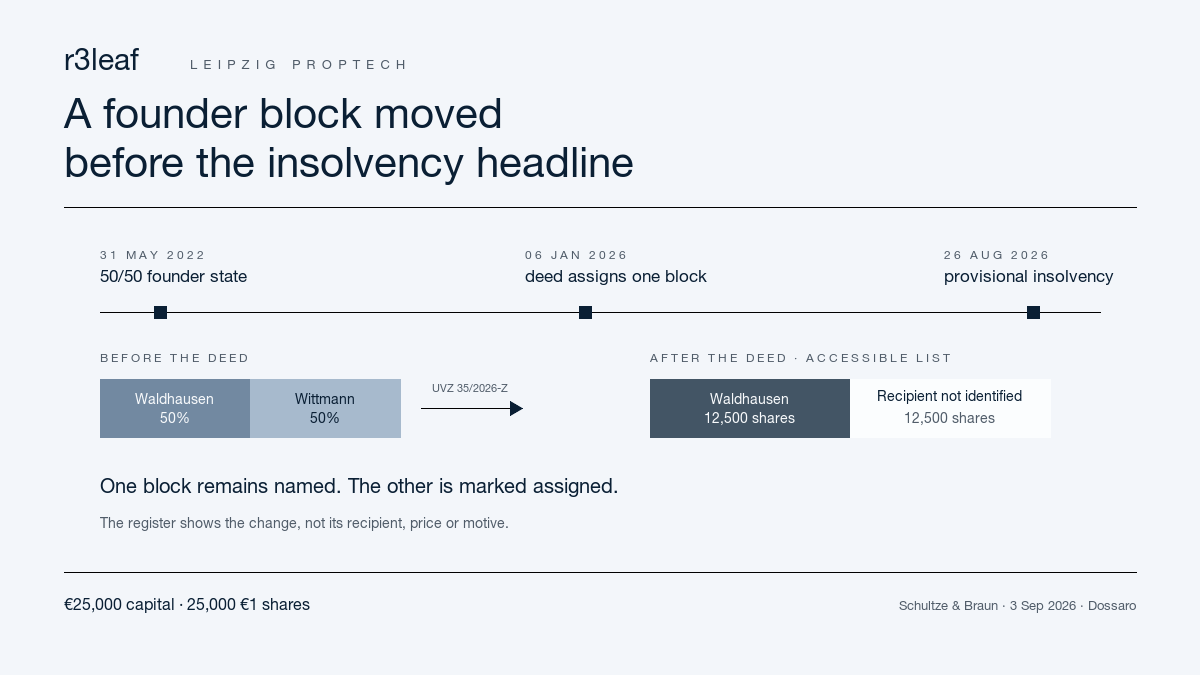
r3leaf's insolvency story contains a material ownership change that the public sale announcement does not explain. The Leipzig PropTech's 6 February 2026 shareholder list keeps Tore Waldhausen's 12,500-share block but leaves the other 12,500-share block unnamed after a 6 January notarial deed. The same filing sequence removed Andreas Wittmann as managing director, leaving Waldhausen as the sole named director.
That sequence came roughly seven months before the provisional insolvency order became public. On 3 September, Schultze & Braun said that r3leaf GmbH was looking for a buyer for its software platform and could have to shut down by the end of September if no buyer emerged. The release describes a four-person business, a mature platform for property-risk decisions and delayed customer decisions that left the company unable to fund its costs and continued development from operating revenue.
The register evidence does not identify who received Wittmann's block, what was paid, or whether the assignment was an ordinary founder reorganisation. It does establish a pre-insolvency control event. For a buyer, lender or employee representative, that is the useful finding: the platform is being marketed after a change in the legal ownership record, but the economic terms of that change remain outside the accessible public file.
The buyer search hides a timing problem
The public narrative starts with a financing shortfall and a search for a platform buyer. The register makes the sequence more specific. It shows a founder exit from management and an assigned share block before the court's provisional measures.
| Date | Register or public event | What it changes |
|---|---|---|
| 31 May 2022 | Formation-era shareholder list | €25,000 capital split 50/50 between Tore Waldhausen and Andreas Wittmann; both were managing directors |
| 31 December 2025 to 6 January 2026 | Shareholder resolution and notarial filings | Wittmann's managing-director role was removed; the transfer deed was dated 6 January |
| 6 February 2026 | Updated shareholder list entered | Waldhausen's 12,500 shares remain named; the other 12,500-share block is marked assigned, without a recipient |
| 26 August 2026 | Provisional insolvency order | Leipzig court file 405 IN 1723/26 placed the company under provisional administration measures |
| 3 September 2026 | Administrator's sale announcement | A buyer is sought for the software platform; the four-person operation faces a possible end-September shutdown |
The dates matter because a buyer is not assessing a static founder cap table. The share record changed before the process was described publicly as an insolvency sale. The exact gap between the assignment and the insolvency order is about seven months, but timing alone does not establish a cause.
r3leaf began as a two-founder vehicle
The 2022 list recorded a straightforward German limited company. Its €25,000 capital was divided into 25,000 one-euro shares. Waldhausen held shares numbered 1 through 12,500 and Wittmann held shares numbered 12,501 through 25,000. In percentage terms, that was 50% each. The same two people were listed as managing directors.
That baseline is important for reading the later list. It means the blank 12,501 to 25,000 line is not a small correction or an unallocated option pool. It is the exact block that had represented one founder's half of the company. The public material does not show whether the block moved to another individual, a company connected to one of the founders, or a third-party investor.
The formation record also puts a limit on any claim about current control. A 50/50 starting point says nothing about voting agreements, restrictions on transfer or later arrangements that were not filed in the accessible list. It is a verified historical state, not a complete fully diluted cap table.
The January deed changed both the board and the share record
The filing sequence has two linked parts. A 31 December 2025 shareholder resolution and a 6 January 2026 filing removed Wittmann as managing director. The change was entered on 6 February, when the register showed Waldhausen as the sole named managing director.
The shareholder list entered on that same date records Waldhausen's 1 through 12,500 block and leaves the 12,501 through 25,000 block without a shareholder name. In its changes column, it says that block was assigned under notarial deed reference 35/2026-Z dated 6 January 2026. The list's notary certification says the remaining entries agree with the earlier list.
There is an important presentation wrinkle. The parsed list displays a 100% total-participation figure next to Waldhausen even though only one 12,500-share block is named and the second block is expressly marked as assigned. That inconsistency is why the 100% field cannot be treated as proof that Waldhausen owned the whole company. The stronger, narrower reading is that Waldhausen's block remains identified while the other founder block changed hands under a referenced deed whose recipient is not visible in the accessible record.
This is a source-backed ownership observation, not a conclusion about motive. The deed could reflect an intra-founder arrangement, a transfer to a related vehicle, a settlement of another obligation or a sale to a new holder. Without the deed itself or a subsequent list naming the recipient, the public record cannot distinguish those explanations.
What the filing proves, and what it does not
The Schultze & Braun release gives the commercial context. r3leaf built software that automates property analysis, including heat, heavy rain and flood risks, and turns building data into investment recommendations. It says early customers used the platform and that the company was pursuing promising orders whose decisions were delayed. Running costs and product investment could not be covered by the operating business, the administrator said.
An independent Übernahme-Radar entry identifies the same Leipzig proceeding and file number, 405 IN 1723/26. It records the 26 August provisional order and a general consent reservation in favour of provisional administrator Rüdiger Bauch. That cross-check supports the legal status and administrator role, while the press release supports the platform description, employee count and end-September decision window.
Neither source fills the ownership gap. The accessible register material does not disclose a transfer price, a buyer vehicle, beneficial ownership, liquidation preference or a side agreement. It also does not establish that the January assignment caused the later cash crisis. Those are separate questions. A buyer may ultimately learn that the transfer was routine and economically immaterial, or that it changed who must approve a sale. The current evidence supports neither conclusion.
The insolvency process now puts the gap on the buyer's desk
The administrator is offering the software platform, not announcing a completed takeover. The release says that a buyer could acquire the developed technology and potentially the specialised developers, but warns that the business may be wound down if no buyer is found by the end of September. Even if operations stop, the platform could still be sold.
That creates a practical diligence question. A prospective buyer needs to know which rights, approvals and claims sit with the company and which may be affected by the January transfer. The named director and visible share block are straightforward starting points. The unlisted block is not. It may have no effect on an asset purchase, but it could matter if the transaction includes equity, intellectual property approvals, founder warranties or a continuing service arrangement.
The distinction resembles the point made in Dorma-Glas's prepared successor sale: an insolvency transaction is easier to understand when the perimeter of the asset or successor is separated from the old ownership story. For r3leaf, the public sources describe a platform sale, while the register leaves an ownership perimeter question open. Treating those as the same thing would overstate what is known.
Evidence boundary and next document watchpoint
High-confidence facts are the Leipzig registration, the €25,000 2022 capital, the original 50/50 founder split, Wittmann's removal as managing director, Waldhausen's continuing 12,500-share block, the 6 January deed reference, the 26 August provisional order and the administrator's 3 September sale announcement. The recipient, price, motive, beneficial owner, creditor recovery and any causal link to insolvency remain unresolved.
The next decision-changing document is the deed referenced as 35/2026-Z, or a later shareholder list that names its recipient. A subsequent court filing or administrator report could also clarify whether the block affects the proposed platform sale. Until one of those records is public, the defensible conclusion is precise: before r3leaf's insolvency became a buyer search, one founder left management and the register recorded the assignment of his 50% block without showing who received it.
Continue reading
Related Research
DORMA-Glas's Asset Deal Was Prepared Before The Rescue Headline
DG Glas's €25,000 successor vehicle and shareholder filings predated DORMA-Glas's rescue announcement, separating operating continuity from creditor recovery.
Deskcenter’s Software Survived in Mosaic IT After the Rescue Failed
Mosaic IT bought Deskcenter’s software, code, brands and domains after investor financing failed, while 41 jobs disappeared and creditor recovery stayed undisclosed.
ecoLocked's Lead Investors Doubled Their Stakes Before Insolvency Proceedings
Matterwave and Climentum doubled their ecoLocked share counts in a 2025 issue, concentrating investor exposure before preliminary insolvency proceedings.
Chift's €10.5m Series A Arrived After a Return to Profit
Chift's €10.5m Series A followed a 2025 return to profit, a positive gross-margin swing and a larger team, while ownership terms remain undisclosed.