
Deskcenter’s Software Survived in Mosaic IT After the Rescue Failed
Mosaic IT bought Deskcenter’s software, code, brands and domains after investor financing failed, while 41 jobs disappeared and creditor recovery stayed undisclosed.
On this page
Conduct your own private market research
Add dossaro to Claude or ChatGPT and run source-backed register research from your own workspace.
 Add to Claude
 Add to ChatGPT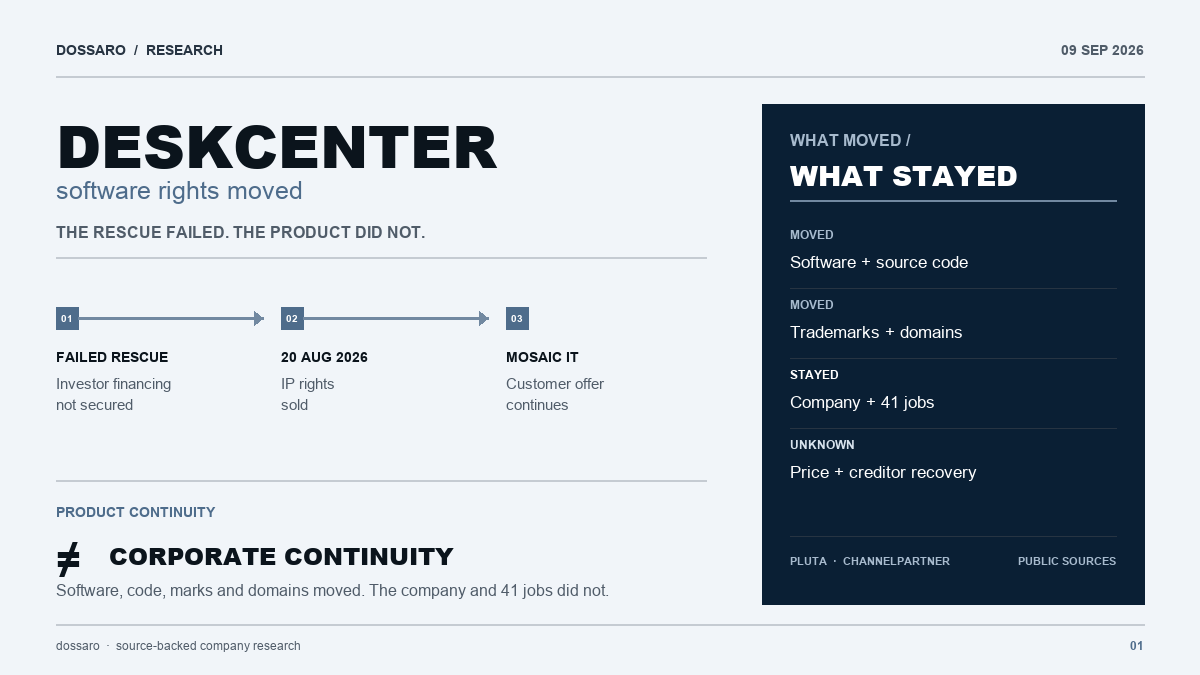
Deskcenter’s software has a new home, but Deskcenter AG does not. In August 2026 the insolvency administrator sold the Leipzig company’s software, source code, trademark rights and domains to Mosaic IT GmbH after investor financing failed. Mosaic says it will offer the roughly 600 customers a way to keep using the product. The transaction price is undisclosed, and the legal company, its employees and its creditors remain on the insolvency side of the perimeter.
That split is the useful finding. This was a transfer of product and customer continuity without a rescue of the operating company as a going concern. Public reporting also says Deskcenter had been a minority shareholder in Mosaic IT before the insolvency. The buyer was therefore not a stranger to the failed business, although the accessible record does not establish the size of that stake, the price paid for the assets or who ultimately receives value from the sale.
The sale preserved software, not the operating company
The PLUTA sale notice says attorney Dr Stephan Thiemann sold Deskcenter’s intellectual-property rights to Mosaic IT. The agreement covers the software, source code, trademark rights and associated domains. The parties did not disclose financial details.
The same notice says the buyer will soon make Deskcenter customers an offer that allows them to continue using the software. Mosaic is a Leipzig service provider focused on security and cloud solutions, and PLUTA says it had already worked with Deskcenter for many years. The sale therefore gives Mosaic an operating product and a route to retain users without transferring every obligation of Deskcenter AG.
An asset list is not a company sale. The notice does not say that customer contracts, employees, historic liabilities, warranties or all data permissions moved with the code. It says only the rights held by Deskcenter transfer. A buyer can obtain a valuable software base while leaving the failed company to deal with claims and recoveries through the insolvency process.
A failed financing narrowed the outcome
PLUTA says the Local Court of Leipzig opened insolvency proceedings over Deskcenter AG’s assets on 1 August 2026. The administrator and management had held discussions with potential investors during the provisional phase, but an acquisition could not be completed because investor financing was not secured in time. The business then ceased trading in early August.
ChannelPartner’s independent account describes the proceedings as opening at the end of June and reports that 41 employees had lost their jobs by 6 August. The two accounts differ on the opening date, so this article does not use that date to infer a different legal status. They agree on the economic sequence: a rescue of the business did not close, the company stopped operating and the residual software rights were sold soon afterward.
ChannelPartner also reports about 600 Deskcenter customers and says Mosaic’s shareholders bought the remaining assets. PLUTA’s account identifies Mosaic IT GmbH as the contractual buyer. Those descriptions can coexist, but they do not turn a buyer-side relationship into a disclosed ownership or consideration figure. The public evidence supports the asset transfer and customer offer, not a final distribution to creditors or shareholders.
Mosaic was already inside the story
The buyer’s prior relationship is more revealing than the headline “software sold to a Leipzig provider.” ChannelPartner says Deskcenter AG had been a minority shareholder in Mosaic IT until the insolvency. It also names Christoph Harvey and Michael Bölk among Mosaic’s shareholders and quotes them saying the companies had worked together for years.
That history explains why Mosaic could move quickly from failed rescue talks to a customer-continuity offer. It does not prove that Mosaic controlled Deskcenter, that its shareholders directed the insolvency outcome or that the asset sale was anything other than a process run by the administrator for creditor value. The exact percentage of the former minority holding, its acquisition cost and any rights attached to it are not disclosed in the public reporting.
PLUTA frames the sale as the best possible value achieved in the interests of creditors. That is an administrator’s stated objective, not evidence of the eventual recovery. The public record also does not show whether the former Mosaic stake had value at the time of the sale or whether it was extinguished, transferred or left inside the insolvency estate.
What moved, and what stayed behind
| Evidence point | What the record supports | What it does not establish |
|---|---|---|
| Software and source code | Sold by the insolvency administrator to Mosaic IT | A transfer of every licence, contract or data permission |
| Brands and domains | Trademark rights and associated domains included in the agreement | A valuation of the brand or future recurring revenue |
| Customer continuity | Mosaic plans an offer for about 600 customers | That every customer renews or that contracts moved automatically |
| Employment | ChannelPartner reports 41 jobs lost by 6 August | Any employee transfer or future hiring by Mosaic |
| Financing | A potential investor acquisition failed because financing was not secured | The identity of the investor, financing terms or cause of failure |
| Creditor outcome | PLUTA says the sale sought the best possible value for creditors | Sale price, creditor recoveries or shareholder distributions |
The table keeps the asset perimeter separate from the economic outcome. A source-code transfer can preserve technical utility while still destroying the legal company that employed the developers and signed the original customer agreements. Conversely, customer continuity can create value for Mosaic without proving that Deskcenter’s creditors receive a meaningful recovery.
Customers get a continuity offer, not a continuity guarantee
The practical consequence falls first on the customer base. Mosaic says it will offer continued use of the software, and ChannelPartner reports that customers and distribution partners can confirm a new relationship through the Deskcenter website. That gives users a path to keep their workflows, but it also asks them to decide whether the new provider can supply the same support, updates, security commitments and commercial terms.
The public notices do not specify how licence assignments, maintenance obligations, customer data, support history or service-level commitments are handled. They also do not say whether the new offer is a novation, a fresh contract or another arrangement. Customers can therefore see the operational benefit of a familiar product while still needing to diligence the legal basis for continued use.
For Mosaic, the commercial upside is more concrete. It receives a product that has already been deployed, a known customer list and a software category that fits its security and cloud portfolio. It also inherits the work of rebuilding trust after Deskcenter’s employees were not carried over. The sources support that opportunity, not a forecast of recurring revenue or a claim that the product has been fully integrated.
This is a rescue of value, not a rescue of the company
The distinction resembles other private-market asset outcomes, but the facts here are specific. Aibly’s IP sale also put software, brands and domains into a liquidation process rather than selling a clean operating company. Noscendo’s selective software sale shows the other side of the same perimeter question: a strategic buyer can take selected technology while the venture-backed corporate history remains separate.
Deskcenter adds a prior commercial and equity connection between the failed company and the buyer. That connection improves the explanation for customer continuity, but it does not answer the economics. The administrator still had to market the assets after a financing-backed acquisition failed, and the buyer still has not disclosed what it paid.
The result is a two-sided transfer of risk. Mosaic receives the chance to monetise software and customer relationships. Deskcenter’s employees lose their roles, while creditors remain exposed to whatever the insolvency estate can recover. The former shareholder relationship may matter to the history, but no source shows that it guarantees a payout or a special claim.
The missing documents carry the remaining value question
The public announcements establish the transaction perimeter and the customer-facing plan. They do not establish the consideration, the detailed asset schedule, the treatment of customer data or the distribution waterfall in the insolvency estate. Those are the documents that would explain who won economically.
A sale agreement or administrator report could show whether licences, contracts and data rights were transferred together. An insolvency statement of affairs could show secured and unsecured claims and any expected recovery. A later Mosaic filing could clarify the company’s ownership and whether Deskcenter’s former minority position had any remaining value. Until those records appear, the defensible conclusion is narrower but still material: Mosaic preserved the product and a route to customer continuity after Deskcenter’s rescue failed, while the company, its jobs and its creditor outcome stayed behind.
Sources and method
This analysis uses PLUTA’s administrator notice, ChannelPartner’s independent report, the Deskcenter website and the German register portal. The exact subjects are Deskcenter AG, Leipzig HRB 23096, and Mosaic IT GmbH, Leipzig HRB 43576. Public sources support the asset sale, failed financing, customer count, job loss and prior minority relationship. They do not support a sale price, exact former stake, creditor recovery, customer-contract transfer or any individual motive.
Continue reading
Related Research
Aibly's IP Sale Follows a £467,430 Share-Funding Cycle
Aibly's liquidators are selling its AI compliance IP after £467,430 of cash-paid allotments, a satisfied bank charge and £120,234 of net liabilities.
Bruker Bought Noscendo's Software, Not The Venture-Backed Company
After nearly €40m of venture funding, Noscendo entered insolvency. Bruker acquired DISQVER, patents and selected staff while the laboratory closed.
Nalvin Entered Liquidation 48 Days Before Lovable Acquired Its Team
Version Lens Sweden entered liquidation 48 days before Lovable acquired the Nalvin team, separating the talent deal from the venture-backed company.
r3leaf's 50% Founder Block Moved Before Its Insolvency
r3leaf's shareholder list records a 50% founder block assignment before insolvency, while the public sale process leaves the recipient and price undisclosed.