
Aibly's IP Sale Follows a £467,430 Share-Funding Cycle
Aibly's liquidators are selling its AI compliance IP after £467,430 of cash-paid allotments, a satisfied bank charge and £120,234 of net liabilities.
On this page
Conduct your own private market research
Add dossaro to Claude or ChatGPT and run source-backed register research from your own workspace.
 Add to Claude
 Add to ChatGPT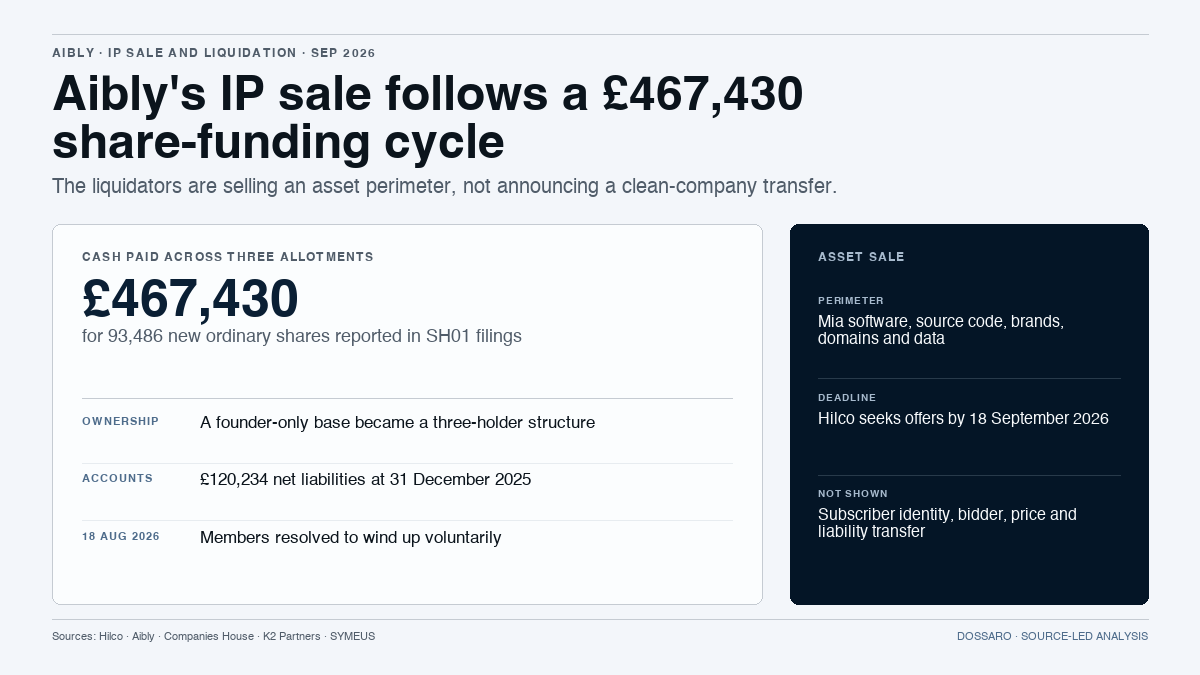
Aibly's liquidators are seeking bids for its AI-compliance intellectual property after a visible ownership, cash-funding and creditor sequence. The Hilco sale notice sets an offer deadline of 18 September 2026 for some or all of Aibly Limited's assets, including the Mia software, source code, workflows, brand, domains, social accounts and historic commercial data. It does not announce a sale of the legal company.
The Companies House record adds the financial context missing from a simple software-for-sale description. A one-million-share base that was once held by Stuart Campbell was followed by transfers to Carly Watson and Michael Hollier, three later cash-paid allotments totalling 93,486 shares and £467,430, a bank-account charge in favour of HSBC Innovation Banking that was later satisfied in full, and 2025 micro-entity accounts showing £120,234 of net liabilities. Those facts do not establish the buyer price or creditor recovery. They do establish why the opportunity should be analysed as an asset perimeter carved out of a financially exposed entity.
The sale is for an asset perimeter, not automatically the company
Hilco is acting for joint liquidators Jeremy Karr and Simon John Killick of BTG Begbies Traynor (Central) LLP. Its notice says Aibly developed Mia as an AI-powered compliance platform, with Mia Studio for document-processing workflows and Mia Concierge for explainability and audit. It describes use cases spanning document review, KYC and customer due diligence, anti-financial-crime processes and safer gambling.
The notice says the technology had reached user-acceptance testing with two prospective customers in document-processing applications, but remained under development at the date of liquidation. It also lists the Aibly and Mia brands, a registered Aibly trade mark, the aibly.io, aibly.ai and aibly.co.uk domains, website content, LinkedIn and YouTube accounts, and historic customer, prospective-customer and partner contact data. The Aibly product site provides a similar description of the Mia platform and its regulated-industry positioning.
That list gives an existing RegTech or compliance provider a development base and market identity without necessarily buying the corporate shell. It is not, by itself, a transfer of customer contracts, employees, liabilities or every data permission. Hilco says only whatever right, title and interest Aibly has will transfer.
The terms keep the diligence burden with bidders. Sales are strictly “as is, where is”, with no warranties or guarantees, and Hilco says its information has not been independently verified. A successful bidder must pay a 20% deposit within 48 hours, a 10% buyer's premium and, unless agreed otherwise, complete within five business days. That describes a process, not a completed transaction or a valuation.
A founder-only base became three holders
The 12 July 2025 confirmation statement, filed on 12 August, records the starting point: 1,000,000 ordinary shares, held by Stuart Campbell. The filing says the shares rank pari passu, carry one vote and participate in dividends and any distribution of capital on a winding up.
The corrected filing registered on 1 September 2025 records transfers dated 1 May 2025. It lists Stuart Campbell with 723,750 shares, Carly Watson with 241,250 and Michael Hollier with 35,000. Against the one-million-share base in that statement, those holdings are 72.375%, 24.125% and 3.5% respectively. They are the last disclosed holder split in the evidence used here, not a current post-allotment cap table.
The distinction matters. The 2025 transfers explain how the ownership base changed before the cash-paid allotments. They do not tell us whether the later shares were issued to those same holders, to a new investor, to an employee pool or to another party. The 31 March 2026 PSC filing records Stuart Campbell in a more than 50% but less than 75% band for shares and voting rights, with a right to appoint or remove a majority of the board. That band is compatible with continued influence, but it is not a precise statement of the post-April share register.
Cash-paid allotments changed the funding path
Three SH01 returns put amounts and dates on the next phase. On 14 August 2025, Aibly reported 50,000 ordinary shares allotted for £250,000 paid. On 20 August, it reported a further 24,000 shares for £120,000 paid. On 21 April 2026, it reported 19,486 shares for £97,430 paid and a total issued share count of 1,093,486.
| Filing or event | What the public record states | Decision use |
|---|---|---|
| 12 Aug 2025 confirmation statement, corrected 1 Sep | One-million-share base; 72.375% Stuart Campbell, 24.125% Carly Watson and 3.5% Michael Hollier after 1 May transfers | Establishes the last disclosed pre-allotment holder split |
| 14 Aug 2025 SH01 | 50,000 ordinary shares; £250,000 paid in cash | First identified cash-paid allotment |
| 20 Aug 2025 SH01 | 24,000 ordinary shares; £120,000 paid in cash | Second identified cash-paid allotment |
| 21 Apr 2026 SH01 | 19,486 ordinary shares; £97,430 paid in cash; 1,093,486 total shares | Later allotment before liquidation; subscriber remains unnamed |
| 14 Jul 2025 MR01 and 5 Jun 2026 MR04 | HSBC bank-account charge, then recorded satisfied in full | Shows a filed security cycle without proving repayment mechanics |
| 31 Dec 2025 accounts, filed 13 Apr 2026 | £120,234 net liabilities; £29,756 net current liabilities; seven average employees | Dates the balance-sheet pressure before the August winding-up |
| 18 Aug resolution and 28 Aug form 600 | Voluntary winding-up and appointment of Jeremy Karr and Simon John Killick | Places the sale process with joint liquidators |
The arithmetic is 50,000 plus 24,000 plus 19,486, or 93,486 new shares, and £250,000 plus £120,000 plus £97,430, or £467,430 paid. Each filing reports £5 paid per newly allotted share against a nominal value of £0.000001. The forms do not identify subscribers, disclose a valuation, specify preference rights or show the resulting ownership percentages.
That is why “£467,430 of funding” is a useful description of the stated cash paid, but not proof of a conventional priced financing round. The public record supports a capital path, not an investor map. A buyer should not assign the allotments to a named party merely because a separate announcement describes an investment in Aibly.io.
Security was filed, then satisfied
The 14 July 2025 MR01 registers charge code 1583 7048 0001 in favour of HSBC Innovation Banking. The form describes fixed charge(s) and a negative pledge. The underlying charge-over-bank-accounts deed says the security covers present and future obligations to HSBC Innovation Banking.
Companies House recorded the charge as satisfied in full on 5 June 2026. The MR04 names HSBC Innovation Banking and gives its interest as “CLOSURE”. That filing closes the registered charge, but it does not say why the obligation ended, whether it was paid from a financing, or whether any creditor recovered a particular amount. The sequence is a signal that a bank security interest existed and later left the register, not a complete creditor waterfall.
Last accounts show a balance-sheet wall
The micro-entity accounts for the year ended 31 December 2025 were approved on 10 April 2026 and filed three days later. They show fixed assets of £254,761 and current assets of £26,588. Current liabilities of £58,859 produce net current liabilities of £29,756. Creditors due after more than one year were £330,554, and accruals and deferred income were £14,685. Total net liabilities were £120,234, with an average of seven employees.
The numbers should be read as a dated balance-sheet position, not as a liquidation statement of affairs. The accounts predate the 21 April 2026 allotment and the 18 August winding-up resolution. They are unaudited micro-entity accounts, and K2 Partners' independent record likewise warns that the figures are indicative rather than a valuation. The figures nevertheless make the transaction perimeter concrete: the assets being marketed sit inside a company that reported more liabilities than assets at its last filed year-end.
Liquidation changes who sells and what a buyer assumes
Members passed a special resolution on 18 August 2026 to wind up Aibly voluntarily and appoint Karr and Killick as joint liquidators. The form 600 appointment notice was filed on 28 August and identifies BTG Begbies Traynor (Central) LLP as the presenter. Hilco's notice is therefore a liquidator-led process for the company's assets, rather than a founder-led product sale.
The legal distinction is important for an acquirer. Buying source code, domains, a trade mark or historic data can preserve useful elements of Mia, but the public notice does not say that the buyer receives Aibly's debts, customer agreements, employment obligations or every permission attached to the data. Any such transfer would depend on the asset schedule, title checks, contract terms, data rights and completion documents that are not public in the sale notice.
The comparison with Nalvin's liquidation and acquihire perimeter is useful: technology can change hands while the insolvent entity remains in its creditor process. Lowell's creditor-equity carve-out shows the inverse ownership risk. Aibly's notice establishes neither a completed acquisition nor a new owner.
What the public record establishes, and what it does not
The evidence establishes the exact UK company, its dated holder split, three cash-paid allotments, the HSBC charge and full-satisfaction filing, negative net assets in the last accounts, and the voluntary liquidation with named joint liquidators. It also defines the assets and “as is, where is” terms Hilco is asking buyers to price.
It does not establish the SH01 subscribers, post-April cap table, valuation, preference or voting rights, creditor repayment, bidder, sale price, recovery or transfer of contracts, employees and liabilities. The public filings therefore cannot answer the price question. They can show why diligence starts with the asset schedule and liquidation file, not an AI-platform headline.
Next documents to watch
The next decision-changing evidence would be a liquidation statement of affairs and progress reports, the detailed Hilco bid or completion terms, and assignments for the software, domains, trade mark, social accounts and historic data. A post-allotment shareholder or capital filing would identify the subscribers behind the £467,430 and show whether the PSC band changed.
Until those documents appear, Aibly is best understood as an IP and digital-asset sale from a financially exposed legal entity. The ownership and funding trail explains the economic context. The sale notice defines the opportunity. Neither source supports a clean-company acquisition claim.
Sources
- Hilco Aibly sale notice sets the 18 September 2026 deadline, asset perimeter, product status, liquidator mandate and sale terms.
- Aibly product site describes the Mia platform, Mia Studio, Mia Concierge and regulated-industry use cases.
- Companies House company profile, filing history and PSC record provide the official identity and filings.
- K2 Partners' independent AIBLY record independently lists the last micro-entity accounts, employee count and winding-up notices.
- SYMEUS' seed-investment announcement provides independent financing context; it does not disclose terms used in this analysis.
Continue reading
Related Research
Nalvin Entered Liquidation 48 Days Before Lovable Acquired Its Team
Version Lens Sweden entered liquidation 48 days before Lovable acquired the Nalvin team, separating the talent deal from the venture-backed company.
Lowell's Recapitalisation Offers Creditors the New Parent as Orlando Takes DACH
Lowell's 2026 reset offers creditors conditional new-parent equity while Orlando buys its DACH platform, linking debt relief to a cross-border carve-out.
Bruker Bought Noscendo's Software, Not The Venture-Backed Company
After nearly €40m of venture funding, Noscendo entered insolvency. Bruker acquired DISQVER, patents and selected staff while the laboratory closed.
Cycles Lapierre Had €108m Due Within A Year After Its €60m Rescue
Cycles Lapierre reported €108.2m due within one year and €45.7m of negative equity after a €60m rescue, exposing its dependence on Accell funding.