
BOOKR's €6.1m Series A Is a Mixed Transaction, Not Just New Growth Capital
BOOKR says its €6.1m Series A combines primary funding, secondary share purchases and converted instruments, so the headline is not all new cash.
On this page
Conduct your own private market research
Add dossaro to Claude or ChatGPT and run source-backed register research from your own workspace.
 Add to Claude
 Add to ChatGPT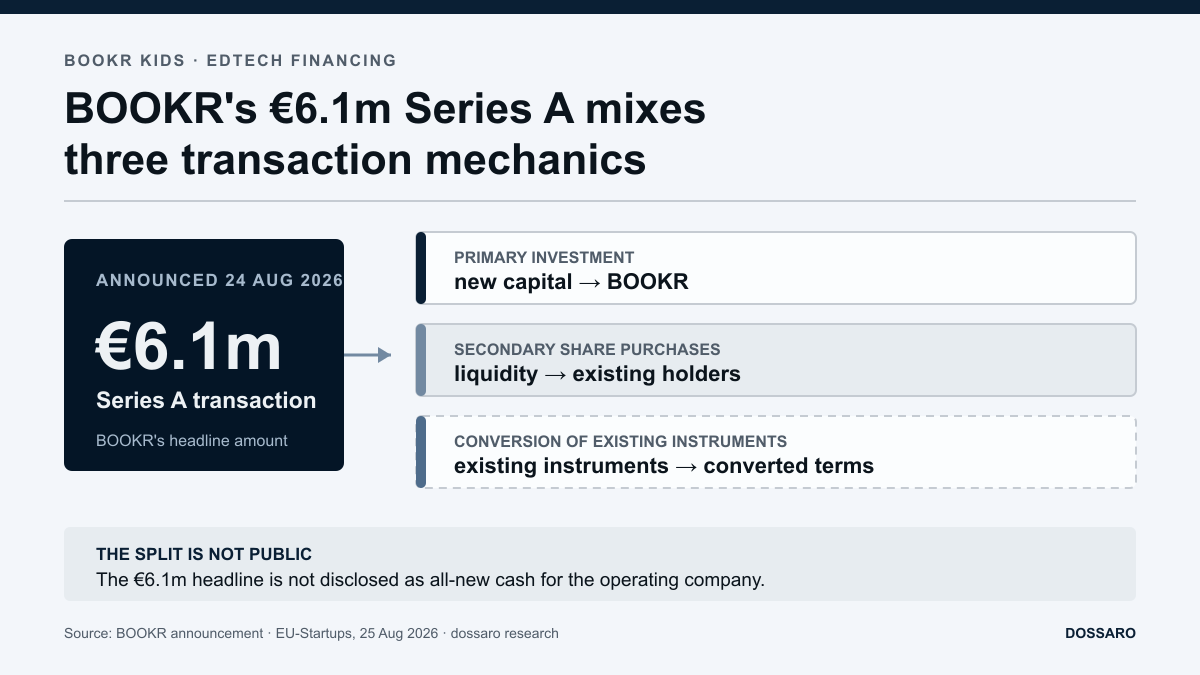
BOOKR Kids says its €6.1 million Series A is three transactions in one: a primary investment, secondary share purchases and the conversion of existing financing instruments. That structure matters more than the round label. The headline amount cannot be read as €6.1 million of fresh cash delivered entirely to the operating company.
The Budapest-based education technology company announced the transaction on 24 August 2026 in its transaction announcement. It says TCEE Fund IV, advised by 3TS Capital Partners, led the deal, with participation from Kids Read Now, SchoolDay, Infinit Capital and Albert Sárospataki through FusionWise. An independent account from EU-Startups repeated the €6.1 million figure and the investor group, while adding context on BOOKR's earlier financing.
The available public record supports the mixed structure and the commercial distinction between new money, liquidity for existing holders and the settlement of earlier claims. It does not disclose the amount in each bucket, identify any seller or show the post-transaction ownership percentages. Those unanswered details are not a reason to discard the announcement. They are the part of the financing that investors, founders and potential acquirers should ask for next.
A Series A headline can contain different economic outcomes
The phrase “€6.1 million Series A” sounds like a single cash injection. BOOKR's own wording is more precise. It says the transaction combines the following components:
| Component named by BOOKR | Immediate economic effect | What the announcement does not say |
|---|---|---|
| Primary investment | New capital goes into the company and can fund operations, product or expansion | The amount subscribed, price per share or resulting share count |
| Secondary share purchases | Existing holders sell shares and receive liquidity; the company is not the sole recipient of the proceeds | Which holders sold, how much they sold or the price paid |
| Conversion of existing financing instruments | Earlier claims become equity or another agreed security, changing the capital stack | The instruments converted, conversion terms, class rights or resulting ownership |
These are not interchangeable uses of the same euro. Primary capital can extend runway or finance product investment. A secondary purchase can give an early holder a partial exit while bringing a new investor into the register. Conversion can remove an outstanding instrument from the liability side or alter its priority, depending on the terms. A round that combines all three can be strategically useful, but its headline is not a measure of company cash alone.
The distinction also prevents a false precision problem. Without the split, no public calculation can say how much of the €6.1 million increased BOOKR's cash balance, how much went to sellers or what ownership block was created by conversion. Reporting the full amount as new growth capital would go beyond the company's disclosure.
The investor list shows a broad syndicate, not the allocation
BOOKR names TCEE Fund IV as the lead through its adviser, 3TS Capital Partners. The announcement also names Leib Lurie of Kids Read Now, Robert Iskander of SchoolDay, Infinit Capital Oy, described as a Koponen family vehicle, and Albert Sárospataki through FusionWise. The group combines a specialist fund with education operators, a family-linked investment vehicle and a strategic individual participant.
That mix can serve more than one purpose. A lead fund may provide institutional capital and follow-on capacity. Education operators can bring distribution or market knowledge. A family vehicle may add patient capital, while a secondary purchase can give an existing holder liquidity without requiring the company to sell more primary shares. These are reasonable commercial readings of the named participants, not evidence of their individual allocations or rights.
The public announcement does not say which investor used which part of the transaction. It would therefore be wrong to describe any named participant as a buyer of existing shares, a recipient of converted instruments or a holder of a particular percentage. The names establish participation as BOOKR presents it. They do not establish the cap table.
BOOKR's earlier financing makes the conversion clause consequential
EU-Startups reports that BOOKR's 2020 financing included €2 million of funding and a €2 million convertible note. That earlier combination helps explain why the 2026 announcement calls out conversion of existing financing instruments instead of describing only a new share issue.
The 2020 figures are historical context, not a statement that the full €2 million note remained outstanding or converted in 2026. The public material does not disclose the balance still eligible for conversion, the conversion price, accrued return, share class or any cap on the resulting stake. The safe conclusion is narrower: BOOKR had previously used a financing instrument that could create a conversion question, and the company says existing instruments were part of the new transaction.
This is the same capital-stack issue visible in other private-company financings. Callosum's filed seed round separates a public dollar headline from a specific preferred-share allotment at the UK holdco. BOOKR's case is different because the company itself discloses several transaction types, while the public announcement stops before the amount and ownership split. In both cases, the financing label is only the starting point for understanding who received value and which claims changed.
The operating story is large, but scale does not answer the cash question
BOOKR says it serves more than 600,000 paying students across more than 3,000 schools in over 30 countries. The company also reports approximately $2.7 million of revenue in 2025 and says it was EBITDA-positive. Those are company-reported operating claims in the transaction announcement, not figures independently reconstructed here.
The scale explains why a mixed financing could be commercially attractive. Global school distribution and a positive earnings claim can support a primary expansion story, while the secondary component can provide liquidity to early backers after a period of growth. Instrument conversion can simplify the capitalization before a larger international push. None of those possibilities proves the deal was structured for one particular motive, but each changes how a reader should interpret the €6.1 million.
The company frames the next phase as literacy infrastructure for the artificial-intelligence age. It also cites a €662,000 non-repayable European Union grant and describes evidence-based learning work, including research and a 2026 Jordan pilot. Those details show a business combining commercial financing with grant-supported product development. They do not change the basic distinction between primary money and value transferred within the shareholder base.
Why the mixed structure matters for diligence
For a venture investor, the first question is how much of the round is available for execution after closing costs and any secondary settlement. A large secondary component may be positive for founder or early-investor liquidity, but it does not extend operating runway by the same amount as primary capital. A large conversion component may improve the balance sheet or remove a maturity risk, but its price and rights determine who benefits.
For a founder, the questions are about dilution, governance and the trade between fresh cash and liquidity. A secondary sale can provide personal liquidity without issuing as many new shares, while a conversion can change the denominator or the seniority of earlier claims. The company announcement does not publish those terms, so no founder-ownership outcome can be calculated from the €6.1 million headline.
For a potential acquirer, the transaction creates a document request rather than a clean valuation shortcut. The buyer would need the subscription and transfer agreements, the converted instrument terms, the post-close shareholder list, any amended articles and the treatment of investor rights. The amount paid into the company, the amount paid to sellers and the claims retired through conversion should be reconciled separately.
This discipline is especially important when a transaction includes strategic participants. A school operator or family vehicle may hold commercial rights, information rights or a board relationship that is not visible in the announcement. Those rights should be verified in the definitive documents, not inferred from the participant list.
What the next disclosure should settle
BOOKR's announcement gives a strong affirmative finding: the €6.1 million Series A is a mixed transaction. It does not provide the allocation needed to map the economic outcome. The next useful disclosure would answer four questions:
- How much of the headline was primary cash subscribed into Móra-BOOKR Kids Ltd?
- Which existing holders sold shares, and what portion of the consideration was secondary?
- Which financing instruments converted, at what price and into which class or rights?
- What did the post-transaction shareholder and board positions look like?
The Hungarian register route tested for Móra-BOOKR Kids was protected by a CAPTCHA, so no public shareholder list, conversion filing or seller position could be verified for this analysis. That leaves the claim boundary clear. BOOKR has announced the amount, structure, lead and participants. The split, allocations, dilution and control consequences remain open.
The commercial takeaway is therefore precise: BOOKR has secured a €6.1 million financing transaction, but the amount of new growth capital is not yet public. Anyone evaluating the round should treat the headline as a capital-stack figure until the primary, secondary and converted components are separately documented.
Continue reading
Related Research
Callosum's $100m Seed Put 24.1% of the Holdco Into a New Preferred Class
Callosum's $100m seed maps to a filed £57.20m Series Seed 2 issue for 24.1% of its holdco, while Atomico and Plural-linked directors joined the board.
Oshen's $5m Round Began Before the Announcement
Oshen's founders held 94.5% before its $5m round, while June resolutions authorised a potential 24.3% share envelope and ratified earlier ASAs.
SoftBank's $200m Gravis Round Created A 12.63% Series A Class
Gravis's $200m SoftBank round created a Series A class equal to 12.63% of nominal shares and added two board members, not a takeover.
Lupin Dental's €15m Round Turned Old Claims Into Equity at a 28% Lower Issue Price
Lupin Dental’s €15m round issued 19.75% new shares, settled €3.37m of claims by setoff, priced them 28% below prior issues and created a Strategic Committee.