
ReGuest Trades Most of Servecloud Equity for a 6% Convertible Loan
ReGuest cut its Servecloud stake from 30% to 3%, took €0.5m cash and a €2.5m 6% convertible loan, shifting most equity risk into credit over three years.
On this page
Conduct your own private market research
Add dossaro to Claude or ChatGPT and run source-backed register research from your own workspace.
 Add to Claude
 Add to ChatGPT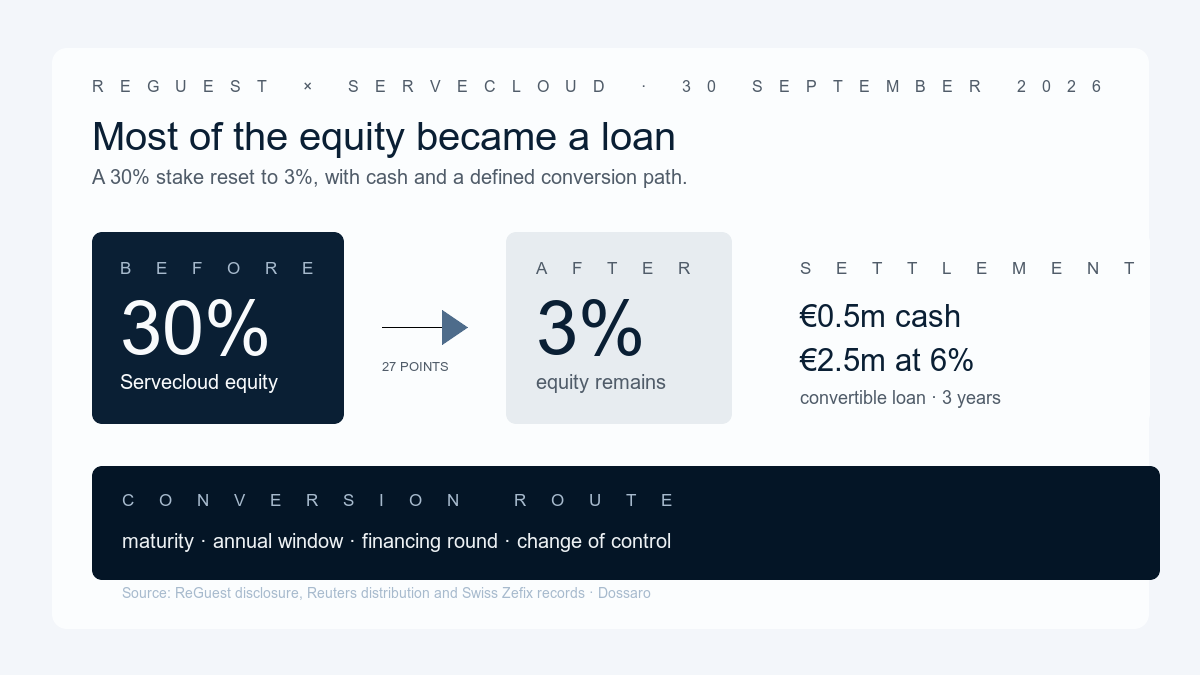
ReGuest S.p.A. has turned most of its Servecloud equity exposure into a defined creditor claim. Under a 30 September 2026 agreement, the Italian hospitality-software company cut its stake in Servecloud AG from 30 percent to 3 percent, received €0.5 million in cash and converted the remaining €2.5 million into a three-year convertible loan paying 6 percent a year.
That is more than a routine reduction in a portfolio holding. It moves €2.5 million of ReGuest's exposure from an open-ended equity position into a contractual claim that pays interest and can convert back into shares at specified points. ReGuest keeps a smaller equity position and a conversion option, but the payoff now depends on the loan's maturity, conversion windows and the next financing or control event.
A 30% holding became a two-part claim
The transaction was announced in a ReGuest investor-relations disclosure dated 30 September. An independent Reuters distribution carried by TradingView gives the transaction terms: the 30 percent stake, carried at €3.0 million, was settled through cash and a loan under a mutual agreement with Kingstone Capital Holding AG.
| Position before the reset | Position after the reset |
|---|---|
| 30% Servecloud equity stake | 3% Servecloud equity stake |
| €3.0m carrying value | €0.3m stated carrying value for the remaining stake |
| Open-ended equity exposure | €0.5m cash plus €2.5m convertible loan |
| Return depended mainly on Servecloud equity value | Loan pays 6% annually for three years, with defined conversion rights |
The arithmetic is straightforward: 27 percentage points of the stake left the equity line, equal to 90 percent of ReGuest's former percentage holding. The transaction release describes the €0.5 million as cash returned to ReGuest and the €2.5 million as the converted balance. It also says the reset had no impact on ReGuest's half-year figures at 30 June 2026, because the agreement was reached after that reporting date.
The distinction between carrying value and transaction value matters. The €3.0 million figure is the value at which ReGuest says the stake was carried. It is not a valuation for all of Servecloud, and it does not by itself reveal a price per share or the economics of the agreement with Kingstone.
The loan keeps upside, but changes the timing of risk
The convertible loan pays 6 percent a year and runs for three years. ReGuest can convert into Servecloud shares at maturity and when defined events occur, including an annual conversion window, early repayment, a financing round or a change of control. Those triggers create a hybrid position: ReGuest has a current interest claim, but it can still exchange the loan for equity if a specified event makes that attractive.
| Loan feature | Publicly disclosed detail | Still not disclosed publicly |
|---|---|---|
| Coupon | 6% a year | Ranking, security and other creditor terms |
| Term | Three years | Repayment source at maturity |
| Conversion path | Maturity, annual window, early repayment, financing round or change of control | Conversion price and resulting share count |
This is a different risk profile from holding 30 percent of a private company. Equity absorbs the full change in value and normally has no scheduled cash return. A three-year loan creates an interest stream and a maturity date, although the value of any claim still depends on Servecloud's ability to meet its obligations and on the contract's ranking and terms. The public disclosure sets the coupon, term and conversion events; it does not publish the conversion price, security package or priority relative to other creditors.
The conversion right also makes the next financing a pricing event for ReGuest. If Servecloud raises new money, the loan can become convertible under the agreed terms. If a change of control occurs, the same is true. ReGuest has therefore exchanged a large standing equity position for a smaller equity stake plus an instrument that can re-enter the cap table when the company reaches a defined financing or exit point.
That structure resembles the risk-transfer logic in Reactive Technologies' EIB financing, where the word “non-dilutive” describes a share-count outcome but not the priority or repayment risk added to the company. The Servecloud transaction runs in the other direction: ReGuest reduces its equity risk while leaving Servecloud with a loan obligation and a possible future equity conversion.
Servecloud's register history stops before the reset
The Swiss company behind the transaction is Servecloud AG, registration number CHE-175.582.414. Zefix's company profile identifies an active company at Seestrasse 93 in Hergiswil, Nidwalden. Its 2023 publication records a new registration with CHF 100,000 of fully paid share capital divided into 100,000 registered shares.
The 2023 Swiss Official Gazette publication establishes the starting legal identity and capital. A January 2026 publication records a change of purpose, a move to the Seestrasse address and a new board led by Rainer Gruber. It is useful evidence about the issuer, but it predates the September transaction and does not publish a post-reset shareholder list.
That timing is the critical boundary. The public transaction announcement identifies a 30 percent-to-3 percent change and the cash-plus-loan settlement. The Swiss register documents establish Servecloud as the exact legal company and show its formation and 2026 governance updates. Neither source set discloses the post-transaction share register, the number of shares held by Kingstone, or the conversion price that would apply if ReGuest returns to the equity table.
The absence of a new cap table does not erase the economic fact that ReGuest changed the form of its exposure. It sets the next diligence question: which party now owns the 27 percentage points that ReGuest no longer holds, and how does the convertible loan rank against Servecloud's other obligations?
Why the reset changes underwriting
For ReGuest shareholders, the reset makes the return path more legible. The company receives €0.5 million immediately, collects a 6 percent coupon on €2.5 million and keeps a 3 percent equity position. The trade-off is that most of the former equity upside has been replaced by a claim with a fixed term and contract-defined conversion points.
For Servecloud, the same transaction creates a financing obligation. A 6 percent coupon is not a valuation signal and the loan's conversion feature is not the same as a new equity round. But the company now has to manage maturity, interest and a potential conversion alongside future financing and change-of-control discussions. Those obligations matter to any investor assessing how much of a future round can fund product development rather than settle existing claims.
For Kingstone, the agreement changes the ownership perimeter without publicly fixing the new cap table. ReGuest's release says the reset was reached by mutual agreement with Kingstone Capital Holding AG, but it does not describe the allocation of the 27 percentage points, any cash paid by Kingstone, or any governance rights attached to the remaining stake. Those are transaction questions, not facts to infer from the company's name or address.
The remaining 3 percent is also important. ReGuest has not fully exited Servecloud. The disclosure says the residual holding will continue to be carried at approximately €0.30 million. That keeps an equity link in place while the loan provides a scheduled return. The result is a split exposure: one small piece participates in Servecloud's value, while the larger piece behaves like credit until a defined conversion event occurs.
The next document that could change the reading
The next decision-changing record would be a post-transaction Swiss shareholder list, the loan agreement or a financing announcement that states the conversion price and creditor ranking. Those documents could show who received the transferred equity, whether the 6 percent loan is secured, and how many shares ReGuest could receive at maturity or after a new financing.
Until then, the strongest conclusion is narrower and more useful than calling the move an exit. ReGuest traded most of a 30 percent Servecloud stake for €0.5 million in cash and a €2.5 million, three-year loan paying 6 percent, while retaining 3 percent equity and a route back into the cap table. The transaction shifts the underwriting question from how a large shareholder participates in Servecloud's upside to how a hybrid creditor position will be paid, converted or settled when the company's next financing or ownership event arrives.
Continue reading
Related Research
Reactive Technologies’ €19m EIB Debt Meets a £25m Preference Stack
Reactive Technologies’ €19m EIB debt is non-dilutive, but filings show £25m of Series D preference rights and an HSBC charge over IP and assets.
Hadrian's $40m Round Leaves a 399,057-Option Question at the Dutch Parent
Hadrian's $40m round sits at a Dutch parent while UK accounts show 399,057 outstanding employee options, exposing a future-value claim absent from the announcement.
Wiener Börse's 80% North Data Deal Was an Existing-Share Transfer
North Data's latest shareholder list shows Wiener Börse took 80% through existing shares, while founder Frank Debatin kept 20% and two 30% blocks exited.
Gaia Fertility Moved From VC Share Classes to One Parent Shareholder
Gaia Fertility's UK register moved from VC preference classes to 920,689 ordinary shares held by Gaia Family Inc, while founder Nader Alsalim remains an active PSC.