
Pixelgen's SEK150m Series B Puts a 26.7% Cheque Behind New Board Seats
Pixelgen's SEK150m Series B includes Flat Capital's SEK40m cheque and two new directors, but Swedish public records do not yet show the post-round ownership split.
On this page
Conduct your own private market research
Add dossaro to Claude or ChatGPT and run source-backed register research from your own workspace.
 Add to Claude
 Add to ChatGPT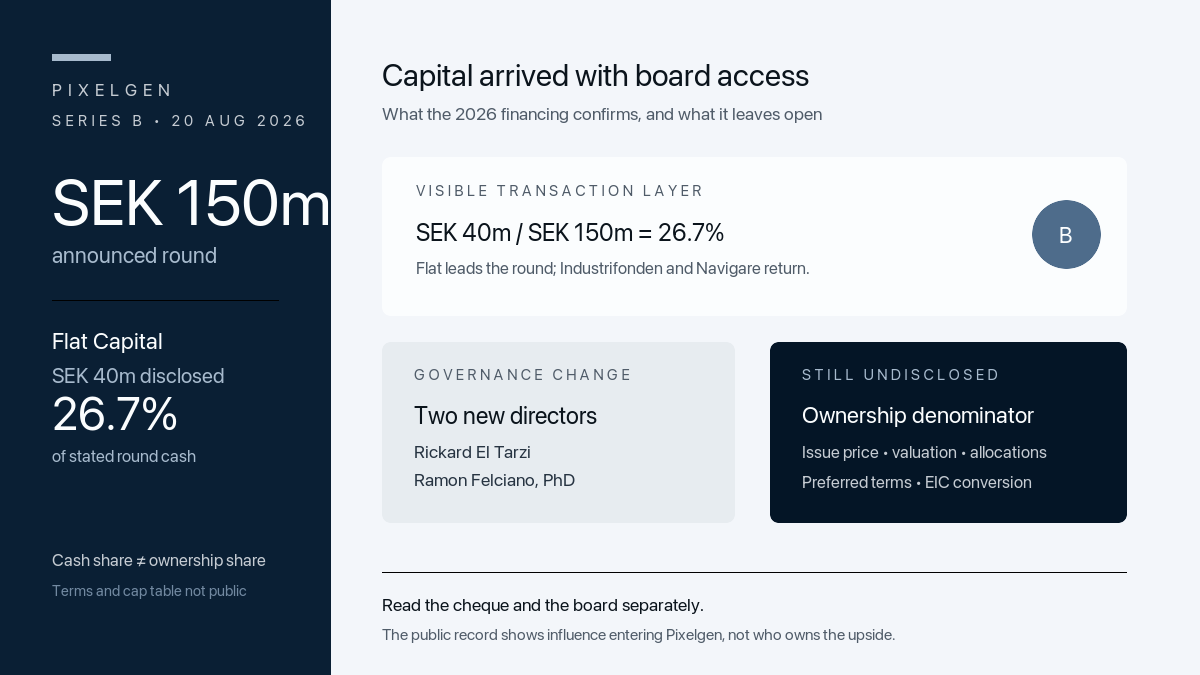
Pixelgen Technologies' SEK 150 million Series B has a measurable cheque and a visible governance outcome, but not a public post-round ownership split. Flat Capital disclosed an investment of approximately SEK 40 million, equal to 26.7% of the announced round's cash on the stated figures. Alongside the financing, Pixelgen added Flat CEO Rickard El Tarzi and life-sciences operator Ramon Felciano to its board.
That is a meaningful influence package. It is not evidence that Flat owns 26.7% of Pixelgen, controls the company or received a particular number of preferred shares. The public announcements do not disclose the issue price, valuation, security terms or allocation between Flat, continuing investors Industrifonden and Navigare Ventures, and any other participants. Sweden's public/free company-register surface available for this review does not close that gap.
The distinction matters because Pixelgen is moving from scientific validation into global commercialisation. The company sells the Proxiome Kit and related analysis software for mapping the spatial organisation of proteins on individual cells. The financing therefore combines growth capital with board-level access at the point where product adoption, hiring and market expansion become the operating priorities.
The public round is clear on cash and commercial purpose
Pixelgen's announcement dated 20 August 2026 says the Stockholm company closed an oversubscribed $15.5 million Series B, approximately SEK 150 million, led by new investor Flat Capital. Existing investors Industrifonden and Navigare Ventures continued in the round. Pixelgen said the proceeds would accelerate global commercialisation of its Proxiome Kit and expand its presence in key markets.
The company describes the kit as a high-throughput platform for mapping molecular cell architecture at nanoscale resolution. Unlike an abundance-only measurement, its Proximity Network Assay is designed to show how proteins are organised, clustered and positioned on the surface of individual cells. Pixelgen links that architecture layer to research in immunology, hematology, oncology and cell therapy.
Industrifonden's follow-on account confirms the Series B and places the money in the same commercialisation phase. The investor says Pixelgen is expanding its product and applications while working with researchers across those life-science fields. Nordic Life Science independently reports the round, investor group and board additions.
Flat's cheque is large, but it is not an equity percentage
Flat Capital's listed-company disclosure supplies the one piece of arithmetic that the company release leaves implicit: Flat invested approximately SEK 40 million and led an approximately SEK 150 million round. Dividing the two stated amounts gives 0.2667, or 26.7% when rounded to one decimal place.
| Visible financing fact | Calculation or source | What it does not establish |
|---|---|---|
| Announced Series B | Approximately SEK 150m, also described as $15.5m | A filed issue amount, valuation or post-money denominator |
| Flat Capital investment | Approximately SEK 40m | Flat's ownership percentage or liquidation preference |
| Flat share of stated cash | SEK 40m / SEK 150m = 26.7% | Control, voting power or a 26.7% shareholding |
| Continuing investors | Industrifonden and Navigare Ventures | Their current percentages or whether they were fully protected from dilution |
The qualifier is not a technicality. A cash share can diverge from an ownership share when investors buy at different prices, use preferred securities, convert earlier instruments or receive rights that are not represented by nominal shares. MarketScreener's transaction summary describes the transaction as issuing convertible preferred stock, but it does not publish the term sheet or an investor-by-investor cap table. The article therefore uses the 26.7% figure only as a share of the round's disclosed cash.
The financing arrived with two new directors
Pixelgen says Rickard El Tarzi and Ramon Felciano joined its board with the Series B. Flat's disclosure identifies El Tarzi as its CEO and says he joined the board in connection with the investment. Felciano is described as a life-sciences technology executive who founded Ingenuity Systems, later acquired by QIAGEN for $105 million, and led data and AI businesses inside QIAGEN.
The appointments give the round a governance dimension that is visible even without a cap table. El Tarzi brings the lead investor's portfolio and commercial perspective. Felciano adds experience translating data products into life-sciences workflows. Pixelgen's stated aim is to turn its molecular-cell-architecture technology into a broader product and software business, so those roles line up with the company's next operating problem.
Board access still has to be described precisely. The announcements do not state how many seats investors can appoint, which matters require investor consent, whether either director has a casting vote or how the new members voted on the financing. Their appointment is evidence of participation and access, not proof of control.
The investor path started before this round
The Series B sits on a visible earlier financing sequence. In its 9 October 2023 Series A announcement, Pixelgen said Industrifonden led an approximately $7.3 million round with Navigare Ventures, which had backed the company at seed stage. Industrifonden Senior Investment Director Patrik Sobocki joined the board at that time.
Industrifonden's 2024 annual report records a 13.46% capital and voting position in Pixelgen at 31 December 2024. That is useful historical context for the returning investor, but it is not a live Series B percentage. Without a current share count, the 2024 position cannot be rolled forward into a dilution calculation.
In June 2025, Pixelgen also announced €12.5 million of blended grant and equity financing from the European Innovation Council Accelerator. The announcement does not separate the grant and equity components or say how any equity converted into shares. It is therefore part of the financing context, not a missing input that can be silently added to the 2026 ownership math.
This history makes the latest round more consequential. Flat is a new lead investor, while Industrifonden and Navigare return after earlier exposure and board involvement. The capital stack may include preferred and convertible instruments, but the public evidence does not show how those layers rank or convert.
Sweden's public register leaves the ownership question open
The exact legal subject is Pixelgen Technologies AB, Swedish organisation number 559270-2574. A production Dossaro resolution confirmed that entity, but the Bolagsverket source returned HTML instead of the expected structured response. A subsequent document-list request returned a typed limitation: the public/free tool does not support company-specific documents for this source.
That boundary prevents a stronger claim. There is no reviewed public/free share register, allotment notice or current filing here that identifies the Series B issue price, class, allocation or post-round ownership. The absence of a document is not evidence that an issue did not occur, and the historical 13.46% Industrifonden position is not evidence of its 2026 percentage.
The next decision-changing evidence would be a Swedish filing or investor disclosure that names the new share count, class, issue price and allocations. A document showing how the EIC equity component converted would also change the denominator. Until then, the defensible reading is narrower: a SEK 150 million financing brought a SEK 40 million Flat cheque and two board seats into Pixelgen, while the ownership economics remain undisclosed.
That is still commercially useful. Investors can see who supplied a quarter of the stated cash and which expertise entered the boardroom. Employees, customers and counterparties can see that Pixelgen is entering a commercialisation phase with new investor access, but they cannot responsibly infer who controls the company or how much of the upside any participant owns. The Gravis Robotics Series A shows why a financing headline should be separated from the legal share class; ColibriTD's earlier Earlybird issue shows the value of identifying repeat-investor history before a new round is mapped.
Continue reading
Related Research
SoftBank's $200m Gravis Round Created A 12.63% Series A Class
Gravis's $200m SoftBank round created a Series A class equal to 12.63% of nominal shares and added two board members, not a takeover.
ColibriTD's €4m Seed Builds on an Earlybird-Heavy 2023 Share Issue
ColibriTD's €4m seed follows a 2023 issue where Earlybird Uni-X took 6,293 of 6,714 shares, while founders held 80.4% before the new round closed.
Oceanloop's €38.5m Headline Is Mostly a 2024 EIB Facility
Oceanloop's €38.5m financing headline is 83% debt tied to a 2024 EIB facility, while €6.5m equity enters a 22-position roll-up with dilution unresolved.
Oshen's $5m Round Began Before the Announcement
Oshen's founders held 94.5% before its $5m round, while June resolutions authorised a potential 24.3% share envelope and ratified earlier ASAs.