
Nuggit's £5m Creator Fund Buys A Slice Of Future YouTube Revenue
Nuggit advances cash against future YouTube income, while filings show how creator revenue rights can become licence assets financed with long-term debt.
On this page
Conduct your own private market research
Add dossaro to Claude or ChatGPT and run source-backed register research from your own workspace.
 Add to Claude
 Add to ChatGPT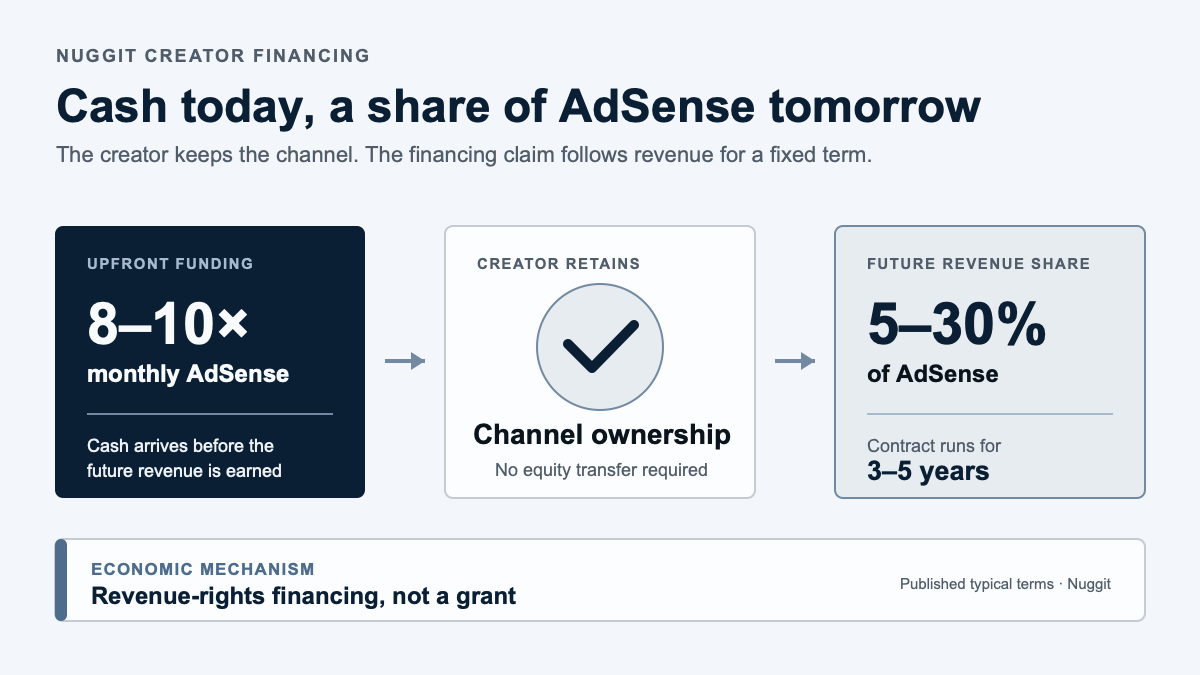
Source record available
THE DIGITAL CONTENT GROUP LIMITED · 13978278
Open the legal identity and 3 reviewed filings behind this analysis.
Nuggit's Creator Support Fund advances cash against future YouTube advertising income. Creators keep ownership of their channels, but a typical deal gives Nuggit 5% to 30% of AdSense revenue for three to five years.
The exchange turns a creator's future cash flow into a financeable asset. Nuggit says a typical upfront amount is eight to ten times the channel's current monthly AdSense, the revenue YouTube shares with creators from advertising. That is liquidity without equity dilution, but it is not free support.
The financing machinery is visible in two sets of UK filings. Nuggit's operator, The Digital Content Group Limited, runs the service and remains majority-owned by Jonathan and Catriona Freeland on its latest disclosed share count. A separately controlled company at the same address reported £331,335 of fixed-term licence investments backed by expected future cash flows, alongside £516,000 of long-term creditors.
| Nuggit's published typical deal | Term | Economic meaning |
|---|---|---|
| Upfront funding | 8-10x monthly AdSense | Cash arrives before the creator earns the future revenue |
| Revenue share | 5-30% of AdSense | Nuggit participates directly in channel performance |
| Contract period | 3-5 years | The creator gives up part of revenue for a fixed term |
| Channel ownership | Retained by creator | Financing does not require an equity sale of the channel |
The table shows the core trade-off. The creator keeps the asset and avoids a fixed repayment schedule. The capital provider receives a contractual claim on one of the channel's most transparent recurring income streams.
The Fund Buys Revenue, Not Channel Equity
Nuggit says creators can use the money to hire editors and managers, increase production, launch products or even fund personal needs such as a house deposit. The company pairs the financing with analytics, content strategy and commercial support, but says that strategic support is optional and never a condition of financing.
The funding terms do the economic work. If a channel earns £10,000 of AdSense in a typical month, the published range points to an upfront amount of roughly £80,000 to £100,000. A 20% revenue share would then send £2,000 of a £10,000 month to the financing side, before allowing for growth, decline or contract details.
That example explains the model without predicting a return. Actual contracts can differ, and future monthly revenue will move with views, advertising prices and the creator's output. A stronger channel produces more revenue for both sides. A weaker one reduces the financing side's receipts as well as the creator's retained income.
Nuggit announced the £5 million initiative on 31 July. It said its first 33 creators achieved median revenue growth of 29% in less than a year and that six had become full-time creators. Those are company-supplied performance figures. They make growth central to the proposition, but they are not a published portfolio return or an independently audited cohort study.
The £5 million figure also describes the announced initiative. It is not evidence that £5 million had already been committed, borrowed or deployed when the announcement appeared.
The Licence Assets Sit Beside Long-Term Creditors
Nuggit's privacy policy identifies its operator as The Digital Content Group Limited, company number 13978278. It also says the operator acts as agent for a principal called “Digital Licence UK Limited”.
The closest legal and functional match in the UK register is DIGITAL LICENCES INVEST (UK) LIMITED, company number 15221966. It was incorporated in October 2023 at the same 64 Southwark Bridge Road address. William Agnew controls that company and also appears as a shareholder in the operating company.
The names are not identical, so the public record does not establish that the registered company is definitively the principal named in the policy. Its filed accounts nevertheless show the kind of balance sheet the product mechanics would create.
| DIGITAL LICENCES INVEST (UK) LIMITED, March 2025 | Amount | What it indicates |
|---|---|---|
| Fixed-term licence investments | £331,335 | Contractual assets linked to expected cash flows |
| Debtors | £227,019 | Amounts due to the company at the reporting date |
| Cash | £2,417 | Small liquid balance relative to the asset pool |
| Long-term creditors | £516,000 | Creditor funding sits behind the licence assets |
| Net assets | £31,596 | A thin equity layer relative to long-term creditors |
The accounting policy measures the licence investments at the present value of expected future cash flows. During the period, the company added £296,100 of licences, recorded £66,297 of revaluations, £20,815 of amortisation and £10,247 of impairment.
Those movements are the language of an asset portfolio, not a grant programme. Licence additions put new contracted cash flows onto the balance sheet. Revaluations change their carrying value when expectations move. Amortisation recognises the passage of the contract term, and impairment absorbs weaker expected recovery.
The £516,000 creditor balance does not identify a lender, interest rate, maturity or security package. It also predates the new £5 million announcement. The filing supports a narrower conclusion: creditor capital was already materially financing a pool of licence assets in March 2025.
Operating Control And Financing Control Are Separate
The operating company's filings show a different ownership centre. Its February 2026 confirmation statement recorded 122,720 shares. Jonathan and Catriona Freeland held 85,000 between them, equal to 69.26% of that issued total.
A replacement allotment filing then records 1,760 new ordinary shares issued on 19 January 2026 at £56.78804 each. That represents £99,946.95 of calculated cash and takes the issued total to 124,480 shares.
| Operating-company reference point | Filed value | Commercial reading |
|---|---|---|
| Jonathan and Catriona Freeland | 85,000 of 122,720 shares | 69.26% before the January allotment is reflected in a holder list |
| January 2026 ordinary allotment | 1,760 shares | £99,946.95 of calculated cash at the filed price |
| March 2025 current assets | £434,539 | Operating resources sit in the service company |
| March 2025 net assets | £257,648 | Improved from negative £78,962 in the prior period |
| Average employees | 4 | A small operating team supports the platform and creator service |
The filings therefore point to two control roles. The Freelands dominate the latest disclosed operating-company share count. Agnew controls the separate licence-investment company and holds a smaller direct position in the operator.
That separation can be commercially useful. An operating company can provide analytics and account management while an asset vehicle owns revenue contracts and raises capital against them. It can also isolate asset performance from operating costs. The public filings stop before the contracts needed to confirm the full legal chain between the two companies.
For investors, that means enterprise value and asset value should not be collapsed into one number. The operator's software, team and creator relationships sit in one company. The measurable contracted cash flows and creditor exposure may sit in another.
The Trade-Off Replaces Fixed Repayment With Revenue Sharing
Revenue-share finance can align the parties better than a fixed-payment loan. The creator is not required to make the same cash payment in a weak month as in a strong one. The capital provider participates when performance improves and absorbs lower receipts when it deteriorates.
The cost is variable rather than absent. A creator who grows rapidly may transfer substantially more revenue than the upfront amount. A creator who underperforms gives up less, while the asset owner may record an impairment. Pricing therefore depends on channel volatility, contract length, the share assigned and the financing side's return target.
This resembles the broader capital-stack question in Dossaro's analysis of FINN's mix of equity, debt and asset-backed funding. The public headline identifies the pool of capital. The decisive economics sit in which asset generates repayment and who bears the loss if it falls short.
For creators, the comparison is not simply revenue share versus equity. The alternatives can include delaying investment, using a personal or business loan, taking sponsorship advances, selling channel rights or bringing in an equity partner. Each choice assigns control, cash-flow risk and upside differently.
Deployment And Lender Terms Are The Next Test
The current evidence establishes the product terms, the operating company and a filed licence-asset balance sheet funded largely by long-term creditors. Four documents would determine whether the announced expansion preserves the same structure at a larger scale.
| Next evidence | What it would answer |
|---|---|
| Current creator contract | Exact revenue definition, term, termination rights and loss allocation |
| Updated privacy policy or principal disclosure | Which legal company signs and owns the creator revenue rights |
| 2026 financing-vehicle accounts | How much of the £5m initiative was funded and deployed |
| Credit agreement or charge filing | Lender identity, borrowing cost, maturity and security |
Concentration is the remaining underwriting issue. A portfolio of many unrelated channels can diversify creator risk. Exposure to one platform, one advertising market and a small number of high-value channels can leave the asset pool sensitive to policy changes, demonetisation or audience shifts.
Nuggit's financing pitch is still easy to state. Creators keep their channels and receive cash today. The fuller economic description is equally clear: they sell a defined slice of future AdSense, and those revenue rights can become licence assets financed with creditor capital.
The next accounts must show whether the £5 million announcement became a larger diversified portfolio, how much leverage supported it and whether the licence valuations held as the creator cohort expanded. Dossaro's company-register document workflow provides the relevant sequence for comparing the operator and financing vehicle without treating the announced fund size as deployed capital.
Continue reading
Related Research
Modo Energy Put Its Brands Behind $17m Of Venture Debt
Modo Energy called CIBC's $17m package growth funding. UK charges show fixed and floating security over its business and two core trademarks.
FINN's €140m Round Shows The Financing Stack Behind A Mobility Unicorn
FINN's 2025 shareholder lists show a 17.2% wider share base, Planet First's 18.8% block and a new Picus vehicle before the €140m Series D round.
Humanoid's $152m Round Recapitalises A Business With £50.5m Of Founder Loans
Humanoid raised $152m after ending 2025 with £43.5m of net liabilities and £50.5m in founder loans, while its founder appeared to retain 53% of ordinary shares.
QUICKBLOCK's £940k Funding Was Also A Recapitalisation
QUICKBLOCK raised £940,000 after reporting £534,213 of net liabilities. Filings map £638,571 to equity, leaving about £301,429 as implied grants.