
ENGO's €5.1m Round Added Nearly Half Its Voting Shares
ENGO's €5.1m round nearly doubled its voting base, with 641,254 new ordinary shares placing investors close to parity with the MICROOLED spin-out founders.
On this page
Conduct your own private market research
Add dossaro to Claude or ChatGPT and run source-backed register research from your own workspace.
 Add to Claude
 Add to ChatGPT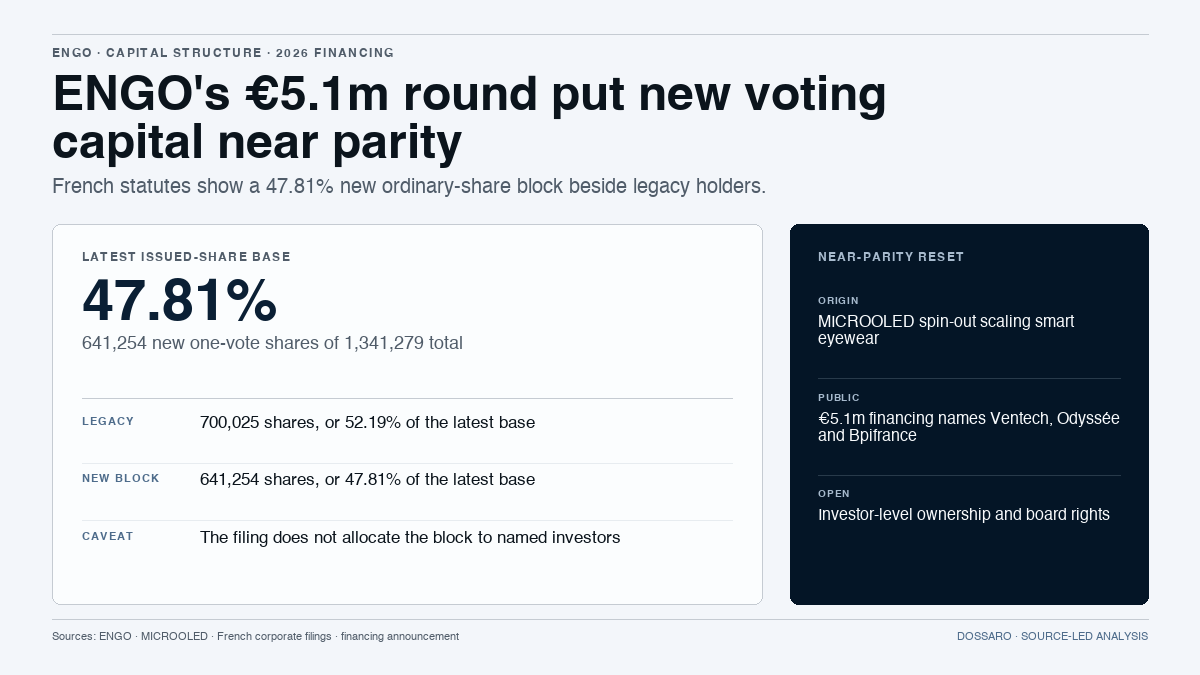
ENGO's €5.1 million financing changed more than the budget for lighter augmented-reality glasses. French corporate filings show the company moved from 700,025 to 1,341,279 fully paid ordinary shares, each carrying one vote. The increase of 641,254 shares represents 47.81% of the latest issued base. The legacy block therefore accounts for 52.19%.
That is a near-parity voting reset, not a small top-up to an unchanged founder structure. The public announcement names Ventech, Odyssée Venture and Bpifrance Amorçage Industriel, but the readable statutes do not allocate the new shares among them or state that all 641,254 shares belong to this financing. The timing makes the connection plausible, while the precise cash-to-share mapping remains a filing watchpoint.
The distinction matters commercially. ENGO is a product company spun out of display maker MICROOLED. Outside capital is arriving as the business tries to scale manufacturing, hire 20 people in France and sell internationally. A new issued-share block just below half of the voting base would give incoming capital a materially different negotiating position from a conventional minority round, even though no investor's individual percentage or board right can yet be proved.
A public €5.1m round with an industrial growth plan
Bpifrance's 17 July release says ENGO completed a €5.1 million financing from Ventech, Odyssée Venture and Bpifrance Amorçage Industriel. It describes a sports frame weighing less than 40 grams, up to 20 hours of battery life and a Micro-OLED display that projects performance data into an athlete's field of vision.
The company says the money will support commercial and industrial development, miniaturised displays and new product features. It plans to hire 20 people in France across marketing, sales, optics, mechanics, software and data. ENGO also reports that 90% of its revenue already comes from outside France, with half of that international revenue generated in the United States.
EU-Startups independently reported the same amount and named investors. Its account places the financing after a September 2025 spin-out from MICROOLED, which manufactures near-eye displays for several high-performance applications. The event is therefore both a venture round and a capital transition from a parent-derived industrial project to a separately financed eyewear company.
The public material establishes the amount, participants and operating purpose. It does not disclose a valuation, investor allocation, primary-versus-secondary split or the share count created at closing. Those questions are where the register adds useful, if incomplete, evidence.
The latest statutes show a 47.81% new share block
ENGO's 2025 corporate records show the pre-round base. The company began with €20 capital and 20 shares subscribed by Eric Marcellin-Dibon. A September 2025 decision then increased capital by €700,005 through 700,005 new ordinary shares. That produced 700,025 issued shares during the MICROOLED spin-out period.
The updated statutes filed on 3 July 2026 state capital of €1,341,279 divided into 1,341,279 fully paid ordinary shares. Each share has one vote, and the parsed statutes do not show a separate preference class. The arithmetic is straightforward:
| Capital state | Issued ordinary shares | Share of latest base | What the filing establishes |
|---|---|---|---|
| Pre-round spin-out base | 700,025 | 52.19% | Legacy issued-share denominator |
| Increase visible in 2026 statutes | 641,254 | 47.81% | New ordinary-share block |
| Latest stated total | 1,341,279 | 100.00% | One vote per share |
The 641,254 figure is the difference between two filed capital states. It is not a subscriber list. The two June 2026 closing-resolution records located in the source run could not be read reliably, so the public record does not say whether the increase was one closing, several subscriptions, a recapitalisation that included legacy adjustments or a mixture of instruments.
If the entire €5.1 million announcement mapped to those shares, the implied price would be about €7.96 per share. That is a transparent scenario, not a disclosed term. The article therefore uses the share-count delta and the one-vote rule as hard facts while keeping the amount-per-share calculation conditional.
Why near-parity capital changes the negotiation
A new block representing 47.81% of issued votes would sit just below the legacy 52.19% base. It does not automatically mean the three named investors collectively own 47.81%. The shares could be split among the funds, existing holders could have participated, or the closing record could include a component unrelated to the announced round.
Even with those limits, the structure changes how the financing should be read. A company with a 700,025-share base and a new block of 641,254 shares has moved close to an institutional-versus-legacy balance. The outside capital may not control the company, but it is too large to be treated as passive capital without further evidence. Conversely, the legacy holders appear to retain only a slim aggregate majority on the latest issued-share denominator.
This is a different risk allocation from a financing where new money represents 10% or 20% of the voting base. Incoming investors are underwriting industrial scale-up while potentially obtaining a blocking-sized voting position. The legacy side retains the larger block but may need to coordinate to exercise that majority. The filings do not identify a board appointment right or shareholder pact, so no stronger control claim is warranted.
The pattern is familiar in capital-intensive climate and hardware businesses. Perceptual Robotics' funding package paired a dominant preferred class with public support, while Moa Technology's Series C gave new investors a large issued block and a filed return-of-capital preference. ENGO's visible feature is different: the parsed material shows one ordinary class and a near-parity voting reset, but not a preference waterfall.
The spin-out's old shareholder map is still incomplete
The statutes identify the capital base, not every economic relationship behind it. The 2025 spin-out records connect ENGO's founding state to Eric Marcellin-Dibon and the MICROOLED period. The 2026 statutes record Eric Marcellin-Dibon as president and BORN DIGITAL as director-general, with Fabrice Berger Duquene identified publicly as co-founder and COO.
The available documents do not establish whether MICROOLED retained shares after the spin-out, whether either founder sold part of a holding, or whether any investor subscription happened at a parent level. They also do not allocate the 641,254 shares among Ventech, Odyssée Venture, Bpifrance or other participants.
Those gaps are economically important. If the increase is entirely primary equity, the company received cash and the old base was diluted to 52.19%. If part of it is secondary, some consideration went to existing holders rather than ENGO. If an instrument or in-kind contribution is involved, the simple €7.96 scenario is not a price at all. A later shareholder statement or readable closing resolution is needed to distinguish those cases.
What the filings prove, and what they do not
The evidence supports four firm conclusions. ENGO publicly announced a €5.1 million financing on 17 July 2026. The exact French company is ENGO SAS, SIREN 989371752. Its latest parsed statutes state 1,341,279 fully paid ordinary shares with one vote each. The difference from the 700,025-share 2025 base is 641,254 shares, or 47.81% of the latest issued total.
The evidence does not support an investor-by-investor cap table, a valuation, a founder payout, a MICROOLED percentage or a claim that the complete €5.1 million was issued as ordinary equity at €7.96 per share. It also does not establish that any holder has control or a blocking right. Those are precisely the facts the next filing should settle.
For now, ENGO is best understood as an industrial spin-out whose financing nearly split its voting base between legacy and new shares. The round may be a straightforward primary raise, but the legal record says the capital structure changed at a scale that deserves to be read as a governance event as well as a growth event.
The next decision-changing document is a readable June 2026 subscription or DUA resolution, an investor allocation schedule or a post-round shareholder statement. Until then, the strongest defensible finding is the one the statutes already show: 641,254 new one-vote shares now sit alongside a 700,025-share legacy base, placing the two blocks within four percentage points of parity.
Continue reading
Related Research
Perceptual Robotics' Senior D Class Now Holds 69% Of Shares
Perceptual Robotics paired about £2.1m of preferred equity with public support, while its senior D class now represents 69% of issued shares.
Moa Technology's £22.2m Round Put £44.4m First In Line
Moa Technology's £22.2m Series C created 46.4% of its issued shares and a roughly £44.4m first claim after accounts warned the round was essential.
PaperShell's €40m EU Grant Leaves A €43m Financing Test
PaperShell's signed 2025 annual report links an €83m factory and €40m EU grant to a planned IPO, while private capital must still fund roughly half.
Kaiko's $110m Round Arrived With a €35.5m Share-Funded Roll-Up
Kaiko's $110m strategic round arrived beside €35.5m of share-funded acquisitions, issuing 553,134 shares while investor allocations remain undisclosed.