
Bridgepoint Put £2m Into Eckoh Before Its Quality Xperience Acquisition
Bridgepoint moved £2 million through Eagle UK Bidco into Eckoh three weeks before its undisclosed-price acquisition of Quality Xperience was announced.
On this page
Conduct your own private market research
Add dossaro to Claude or ChatGPT and run source-backed register research from your own workspace.
 Add to Claude
 Add to ChatGPT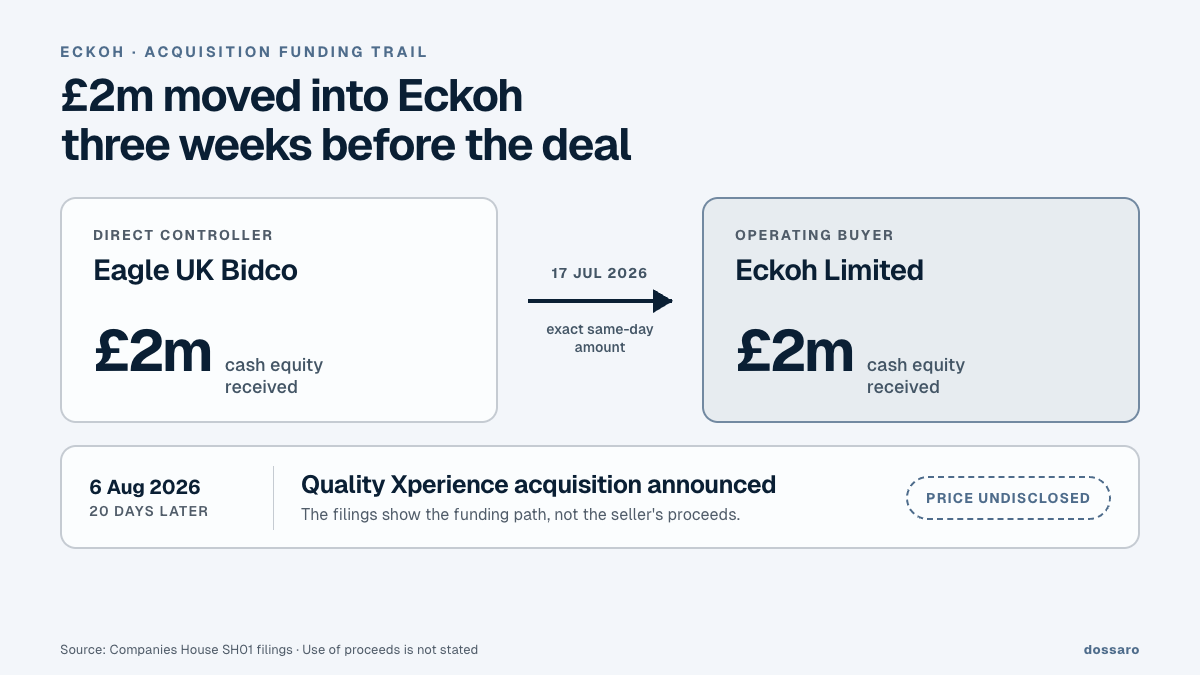
Bridgepoint put exactly £2 million into Eckoh on 17 July 2026, 20 days before Eckoh announced its acquisition of enterprise-AI provider Quality Xperience.
The money left a precise legal trail. Eagle UK Bidco, the Bridgepoint acquisition vehicle that controls Eckoh, allotted 2 million £1 ordinary shares for cash. On the same day, Eckoh allotted 800 million ordinary shares at £0.0025 each, also for cash. Both transactions equal £2 million.
That matching amount and date are strong evidence of fresh sponsor capital moving down the ownership chain into the operating buyer. They are consistent with Bridgepoint funding the bolt-on acquisition, but the filings do not state how Eckoh used the money. The £2 million is not a disclosed purchase price, and it should not be treated as the seller's proceeds.
The distinction matters because the Quality Xperience acquisition announcement did not disclose a transaction value. The filings cannot fill that blank completely. They do show that Bridgepoint accepted an additional, measurable equity commitment shortly before the deal was announced.
Two Filings Show The Same £2m Cash Movement
The official allotment forms create a compact transaction reconstruction.
| Entity | 17 July 2026 cash allotment | Filed calculation | Economic position |
|---|---|---|---|
| Eagle UK Bidco Limited | 2,000,000 ordinary shares at £1 | £2.000m | Fresh cash equity into the direct controller |
| Eckoh Limited | 800,000,000 ordinary shares at £0.0025 | £2.000m | Fresh cash equity into the operating buyer |
Eagle UK Bidco's SH01 filing says the new shares were fully paid and that no shares were allotted other than for cash. Its aggregate nominal share capital rose from £75.411 million to £77.411 million.
Eckoh's matching SH01 records 800 million new shares, each with a nominal and paid amount of £0.0025. Multiplying the share count by the paid amount produces the same £2 million.
The large difference in share counts is only a consequence of nominal value. Eckoh's new shares cost one quarter of one penny each, while the bidco's shares cost £1 each. The relevant comparison is paid cash, not the number of legal units.
Both filings appeared on the public register on 21 July. Eckoh announced the acquisition on 6 August. The 20-day interval is close enough to be commercially relevant, but the announcement date is not necessarily the signing, completion or seller-payment date.
The Control Chain Makes This Sponsor Capital
Eckoh's current Companies House control record names Eagle UK Bidco as holding 75% or more of shares and voting rights, with the right to appoint or remove directors. That direct legal relationship is what turns the matching allotments into a capital path rather than two isolated corporate events.
Bridgepoint completed its take-private of the former Eckoh plc in January 2025. The sponsor's completion statement identifies the transaction as the first investment from Bridgepoint Development Capital V and says the partnership would support targeted acquisitions as part of Eckoh's growth strategy.
The July 2026 filings show that strategy moving from language into balance-sheet risk. Fresh capital entered the acquisition vehicle and the same amount entered Eckoh. That indicates the sponsor did more than approve management's use of cash already sitting inside the business.
It also identifies the economically relevant decision layer. Eckoh executed the Quality Xperience acquisition, but Eagle UK Bidco supplied the visible equity immediately beforehand. Bridgepoint's private ownership structure therefore carried a concrete part of the funding decision.
This is a narrower version of a recurring private-market pattern. In Mistral AI's acquisition of Koyeb, public filings separated cash consideration from continuing equity. Here, the filings expose the pre-deal funding path while leaving the seller-side consideration unresolved.
What The £2m Does And Does Not Establish
The strongest reading is neither “no price is known” nor “the deal cost £2 million.” The evidence sits between those extremes.
| Evidence supports | Evidence does not support |
|---|---|
| Bridgepoint's direct bidco received £2m of cash equity | Quality Xperience cost £2m |
| Eckoh received exactly £2m of cash equity on the same day | The entire injection was paid to the seller |
| The injection preceded the acquisition announcement by 20 days | No debt, earn-out or deferred consideration existed |
| Timing and amount are consistent with acquisition funding | The capital was raised solely for this transaction |
Several benign alternatives remain possible. Eckoh could have needed working capital, product-development funding or general balance-sheet support. The sponsor could also have funded a broader acquisition programme rather than one specific purchase.
Those alternatives are why timing must remain an inference, not a statement of use of proceeds. Yet they do not erase the verified result: Bridgepoint moved fresh equity into Eckoh immediately before a privately priced acquisition.
For transaction readers, that is decision-useful. The undisclosed price prevents an acquisition-multiple calculation. The matching filings still establish the minimum visible sponsor-capital decision associated with the period and show where the risk entered the group.
The Target's Legal Identity Remains Unresolved
Eckoh's announcement names Quality Xperience as an enterprise-AI provider but does not identify the acquired legal entity. A similarly named dissolved UK company is unrelated and cannot be used as a proxy for the target.
That missing identity limits what can be said about sellers, historical financials, ownership and payout allocation. It also prevents a reliable comparison between the £2 million injection and the target's balance sheet.
This is where disciplined M&A target screening matters. A trading name can establish the commercial subject of a transaction, but seller economics require the exact company, jurisdiction and deal perimeter. Without those, a neat cap table can be completely wrong.
The public record therefore supports only the buyer-side capital path. It does not identify the seller, show whether founders retained equity or reveal whether the transaction included assets from more than one legal entity.
Fresh Equity Changes The Reading Of The Bolt-On
Private-equity sponsors often describe acquisitions as part of a portfolio company's growth plan. The meaningful question is whether the company funds them from operating cash, additional debt or new sponsor equity.
Eckoh's filings provide a partial answer. At least £2 million of fresh cash equity reached the buyer immediately before the Quality Xperience announcement. That shifts risk toward Bridgepoint's ownership chain and gives Eckoh capital that does not create a new external creditor claim.
Equity funding also leaves sponsor returns exposed to the acquisition's performance. If the acquired product expands Eckoh's enterprise-AI capability and customer reach, Bridgepoint participates in that upside through its control position. If integration disappoints, the fresh equity absorbs losses before a lender would be asked to share them.
The amount alone does not reveal whether the transaction was small or whether £2 million was only one layer of a larger structure. Debt, deferred payments and earn-outs can sit outside an SH01. The filings establish a funding floor, not a complete sources-and-uses statement.
The Next Accounts Can Turn The Clue Into A Deal Number
Eckoh's first post-acquisition accounts are the most important next document. A business-combination note could disclose cash consideration, deferred payments, identifiable net assets, goodwill and the legal identity of the acquired business. A cash-flow statement could also show whether the £2 million equity movement sat alongside other financing.
Seller-side filings or a sale agreement would go further. They could identify the recipients of consideration, any retained interest and the treatment of earn-outs. A later charge filing could reveal debt layered onto the equity path.
Until those documents appear, the durable conclusion is precise. Eagle UK Bidco and Eckoh each recorded exactly £2 million of cash equity on 17 July 2026. Twenty days later, Eckoh announced the Quality Xperience acquisition without a price.
The filings do not solve the purchase-price question. They do show that Bridgepoint put fresh capital at risk immediately before the deal, converting a generic bolt-on announcement into a measurable sponsor-funding decision.
Continue reading
Related Research
Mistral's Koyeb Acquisition Split A €27.8m Exit Between Cash And Shares
A French contribution report values Koyeb at about €27.8m and shows 36% of its shares rolled into Mistral, splitting liquidity from future upside.
Bruker Bought Noscendo's Software, Not The Venture-Backed Company
After nearly €40m of venture funding, Noscendo entered insolvency. Bruker acquired DISQVER, patents and selected staff while the laboratory closed.
FNZ Built A €3bn Custody Bank Before Reported Sale Talks
FNZ Bank's reported €400 million-plus sale follows a custody carve-in that produced €3.0 billion of assets and €250.1 million of book equity.
Dwelly's $170m Round Mixed Founder Liquidity With Secured Debt
Dwelly's filings show £44.3m of new Series B cash, 19,406 founder shares sold to EQT and General Catalyst, and Trinity secured across the business.