
Circula Reached Personio After a Six-Year Capital Ladder, but Sale Economics Stay Hidden
Circula reached Personio after six years of filed capital increases, but the public register still does not show who held or monetized the sale.
On this page
Conduct your own private market research
Add dossaro to Claude or ChatGPT and run source-backed register research from your own workspace.
 Add to Claude
 Add to ChatGPT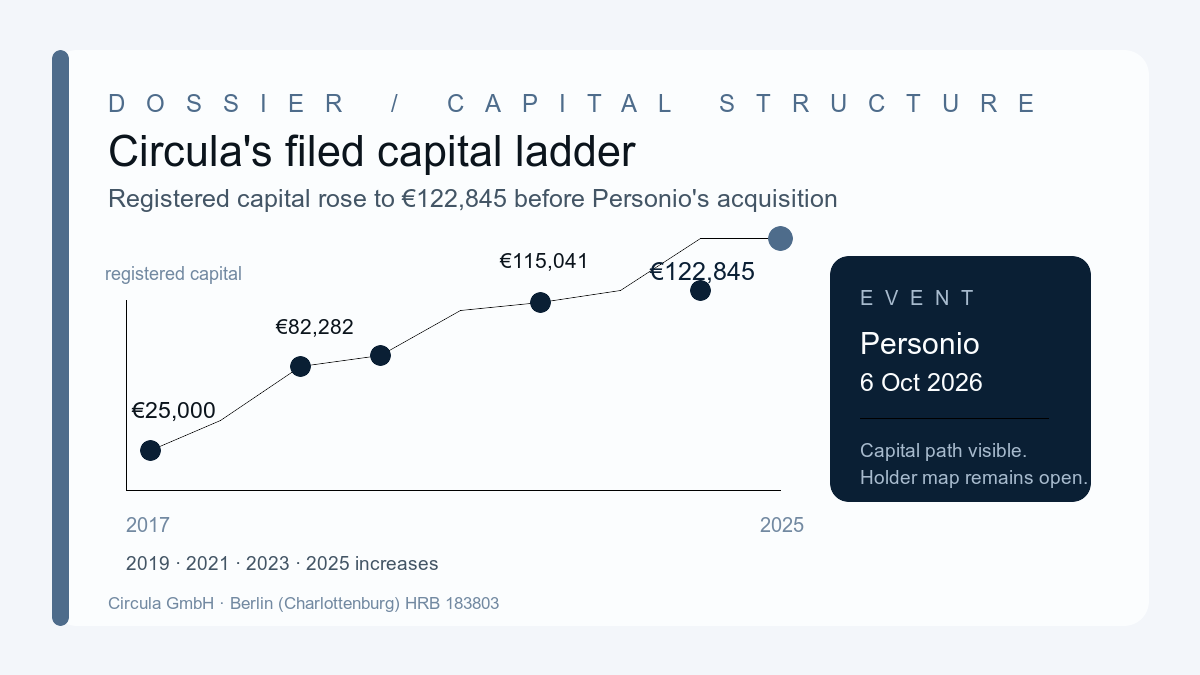
Personio announced on 6 October 2026 that Circula had joined its platform after a six-year German capital ladder that took registered capital from €25,000 to €122,845. The acquisition gives Personio the operating prize, but the available register does not show which holders captured the sale value.
That is a narrower finding than a transaction price or investor-return claim. The register records nominal capital increases and an approved-capital authorization. It does not identify the subscribers behind each increase, the shareholders at closing or the consideration paid by Personio. The useful signal is therefore the sequence: repeated equity capacity was built before the strategic combination, while the economic allocation remains outside the public surface checked here.
Personio's deal announcement leaves the allocation open
Personio's official announcement says Circula is now part of Personio. The contemporaneous PRNewswire release says the business will operate as Circula by Personio, that the team joins Personio and that the product remains available to non-Personio customers as a standalone solution.
The wire describes the commercial logic. Personio says the combination creates a European platform spanning HR, payroll and spend management. It reports 16,000 Personio customers, while more than 3,000 European companies use Circula. Circula was founded in Berlin in 2017. Those figures explain why a strategic buyer would want the product, customer base and team together.
The operating continuity is part of the announced transaction. PRNewswire says Circula will continue serving customers that do not use Personio, while the combined group adds the spend product to a broader workplace stack. That framing points to product integration and distribution, not a disclosed financial outcome for Circula's earlier shareholders. A strategic acquisition can create value through cross-selling, shared infrastructure or a wider sales channel even when the buyer does not publish a price. None of those commercial benefits can be converted into an implied valuation from the €122,845 registered-capital figure.
They do not explain the legal mechanics of the purchase. Neither announcement discloses consideration, seller allocation, the issuer of any acquisition instrument or the post-transaction rights of Circula's earlier backers. An independent YPOG/FYB adviser note confirms the transaction context but adds no price or holder map.
Public coverage gives the financing backdrop. Axios has reported that Circula raised around $40 million from named backers including Alstin, Personio, Neosfer, CIBC, Capnamic, Storm, Peak, HW Capital and WENVEST. That list is useful context, but a funding article is not a shareholder register. The question is not whether those names appeared in coverage. It is whether the available legal records show who held saleable positions when Personio acquired the platform.
The register shows a six-year capital ladder
Circula GmbH is registered in Berlin (Charlottenburg) as HRB 183803. The current register extract records €122,845 of capital. Its chronological history shows how that figure was built:
| Register state | Increase or authorization | Registered capital after the state | Reading boundary |
|---|---|---|---|
| Founding | Starting capital | €25,000 | Nominal capital, not valuation |
| 2019 | +€25,209 | €50,209 | Subscriber and premium not shown here |
| February 2021 | +€32,073 | €82,282 | A dated increase, not a cash-total claim |
| August 2021 | +€4,574 | €86,856 | No holder allocation in the available extract |
| December 2021 | +€28,185 | €115,041 | Capital capacity rose again |
| March 2023 | +€2,500 | €117,541 | No acquisition link inferred |
| September 2024 | Approved capital up to €5,799 | €117,541 issued | Authorization, not issued capital |
| May 2025 | +€5,304; authorization cancelled | €122,845 | Latest visible issued-capital state |
The arithmetic is clear: €25,000 plus the dated increases reaches €122,845. The meaning is not. Registered capital is the nominal amount attached to shares. The extracts do not disclose the subscription premium, cash paid, share class, voting rights or subscriber for each increase. They therefore support a capital chronology, not a financing total or valuation.
The ladder still matters. It shows that Circula repeatedly expanded its registered equity capacity before Personio's announcement. A reader looking only at the acquisition notice would see the strategic combination. The German record adds the corporate preparation that preceded it, without pretending to reveal the commercial terms.
The timing also sets a useful evidence cutoff. The latest visible register entry is dated 24 April 2026, months before Personio's October announcement. It is therefore a pre-deal corporate state, not a closing record. Any later capital act, shareholder list or acquisition filing could change the holder picture. Until such a record appears, the ladder should be read as context for the transaction rather than as proof of its legal completion mechanics.
Approved capital was an option, not a payout
The September 2024 entry authorized up to €5,799 of approved capital. That is a mechanism for issuing capital later under the terms of the authorization. It is not proof that €5,799 was issued, paid in, or distributed to any holder.
The May 2025 entry instead records a €5,304 increase to €122,845 and cancellation of the approved-capital authorization. The sequence can fit ordinary venture financing: a company preserves room for a future issue, then completes a different increase and removes the unused authorization. It can also sit alongside preferred instruments, side letters or parent-level arrangements that do not appear in the extracts. The available evidence cannot choose among those structures.
This is the difference between capacity and allocation. The register identifies when Circula had authority to create more nominal capital and when it actually increased issued capital. It does not say who subscribed, what rights attached to the shares or how any holder fared when Personio bought the business.
A visible capital path is not a holder map
The available German surface did not expose a shareholder list for Circula. That prevents a stronger reading of the acquisition. The record cannot connect the named public backers to specific Circula positions, identify founder ownership, quantify a rollover or establish a sale payout.
That boundary does not erase the public financing history. It simply keeps two layers separate. Axios and Dealroom provide public funding context. The register provides dated nominal-capital states. Personio and PRNewswire provide the acquisition and operating combination. No one of those layers, alone, proves the full legal allocation at closing.
The distinction resembles North Data's 80% control transfer, where dated shareholder lists revealed an existing-share transfer that the buyer's public announcement did not spell out. Circula's available documents stop earlier. They show the capital path but not the holders who stood at its end.
The benign reading remains plausible: repeated venture financing built the company, and Personio later acquired a strategically valuable product and team. Nothing in the register proves distress, an unusual payout asymmetry or a hidden control shift. What the record does is identify the missing document category that would settle those questions.
The next document would change the reading
A post-acquisition shareholder list or capital act would show whether Circula's holders changed and whether any new shares were issued around the transaction. Personio or Circula share-purchase documents could identify consideration and seller allocation. Later financial reporting might disclose acquisition accounting or the legal entity that paid for the business.
Until then, the strongest source-backed conclusion is precise. Personio acquired Circula after a six-year series of filed capital increases that moved registered capital from €25,000 to €122,845. The 2024 approved-capital authorization was later cancelled after a €5,304 increase. The register identifies the capital path; it does not identify holders or sale proceeds.
That is enough to improve the acquisition story, but not enough to price the exit. The capital ladder identifies when equity capacity was built. The next record has to identify who owned that capacity when Personio bought the platform.
Continue reading
Related Research
Wiener Börse's 80% North Data Deal Was an Existing-Share Transfer
North Data's latest shareholder list shows Wiener Börse took 80% through existing shares, while founder Frank Debatin kept 20% and two 30% blocks exited.
Apheon's Hager & Meisinger Deal Meets an Unchanged 50/50 Operating Register
Apheon announced a majority stake in Hager & Meisinger, but the latest operating-company filing still shows two family holding companies at 50/50.
Raynet's Main Deal Ends a Four-Step Control Chain
Main's Raynet deal follows a four-step legal control chain from founders to rayASSETS, Rebella 3 and Raynet Holding, while 2026 seller details remain open.
1KOMMA5°'s €70m Round Arrived With a Founder-to-G2VP Share Transfer
1KOMMA5° announced €70m at a $1.35bn valuation, but its latest Hamburg shareholder list still shows €74,911 capital and a 300-share founder transfer.