
Candi Solar's $50m Project Debt Sits on Three Earlier Claim Conversions
Candi Solar's $50m India facility is project debt layered onto three earlier creditor-claim conversions in its Swiss parent, not a fresh equity round.
On this page
Conduct your own private market research
Add dossaro to Claude or ChatGPT and run source-backed register research from your own workspace.
 Add to Claude
 Add to ChatGPT
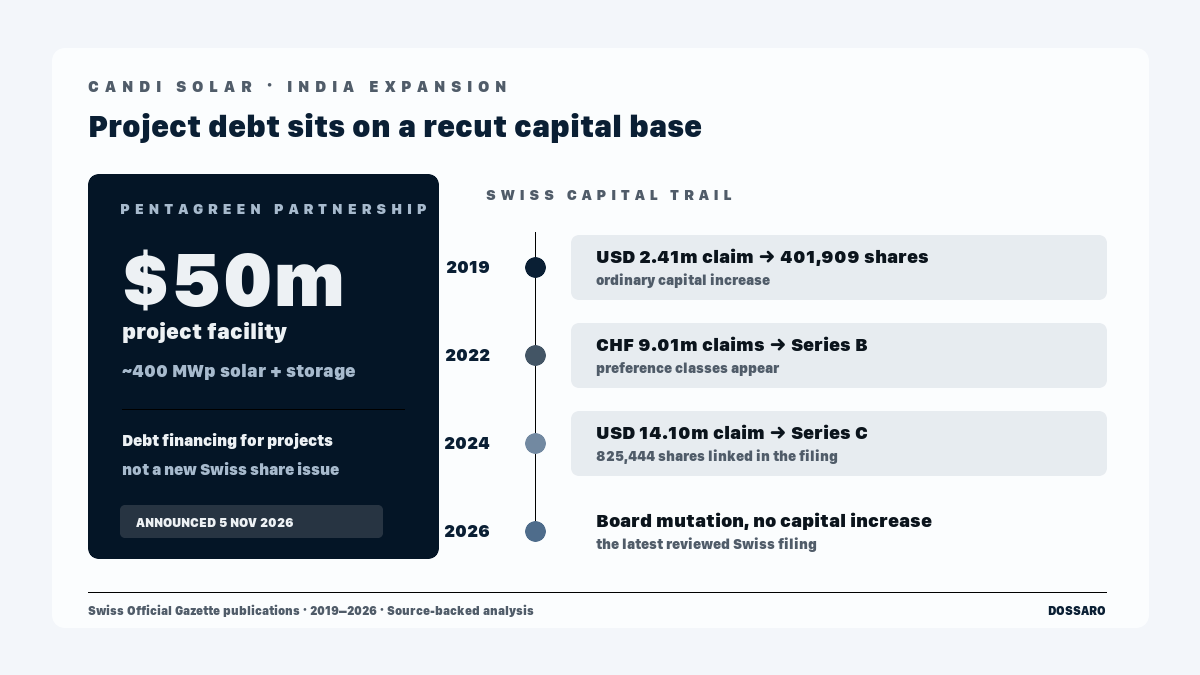
Candi Solar and Pentagreen Capital announced a US$50 million financing partnership on 5 November for about 400 megawatts-peak of solar and battery projects in India. Independent coverage describes the facility as debt financing. The latest Swiss filing in the reviewed trail, dated August, records a board change rather than a new capital increase.
That makes the financing story more precise. Candi is adding project capacity on top of a company that has already converted three large creditor claims into ordinary and preferred equity. The public event is a debt-backed expansion of an existing capital base, not a fresh Candi AG share issue.
The new facility is aimed at projects, not a new corporate round
Candi's announcement says the partnership will finance rooftop, ground-mounted and open-access solar installations paired with battery energy storage across India. It gives the projects a combined target of about 400MWp and says the buildout should help take Candi's total capacity above 1GW within 24 months. Renewables Now separately calls the US$50 million debt financing from Pentagreen.
The distinction is not cosmetic. An equity round would eventually change the shareholder ledger of the issuing company. Project debt can fund construction and equipment while leaving the parent company's issued share capital unchanged. The reviewed Swiss record supports the latter reading for Candi AG: the 24 August 2026 Swiss Official Gazette publication records Antoine Durand leaving the board and Alexis Paskoff joining, both with collective signing authority. It does not record a 2026 capital increase.
| Public financing signal | What it establishes | What remains open |
|---|---|---|
| US$50m partnership | Pentagreen and Candi announced financing for Indian solar and storage projects | Borrower, draw schedule, maturity, pricing and security |
| About 400MWp | The planned project scale | How much capacity is committed, built or operating |
| Debt financing | Renewables Now's independent description | Whether Candi AG has recourse or guarantees the project debt |
| Swiss August filing | A board mutation at candi solar AG | Any financing raised by a parent, subsidiary or Indian project vehicle |
The pattern is familiar in distributed energy. A platform can raise project capital without selling new parent shares. The relevant diligence question is therefore not simply how much Candi has “raised”, but which legal entity borrows, owns the equipment and carries the first loss if projects underperform.
The same distinction appears in Dossaro's analysis of Cloover's $100 million facility, where financing capacity was not treated as a new equity valuation. For Candi, the Swiss capital trail adds a second layer: the company has already reshaped its equity base before this project-finance expansion.
Three earlier claims became shares
The first conversion appears in the 27 December 2019 SOGC publication. Candi's share capital rose from CHF100,000 to CHF165,190.90. The filing says a USD2,411,454 claim was set off for 401,909 registered shares. The company then had 1,651,909 registered shares with a nominal value of CHF0.10 each.
That was not a transfer between shareholders. It was a capital increase in which a claim against the company was used as consideration. The filing does not identify the creditor in the public notice, so the safe conclusion is about the instrument, not the person who received the shares.
The 1 September 2022 capital increase created a more explicit preference structure. Candi reported CHF249,296.10 of share capital divided into 944,822 ordinary shares, 662,892 Series A preference shares and 885,247 Series B preference shares. The publication also says CHF9,010,476 of claims were set off for 522,263 Series B shares. Participation capital increased to CHF8,694.20, represented by 86,942 participation certificates.
The arithmetic is internally consistent: 944,822 plus 662,892 plus 885,247 equals 2,492,961 shares, and 2,492,961 at CHF0.10 equals CHF249,296.10. The claim conversion is therefore visible in a dated capital event, not a modelled ownership estimate.
The next reset came on 24 May 2024. The SOGC publication records CHF436,424.40 of share capital and four classes: 944,822 ordinary shares, 662,892 Series A shares, 885,247 Series B shares and 1,871,283 Series C shares. It specifically links a USD14,096,274 claim to 825,444 Series C shares. Participation capital rose again, to CHF17,635.90 represented by 176,359 participation certificates.
The total share count, 4,364,244, also reconciles to the stated nominal capital. But the filing links the dollar claim to only 825,444 Series C shares. It does not explain the consideration for every share in the enlarged Series C class, and it does not name the current holders.
| SOGC date | Capital event | Claim-linked detail | Filed share state |
|---|---|---|---|
| 27 Dec 2019 | Ordinary capital increase | USD2.411m claim set off for 401,909 shares | 1,651,909 registered shares |
| 7 Sep 2022 | Capital increase and preference-class reset | CHF9.010m claims set off for 522,263 Series B shares | 944,822 ordinary, 662,892 Series A, 885,247 Series B |
| 31 May 2024 | Capital increase and Series C creation | USD14.096m claim set off for 825,444 Series C shares | 944,822 ordinary, 662,892 Series A, 885,247 Series B, 1,871,283 Series C |
Across the three notices, the disclosed conversions amount to USD16.508 million plus CHF9.010 million. No exchange-rate conversion is appropriate, and the publications do not establish that every claim came from the same lender, founder or investor. They do establish a repeated mechanism: claims were turned into capital, and the later structure includes preference shares with rights concerning dividends and liquidation proceeds.
The preference classes change the downside map
The Series A, B and C labels are not just a record of fundraising chronology. The 2022 notice says the preference shares receive statutory preferences regarding dividends and liquidation proceeds. That means the capital stack has more information than a single ordinary-share count, even though the free Swiss notice does not publish a current shareholder register.
The filings therefore support a narrow but important conclusion. Candi's historical capital was not built solely through plain ordinary equity. Some claims became preference equity, and the company continued to carry participation capital alongside the share classes. That structure can allocate downside and upside differently across holders, but the public notices do not reveal the waterfall, conversion rights or the identity of each class holder.
This is why the US$50 million announcement should not be translated into a new percentage ownership calculation. The public sources do not state an issue price, a new share count or a corporate issuer. A project facility can sit beside the classes without changing the Swiss parent ledger. If a later filing shows a new Candi allotment, that would be a different event and should be analysed separately.
India growth makes the recourse question central
Candi says it has deployed more than 340MW across more than 185 installations and secured more than US$200 million of cumulative capital from development-finance institutions and infrastructure investors. The company says the new partnership will support projects expected to deliver 560 gigawatt hours of renewable energy a year, serve 227 commercial and industrial businesses and avoid an estimated 397,000 tonnes of carbon dioxide annually.
Those figures describe the opportunity and the company's operating frame. They do not show audited revenue, cash collected, project-level debt service or investor returns. The debt-versus-equity distinction makes those missing measures more important, not less. A facility can accelerate construction while moving repayment risk to a project borrower, a special-purpose vehicle or a parent guarantee. The reviewed public sources do not say which.
The financing model also explains why Candi's corporate capital history matters. If the Indian projects are financed on a limited-recourse basis, the new debt may be largely insulated from the Swiss company's historical equity waterfall. If Candi AG or a group subsidiary guarantees the facility, the same project ambition would put more pressure on the recapitalised corporate base. Those are different risk allocations, and the announcement does not choose between them.
The next filing should separate capacity from exposure
The public record currently supports a clean split. Pentagreen and Candi announced project financing for India. Renewables Now classified it as debt. Swiss filings show claim-to-share conversions in 2019, 2022 and 2024, then a board mutation in August 2026 rather than a new capital increase.
The next decision-changing document would identify the borrower, security package, recourse and draw status. A new SOGC capital publication would show whether the Swiss parent later issued shares. A project-finance disclosure would show whether the US$50 million is committed, drawn or divided across Indian vehicles. Until that evidence appears, the strongest reading is also the narrowest: Candi is scaling solar and storage with project debt on top of a previously recapitalised equity base.
Continue reading
Related Research
Cloover's $100m Facility Tests Whether Financing Capacity Can Become a Virtual Power Plant
Cloover says a $100m facility lifts financing capacity above $1.3bn as it scales a virtual power plant, but the debt is not a new equity round.
Advanced Electric Machines’ £16m Funding Is a Parent-Level Equity and Debt Stack
AEM's £16m funding headline combines parent-level preferred equity with government-backed debt secured over the operating company's IP, receivables and assets.
Depotcharge's €2.7m Pre-Seed Still Leaves Evolve Energy 50/50
Depotcharge announced a €2.7m pre-seed, but Evolve Energy's latest register still shows founder vehicles owning 50% each with no investor allotment visible.
Bioliberty's $3.3m Extension Sits on a 9.1m-Share A2 Re-cut
Bioliberty's $3.3m extension followed a 9.12m-share A2 re-cut, diluting the old base and authorising a separate Forward Health Ventures warrant.